How Does GPT-5 Combine Reasoning and Pretraining?
TL;DR
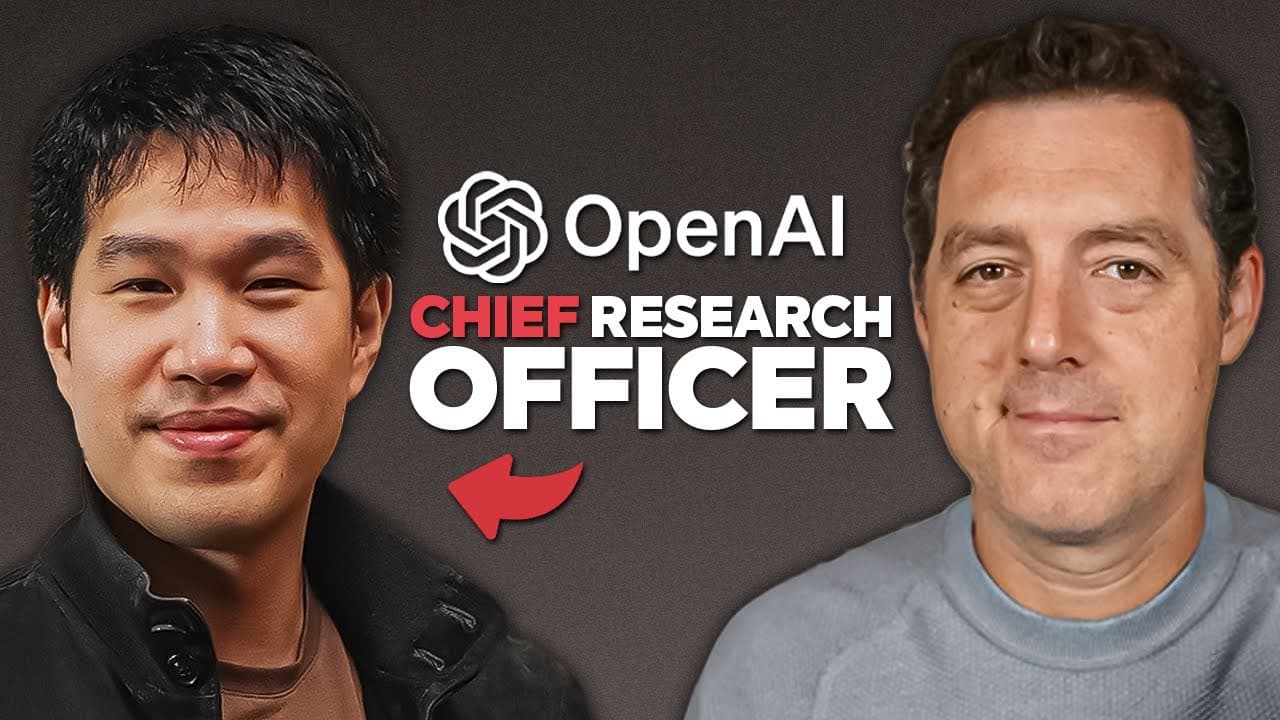
GPT-5 combines pretraining with reasoning so users can receive deeper analysis when needed and fast responses when that is more appropriate. Its development draws on synthetic data, reinforcement learning, architectural and optimization advances, and extensive post-training work intended to make reasoning faster, more robust, and more reliable within a single accessible system.
Transcript
a lot of excitement leading into GPT5. I'm wondering like what the energy is like internally at OpenAI leading up to such a big launch. We have a research road map. In the last several years, this road map hasn't changed much at all. Interesting. It's able to cut the thinking time that it needs to extract the information by several factors. You are... Read More
Key Insights
- GPT-5 is designed to unite pretraining and reasoning within one user-facing system. The intended experience is to provide substantial reasoning when a task requires it while returning a faster response when extended analysis would be unnecessary.
- Research and product development are mutually reinforcing at OpenAI. Research breakthroughs create practical value for users, while successful products give people access to new capabilities and help support further research with stronger contact between experimental work and real-world use.
- Synthetic data is model-generated material used alongside publicly available and licensed data. OpenAI applies it to improve coverage in selected areas and believes it can produce meaningful quality gains rather than merely adding surface-level knowledge inherited from earlier models.
- Coding is one area emphasized in GPT-5's synthetic-data program. Mark Chen nevertheless describes the underlying synthetic-data techniques as broadly applicable, with some domains being more amenable than others rather than any category being fundamentally excluded.
- GPT-5 development combines advances across architecture, optimization, reasoning, infrastructure, and post-training. Exploratory teams initially investigate a wide range of ideas, then narrow those possibilities to approaches that demonstrate value before integrating the successful elements into the final model.
- Combining reasoning with pretraining required substantial post-training work. The reasoning models had to become faster, more robust, and more reliable before both paradigms could be presented through one surface that offers users the advantages of each approach.
- Compute investment remains substantial in both pretraining and reinforcement learning. Reinforcement learning is described as an early paradigm with many variables still being explored, while pretraining continues to benefit from active work in synthetic data, architecture, and optimization.
- Model readiness is partly a matter of judgment rather than a single automatic threshold. A release candidate must perform well in formal work and hands-on use, pass an internal vibe check, and avoid small pathologies or behaviors that cause concern.
Install to Summarize YouTube Videos and Get Transcripts
Explore YouTube Video Summarizer or Get YouTube Transcript Extractor
Questions & Answers
Q: How does GPT-5 combine pretraining and reasoning?
GPT-5 brings the pretraining paradigm and the reasoning paradigm together within one system. Considerable post-training work was required to make reasoning faster, more robust, and more reliable. The goal is for users to receive deeper reasoning when a task needs it and a quick response when speed is more appropriate, without having to choose manually between separate model categories.
Q: Why does OpenAI use synthetic data for GPT-5?
OpenAI uses synthetic data to supplement publicly available and licensed material and to improve coverage in areas where the model should perform especially well. The data is generated by models rather than written directly by humans. Mark Chen says OpenAI has observed enough promising results to use it in GPT-5 and expects synthetic data to become a larger part of model development over time.
Q: Can synthetic data make a model better than its predecessor?
Mark Chen argues that synthetic data has the potential to improve models meaningfully, beyond broadening or deepening surface-level knowledge in a category. He describes the work as an ongoing research program with considerable room to develop. OpenAI has seen sufficient signs of progress to incorporate some synthetic data into GPT-5, although the exact mixture of synthetic and human-created data remains undisclosed.
Q: Which domains benefit from synthetic data in GPT-5?
Coding is specifically identified as an area that received substantial attention in the GPT-5 release. However, Mark Chen does not frame synthetic data as useful only for coding, mathematics, or science. He describes its promise as broad-based and says OpenAI can choose which domains to emphasize with its tools, while acknowledging that some areas are more amenable to the techniques than others.
Q: How does OpenAI balance research and product development?
OpenAI treats research and product development as mutually dependent activities. Research breakthroughs can produce utility and value for people, while products let the public experience newly developed intelligence and help enable continued research. Mark Chen says OpenAI wants its research to maintain contact with the world, making practical deployment part of the research mission rather than a separate or opposing objective.
Q: What technical advances contributed to GPT-5?
GPT-5 emerged from advances across architecture, optimization, reasoning, post-training, and core infrastructure. Exploratory teams investigate numerous ideas during the early stages of a project, producing a broad set of possible approaches. Those ideas are gradually narrowed to the bets that show results, refined further, and integrated so the final system reflects progress across multiple technical dimensions rather than one isolated discovery.
Q: How does OpenAI allocate compute between pretraining and reinforcement learning?
OpenAI invests heavily in both pretraining and reinforcement learning rather than treating either one as complete. Reinforcement learning is characterized as an early paradigm with many factors still available for exploration. Pretraining also remains active, supported by work on synthetic data, model architecture, and optimization. GPT-5 reflects the attempt to combine advances from these parallel areas into a more capable system.
Q: How does OpenAI decide when a model is ready to release?
Choosing a release snapshot is partly an art that balances continued pursuit of improvement against the need to ship. The model is tested extensively through direct use and must pass what Mark Chen calls a vibe check. It should not display small pathologies, troubling behaviors, or noticeable interaction problems. Readiness therefore depends on both systematic development work and qualitative judgment about the complete experience.
Summary & Key Takeaways
-
GPT-5 represents a convergence of two previously distinct development paths: large-scale pretraining and reasoning-focused models. OpenAI wants the system to determine when deeper reasoning is useful and when a fast answer is sufficient, reducing the need for users to select between separate model types for different tasks.
-
Synthetic data supplements publicly available and licensed human-created material by improving coverage in areas OpenAI wants the model to handle well. Mark Chen says its share is increasing over time, although OpenAI does not disclose the exact mixture. Coding received particular emphasis, but the underlying techniques are viewed as broadly applicable.
-
Building and releasing GPT-5 requires coordinated advances in architecture, optimization, reasoning, infrastructure, and post-training. Candidate ideas are explored broadly, refined, and integrated when evidence supports them. Readiness remains partly an art, requiring technical evaluation alongside hands-on testing for small pathologies, unreliable behavior, and overall interaction quality.
Read in Other Languages (beta)
Share This Summary 📚
Summarize YouTube Videos and Get Video Transcripts with 1-Click
Try YouTube Summary with ChatGPT & Claude or YouTube Transcript Generator
Explore More Summaries from Matthew Berman 📚


Summarize YouTube Videos and Get Video Transcripts with 1-Click
Try YouTube Summary with ChatGPT & Claude or YouTube Transcript Generator