Which YouTube Camera Fits Your Budget in 2026?
TL;DR
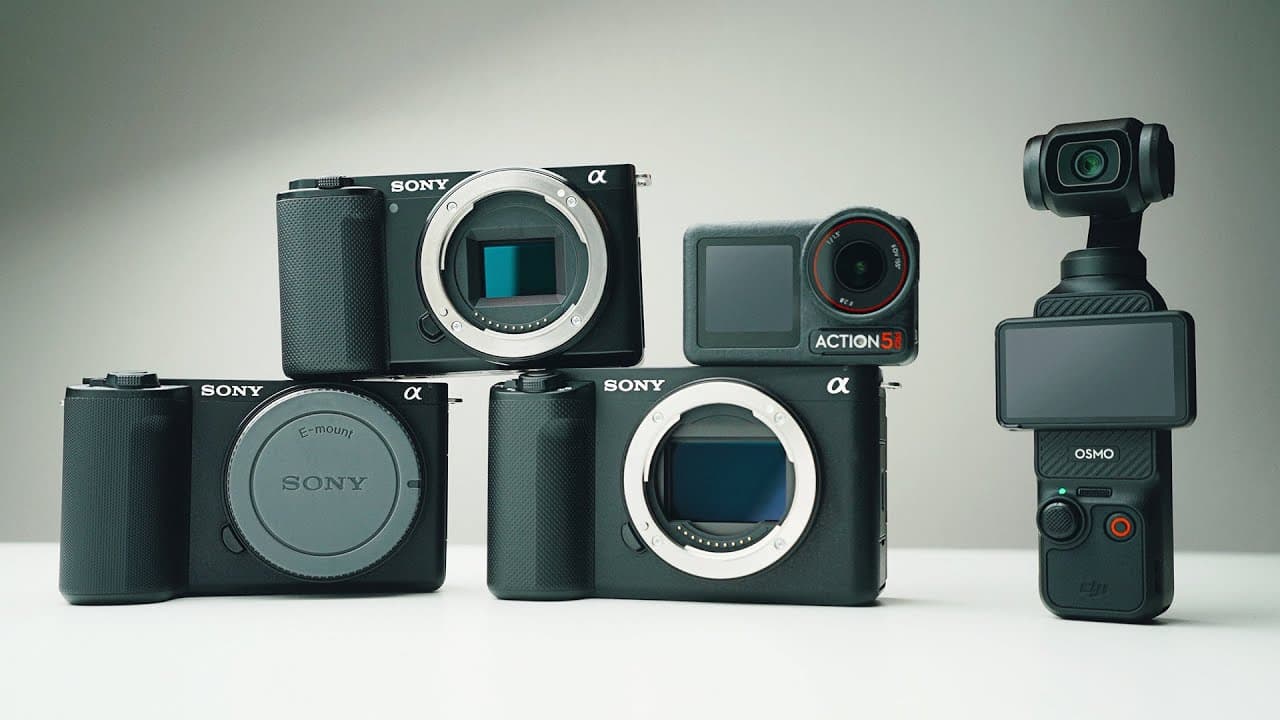
Choose a camera that records at least 4K, has reliable autofocus, and provides a screen for checking your framing. The DJI Action 5 Pro suits rugged travel, the Osmo Pocket 3 favors smooth footage and stronger image quality, the Sony ZV-E10 is an affordable mirrorless starting point, and the FX30 supports long recording with a built-in cooling fan.
Transcript
so you're looking to buy a camera to start making content this year but with so many different options out there it's tough to know which one's actually worth your money so in this video I'll break it down and highlight some of our favorite cameras that we've actually used so you can confidently choose which camera fits your needs and budget you go... Read More
Key Insights
- Ease of use is a primary camera-selection criterion because intuitive controls, dependable autofocus, and a screen that shows the creator’s framing reduce setup difficulties and let the user concentrate on producing content rather than constantly managing technical settings.
- At least 4K recording is recommended because it produces a high-quality image file for editing. The transcript treats 4K capability as a baseline consideration across YouTube camera categories, from compact travel models to interchangeable-lens mirrorless cameras.
- The DJI Osmo Action 5 Pro is designed for rugged travel and vlogging, with a large rear touchscreen, a front framing screen, Horizon Balance, smooth stabilization, built-in storage, and approximately three to four hours of recording from one battery.
- The DJI Osmo Pocket 3 uses a built-in gimbal to counteract handheld movement and create smooth footage. Its larger sensor produces more background blur and subject separation than the Action 5 Pro, giving videos of the creator a more polished appearance.
- Wireless microphone support is built into both recommended DJI cameras. A DJI Mic 2 or DJI Mic Mini transmitter can connect directly, and the cameras support as many as two microphones for recording a creator and guest without requiring a separate receiver.
- The Sony ZV-E10 is an entry-level mirrorless option with 4K video, a large sensor, reliable autofocus, and a flip-out screen. Its limitations include 8-bit recording, less flexibility during color grading, and an older Sony menu system that may confuse beginners.
- The Sony ZV-E10 II offers 10-bit recording, providing more image information and greater flexibility when color grading. Its upgraded sensor also delivers improved colors, but demanding use can generate more heat, particularly during extended 4K 60 recording or filming outdoors in sunny conditions.
- The Sony FX30 is built for longer and more demanding recording sessions. It provides video quality described as similar to the ZV-E10 II, while adding a rugged metal body, a built-in cooling fan, and compatibility with professional accessories such as an XLR top handle.
Install to Summarize YouTube Videos and Get Transcripts
Explore YouTube Video Summarizer or Get YouTube Transcript Extractor
Questions & Answers
Q: What features should a beginner look for in a YouTube camera?
A beginner should prioritize a camera that is easy to operate, records at least 4K video, and has reliable autofocus. A flip-out or front-facing screen is also valuable because it lets a solo creator confirm framing and settings while recording. These practical features reduce technical distractions and allow more attention to be placed on creating the content itself.
Q: Is the DJI Osmo Action 5 Pro good for travel vlogging?
The DJI Osmo Action 5 Pro is recommended for travel and vlogging because it is small, rugged, and intended for challenging environments. It includes front and rear screens, intuitive touchscreen controls, smooth stabilization, and Horizon Balance that keeps footage level through rotations of up to 45 degrees. Built-in storage also allows recording when an SD card has been forgotten.
Q: How long does the DJI Osmo Action 5 Pro battery last?
The DJI Osmo Action 5 Pro can record for approximately three to four hours on one battery, which may cover a full day for some shooting routines. The Adventure Combo includes additional batteries and a charging case, making it possible to swap batteries during longer trips. The speaker suggests that this expanded setup can substantially reduce concerns about finding time to recharge.
Q: What is the difference between the Osmo Pocket 3 and Action 5 Pro?
The main difference is how the cameras handle images and movement. The Osmo Pocket 3 has a larger sensor that creates more background blur and subject separation, while its built-in gimbal produces smooth, cinematic movement. The Action 5 Pro has a more traditional action-camera appearance, with greater sharpness, a rugged design, electronic stabilization, and features intended for unpredictable travel environments.
Q: Can DJI wireless microphones connect directly to these cameras?
The DJI Osmo Pocket 3 and Osmo Action 5 Pro both contain a built-in wireless microphone receiver. A creator can connect DJI Mic 2 or DJI Mic Mini transmitters without adding a separate receiver to the camera. Each camera can connect with as many as two microphones, making the arrangement useful for recording both a host and a guest.
Q: Is the Sony ZV-E10 a good first mirrorless camera for YouTube?
The Sony ZV-E10 is presented as a strong first mirrorless camera because it records 4K video, has a large sensor, provides reliable autofocus, and includes a flip-out screen for self-recording. Its older age also makes it more affordable, at approximately $600 to $700 new. However, it records 8-bit video and uses an older, potentially confusing Sony menu system.
Q: Why choose the Sony ZV-E10 II instead of the original ZV-E10?
The Sony ZV-E10 II adds 10-bit recording, which retains more image information and gives creators greater control when color grading. Its upgraded sensor also produces colors that the speaker considers better even without grading. The tradeoff is heat: the camera can run warmer than the original model, especially during long sessions, outdoor use, or sustained 4K 60 recording.
Q: How can Sony ZV-E10 II overheating be managed?
Overheating risk can be reduced by attaching a cooling fan, such as the Ulanzi model shown in the transcript, to the back of the camera and powering it through USB-C. The reported overheating occurred during an hour of 4K 60 recording, with shutdowns every 20 to 25 minutes. Creators needing greater reassurance can instead consider the fan-equipped Sony FX30.
Summary & Key Takeaways
-
The main buying criteria for a YouTube camera are ease of use, dependable autofocus, visible framing, and at least 4K recording. A flip-out or front screen is especially useful when filming alone. The right choice ultimately depends on the creator’s budget, shooting environment, image-quality expectations, and typical recording duration.
-
The DJI Action 5 Pro is the rugged travel option, with touchscreen controls, front and rear screens, stabilization, Horizon Balance, built-in storage, and approximately three to four hours of battery life. The Osmo Pocket 3 costs more but provides a larger sensor, smoother gimbal-based movement, and more background separation when filming people.
-
The Sony ZV-E10 offers an affordable entry into mirrorless video with 4K recording, autofocus, a large sensor, and a flip-out screen. The ZV-E10 II adds 10-bit video and upgraded image quality but can run hotter during demanding recording. The FX30 addresses extended-session concerns through a rugged body and built-in cooling fan.
Read in Other Languages (beta)
Share This Summary 📚
Summarize YouTube Videos and Get Video Transcripts with 1-Click
Try YouTube Summary with ChatGPT & Claude or YouTube Transcript Generator
Explore More Summaries from Think Media 📚






Summarize YouTube Videos and Get Video Transcripts with 1-Click
Try YouTube Summary with ChatGPT & Claude or YouTube Transcript Generator