Why Did Neural Networks Win the 2024 Physics Nobel?
TL;DR
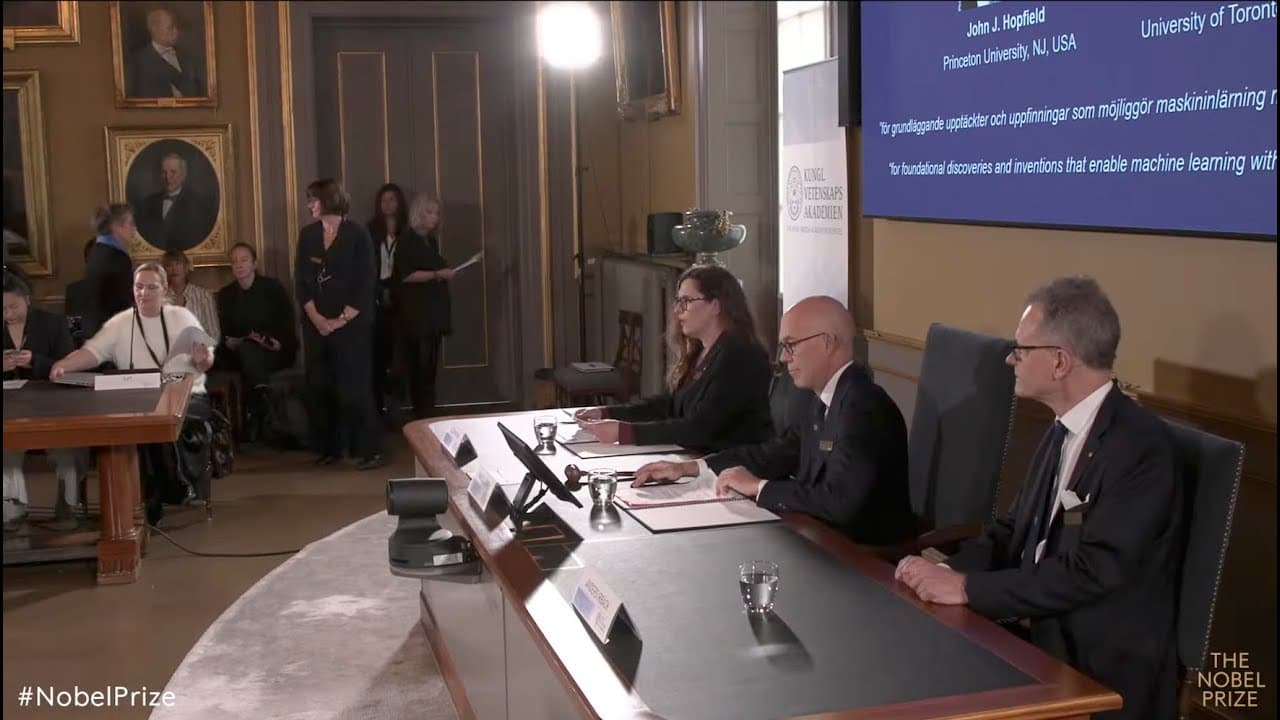
John J. Hopfield and Geoffrey E. Hinton received the 2024 Nobel Prize in Physics for foundational work enabling machine learning with artificial neural networks. Hopfield developed networks that store and retrieve associative memories, while Hinton helped create Boltzmann machines and methods for training networks with hidden layers, contributing to deep learning and applications across physics, medicine, protein analysis, facial recognition, and language translation.
Transcript
welcome to this press conference and the Royal Swedish Academy of Sciences where we will present this year's Nobel Prize in physics we will keep to our tradition and begin the presentation in Swedish and then continue in English and you're of course welcome to ask questions in either language later on my name is hansin I'm the Secretary General of ... Read More
Key Insights
- The 2024 Nobel Prize in Physics was awarded to John J. Hopfield and Geoffrey E. Hinton for foundational discoveries and inventions that enable machine learning with artificial neural networks, connecting concepts from statistical physics with computational systems for learning and recognizing patterns.
- Artificial neural networks are inspired by networks of neurons in the brain, where billions of connected neurons support abilities such as recognizing images and speech and associating new information with memories and previous experiences.
- The Hopfield network is a dynamic associative-memory system with pairwise-connected nodes whose stable states represent memories. Its connections can be trained so that stored patterns remain unchanged as the network updates over time.
- The Hopfield energy function assigns low energy to stored memories, placing them metaphorically in valleys within an energy landscape. A distorted input starts at higher energy and moves toward a nearby valley, enabling the network to recover and correct a remembered pattern.
- The Hopfield network is robust enough to replace binary nodes with analog nodes, and Hopfield also demonstrated that the network could address difficult optimization problems, expanding its significance beyond the storage and retrieval of associative memories.
- The Boltzmann machine is a stochastic version of the Hopfield network created by Geoffrey Hinton and Terry Sejnowski. It focuses on statistical distributions rather than individual patterns and can generate new instances from a learned distribution after training.
- Hidden nodes allow a Boltzmann machine to learn more general distributions than visible nodes alone. Because the original model was computationally prohibitive, a version with fewer connections, called the restricted Boltzmann machine, developed into a more versatile practical tool.
- Machine learning supports research in particle physics, astrophysics, materials modeling, climate modeling, protein structure prediction, and medical-image analysis. It also enables everyday applications such as facial recognition and language translation, while raising concerns about safe and ethical use.
Install to Summarize YouTube Videos and Get Transcripts
Explore YouTube Video Summarizer or Get YouTube Transcript Extractor
Questions & Answers
Q: Why did Hopfield and Hinton receive the 2024 Nobel Prize in Physics?
John J. Hopfield and Geoffrey E. Hinton received the 2024 Nobel Prize in Physics for foundational discoveries and inventions that enable machine learning with artificial neural networks. Their work used fundamental concepts from statistical physics to create systems that function as associative memories, identify patterns in large data sets, learn statistical distributions, and support the training of networks containing hidden layers.
Q: How does a Hopfield network store and retrieve memories?
A Hopfield network stores memories as stable states of a dynamic system containing pairwise-connected nodes. An energy function gives those memory states low energy, placing them in metaphorical valleys within an energy landscape. When the network starts with a distorted, higher-energy pattern, its state moves downward toward a nearby valley, reconstructing the stored pattern and correcting the original distortion.
Q: What role does statistical physics play in artificial neural networks?
Statistical physics provides concepts for understanding the collective behavior of many connected components. Hopfield introduced an energy function resembling those used to study magnetic systems, while Hinton and Terry Sejnowski developed a stochastic network that learned statistical distributions. These ideas helped explain how networks of simplified nodes can form memories, recognize patterns, and learn from examples through adjustable connection strengths.
Q: What is a Boltzmann machine and how does it work?
A Boltzmann machine is a stochastic version of the Hopfield network developed by Geoffrey E. Hinton and Terry Sejnowski using ideas from statistical physics. Rather than focusing only on individual stored patterns, it learns statistical distributions. It contains visible and hidden nodes, and after training it acts as a generative model that can produce new instances from the distribution it has learned.
Q: Why are hidden nodes important in machine learning?
Hidden nodes allow an artificial neural network to learn more general distributions and internal representations that are not directly supplied as visible inputs or outputs. Hinton and Sejnowski added hidden nodes to their Boltzmann machine, and Hinton also clarified the important function of hidden layers in feed-forward networks. These developments supported the training of more capable multilayer and deep network structures.
Q: How did restricted Boltzmann machines contribute to deep learning?
The original Boltzmann machine was theoretically important but prohibitively demanding to use computationally. A restricted Boltzmann machine reduced the number of connections and became a more versatile tool. Hinton used this restricted form to pre-train deep structures, enabling examples of densely connected networks that had previously been difficult to train and creating a breakthrough toward deep learning.
Q: Where are artificial neural networks used in physics and science?
Artificial neural networks are used for data analysis in particle physics and astrophysics, for modeling materials, and for searching for novel, more efficient solar cells. They also support explicit physics-based climate modeling at higher resolution. Applications outside physics mentioned in the announcement include protein structure prediction, medical-image analysis, facial recognition, language translation, and assistance with diagnosing medical conditions.
Q: What benefits and risks did Hinton identify for artificial intelligence?
Hinton said artificial intelligence could influence civilization on a scale comparable with the Industrial Revolution, but through intellectual ability rather than physical strength. He expected better health care, more efficient industries, AI assistance, and major productivity improvements. He also warned about possible harmful consequences, particularly the danger that systems smarter than humans could get out of control, requiring serious attention to safety.
Summary & Key Takeaways
-
The Royal Swedish Academy of Sciences awarded the 2024 Nobel Prize in Physics to John J. Hopfield of Princeton University and Geoffrey E. Hinton of the University of Toronto. Their foundational discoveries and inventions enabled machine learning with artificial neural networks by applying concepts from statistical physics to memory, pattern recognition, and learning.
-
Hopfield introduced a dynamic network whose stable states represented stored memories. An energy function, similar to those used for magnetic systems, placed memories in low-energy valleys. When the network received a distorted pattern, its state moved toward a nearby valley, allowing it to reconstruct the corresponding stored pattern and correct the distortion.
-
Hinton and Terry Sejnowski developed the Boltzmann machine, a stochastic extension of the Hopfield network that learned statistical distributions using visible and hidden nodes. Hinton later used restricted Boltzmann machines to pre-train deep, densely connected structures, helping overcome training barriers and contributing to the development of modern deep-learning methods.
Read in Other Languages (beta)
Share This Summary 📚
Summarize YouTube Videos and Get Video Transcripts with 1-Click
Try YouTube Summary with ChatGPT & Claude or YouTube Transcript Generator
Explore More Summaries from Nobel Prize 📚

Summarize YouTube Videos and Get Video Transcripts with 1-Click
Try YouTube Summary with ChatGPT & Claude or YouTube Transcript Generator