How Did the Supreme Court Affect Trans Rights in 2023?
TL;DR
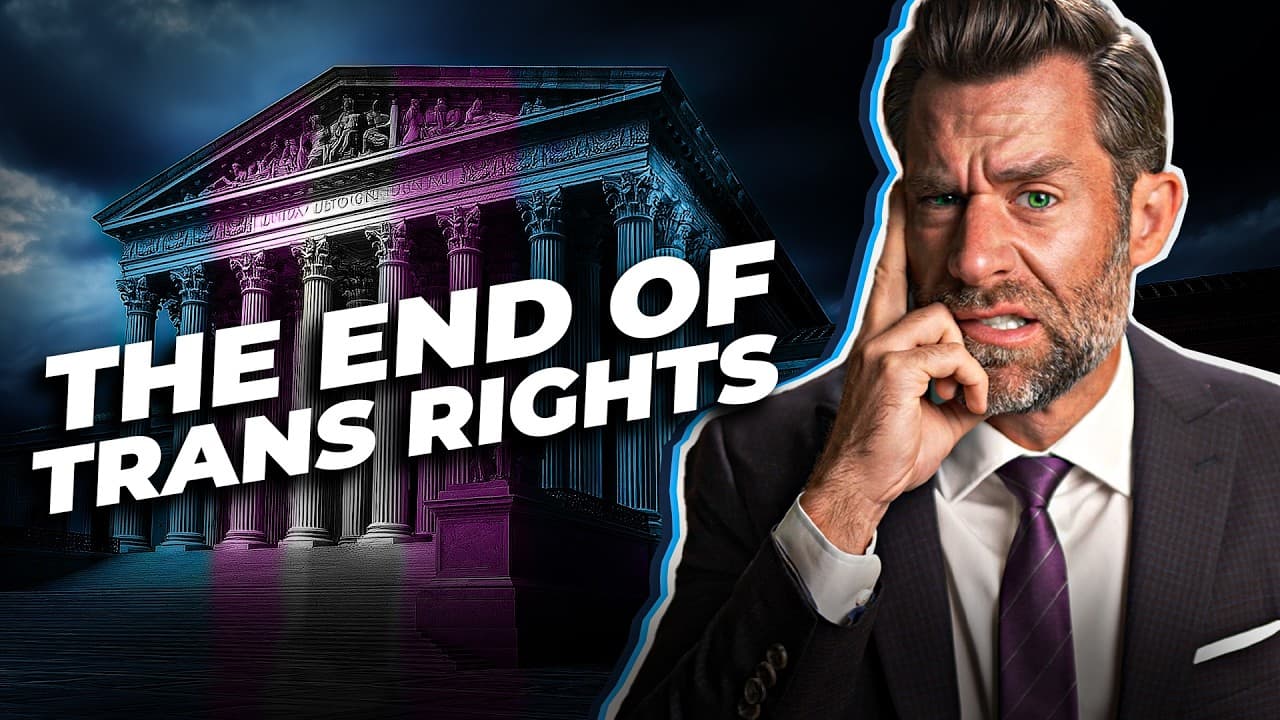
The Supreme Court upheld a Tennessee law banning certain medical treatments for transgender minors, determining it does not classify based on sex but rather on age and medical use, which allowed it to pass under rational basis review. Critics contend this decision signals a potential rollback of transgender rights and undermines parental authority in medical decisions.
Transcript
Apparently, when Tennessee passed a law, the states's purpose is to encourage minors to appreciate and not disdain their birth assigned sex, and that prohibits certain medical treatments for minors seeking treatment for gender dysphoria, but will allow those treatments for other medical reasons. Apparently, that does not draw classifications based ... Read More
Key Insights
- The Supreme Court ruled in favor of a Tennessee law banning specific gender-affirming treatments for transgender minors, classifying the law under rational basis review.
- Chief Justice Roberts argued that the law does not classify based on sex but on age and medical use, applying a less stringent review standard.
- The decision reflects a potential rollback of protections for transgender individuals, with the court unlikely to consider them a protected class.
- The ruling highlights the court's method of selecting a standard of review that aligns with its desired outcome, raising concerns about judicial impartiality.
- Critics argue the ruling ignores parental rights to direct their children's medical care, as established in previous Supreme Court decisions.
- The decision is seen as part of a broader trend of political and cultural influence on judicial rulings regarding transgender rights.
- The dissenting opinion argues that the law explicitly discriminates based on sex and transgender status, warranting a higher level of scrutiny.
- Media coverage of transgender rights issues reveals significant bias, with varying narratives depending on the political leanings of the sources.
Install to Summarize YouTube Videos and Get Transcripts
Explore YouTube Video Summarizer or Get YouTube Transcript Extractor
Questions & Answers
Q: What was the Supreme Court's ruling in United States vs. Skirmdi?
The Supreme Court upheld a Tennessee law that bans specific gender-affirming treatments for transgender minors. The court applied a rational basis review, concluding that the law does not classify based on sex but rather on age and medical use, making it constitutional under this standard.
Q: Why did Chief Justice Roberts argue the Tennessee law does not classify based on sex?
Chief Justice Roberts argued that the Tennessee law does not classify based on sex because it prohibits medical treatments for minors based on age and specific medical uses, not on the sex of the individuals seeking treatment. This classification led to the application of a less stringent rational basis review.
Q: How does the ruling reflect on the status of transgender individuals as a protected class?
The ruling indicates that the Supreme Court does not currently consider transgender individuals as a protected class. The court's decision to apply a rational basis review rather than a heightened scrutiny suggests a reluctance to extend additional legal protections to transgender individuals.
Q: What concerns have been raised about the court's method in selecting the standard of review?
Critics argue that the court's method of selecting the standard of review aligns with its desired outcome, raising concerns about judicial impartiality. The decision to apply a rational basis review, which is more likely to uphold the law, has been seen as an indication of the court's outcome-first approach.
Q: How does the ruling affect parental rights in directing their children's medical care?
The ruling has been criticized for ignoring parental rights to direct their children's medical care, as established in previous Supreme Court decisions. Critics argue that the decision violates these rights by allowing the state to impose restrictions on medical treatments for transgender minors without considering parental consent.
Q: What broader trends does the ruling reflect in terms of political and cultural influence?
The ruling reflects broader trends of political and cultural influence on judicial decisions regarding transgender rights. The decision is seen as part of a pattern where the court's rulings align with conservative political and cultural perspectives, potentially rolling back protections for transgender individuals.
Q: What arguments did the dissenting opinion present against the majority decision?
The dissenting opinion argued that the Tennessee law explicitly discriminates based on sex and transgender status, warranting a higher level of scrutiny. Justice Sotomayor stated that the law's classifications are in plain sight, inviting discrimination, and that the majority's decision fails to recognize this.
Q: How does media coverage of transgender rights issues vary across different political leanings?
Media coverage of transgender rights issues varies significantly across different political leanings. Left-leaning sources often frame rulings as regressive, while right-leaning sources may view them as cultural victories. This variation highlights the presence of bias and the influence of political perspectives in media narratives.
Summary & Key Takeaways
-
The Supreme Court's decision in United States vs. Skirmdi upheld a Tennessee law prohibiting certain medical treatments for transgender minors, applying a rational basis review. Chief Justice Roberts argued the law does not classify based on sex but on age and medical use, leading to significant criticism.
-
The ruling has sparked concerns about the rollback of transgender rights and the potential influence of political and cultural factors on judicial decisions. The dissenting opinion highlighted the law's discriminatory nature, arguing for a higher level of scrutiny.
-
Critics also point out the decision's disregard for parental rights as established in previous cases. Media coverage of transgender rights issues varies widely, with significant bias evident depending on the political leanings of the sources.
Read in Other Languages (beta)
Share This Summary 📚
Summarize YouTube Videos and Get Video Transcripts with 1-Click
Try YouTube Summary with ChatGPT & Claude or YouTube Transcript Generator
Explore More Summaries from LegalEagle 📚






Summarize YouTube Videos and Get Video Transcripts with 1-Click
Try YouTube Summary with ChatGPT & Claude or YouTube Transcript Generator