How Did Earth's History Unfold Over 4.5 Billion Years?
TL;DR
Earth's history spans 4.5 billion years, beginning with its formation in a hellish landscape and evolving through various eons, including the emergence of life and the Great Oxidation Event. Key events include the formation of the moon, the rise and fall of supercontinents, and major extinction events that shaped the planet's biodiversity, culminating in the dominance of mammals and humans.
Transcript
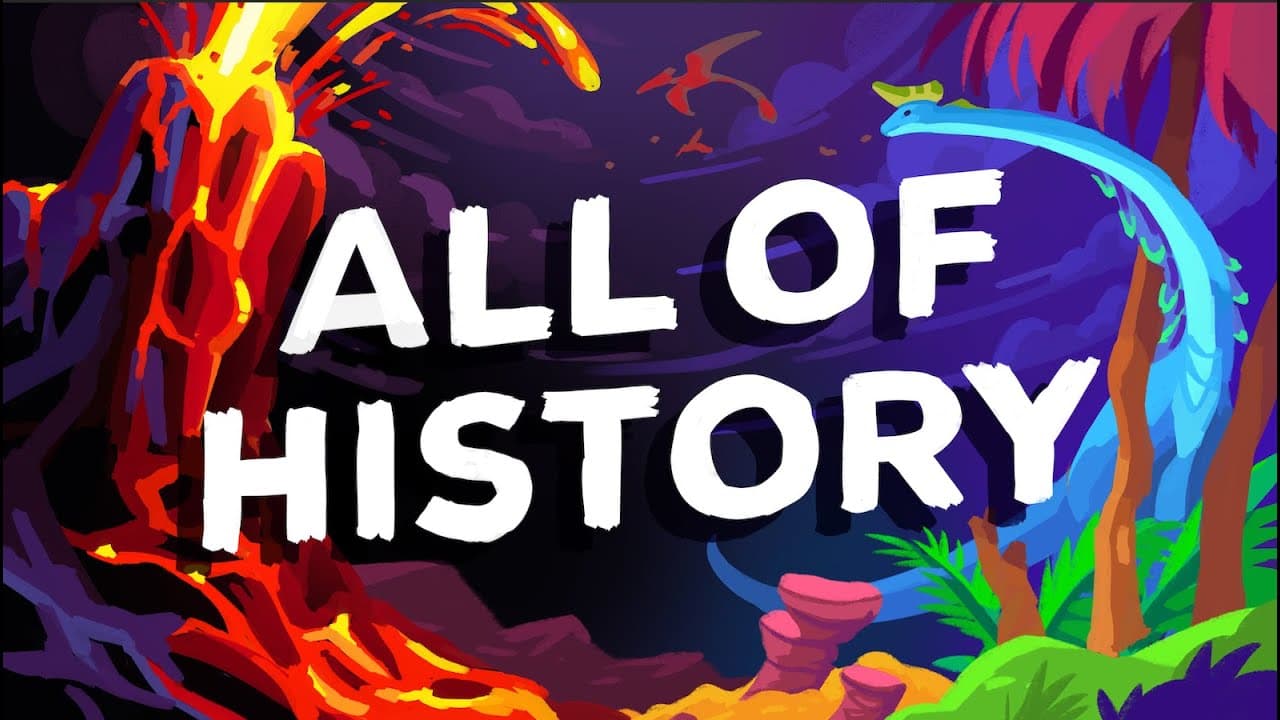
Earth is 4.5 billion years old – impossible for your brain to truly grasp, so here is an experiment: every second around 1.5 million years will pass – you're on a musical train ride looking out the window, passing all of Earth's History in an hour. Watch the eons pass and experience how long a billion years really is. You can have this in the bac... Read More
Key Insights
- 🗂️ Earth's history is divided into eons, each characterized by distinct geological and biological changes.
- 🖤 The early history of Earth, such as the Hadean eon, is mostly inaccessible to us due to the lack of surviving evidence.
- 💋 The emergence of life on Earth, starting with simple cells, marked the beginning of a long process of evolution and diversification.
- 💨 The Great Oxidation Event, which introduced a significant amount of oxygen into the atmosphere, paved the way for more complex life forms.
- 💁 Supercontinents forming and breaking apart had a profound impact on Earth's geography and climate.
- 😮 The rise and fall of different species, including dinosaurs and mammals, shaped the planet's ecosystems and biodiversity over millions of years.
- 💆 Mass extinction events, such as the one that wiped out the dinosaurs, have had a profound impact on the course of Earth's history.
Install to Summarize YouTube Videos and Get Transcripts
Explore YouTube Video Summarizer or Get YouTube Transcript Extractor
Questions & Answers
Q: What were the conditions like during the first eon, the Hadean?
During the Hadean eon, Earth was covered in lava, and the atmosphere was primarily composed of CO2. It was an inhospitable environment, with no visible signs of life.
Q: When did life first appear on Earth?
Life is believed to have started appearing on Earth only a few hundred million years after its formation, with the emergence of the first cells. However, the exact origins of life are still unknown.
Q: What was the significance of the Great Oxidation Event?
The Great Oxidation Event, which occurred around 2.5 billion years ago, marked a turning point in Earth's history. Cyanobacteria released large amounts of oxygen into the atmosphere, paving the way for more complex life forms.
Q: How did the formation of supercontinents impact Earth?
As supercontinents formed and broke apart throughout Earth's history, they influenced the geography and climate of the planet. These events also played a role in shaping the distribution of species and the evolution of life.
Q: When did dinosaurs roam the Earth?
Dinosaurs became dominant during the Triassic period, which began around 252 million years ago. They continued to thrive until the mass extinction event caused by an asteroid impact about 66 million years ago.
Summary & Key Takeaways
-
Earth's history is divided into eons, with the first eon being the Hadean, characterized by a hellish landscape of lava and a high concentration of CO2 in the atmosphere.
-
Over billions of years, Earth goes through multiple stages, including the formation of the moon, the emergence of life in the form of cells, the Great Oxidation Event, and the rise and fall of supercontinents.
-
The video emphasizes the gradual development of Earth, from a lifeless planet to one teeming with diverse organisms, leading up to the rise of mammals and the dominance of Homo sapiens.
Read in Other Languages (beta)
Share This Summary 📚
Summarize YouTube Videos and Get Video Transcripts with 1-Click
Try YouTube Summary with ChatGPT & Claude or YouTube Transcript Generator
Explore More Summaries from Kurzgesagt – In a Nutshell 📚


Summarize YouTube Videos and Get Video Transcripts with 1-Click
Try YouTube Summary with ChatGPT & Claude or YouTube Transcript Generator