How to Automate a YouTube Channel With AI Agents
TL;DR
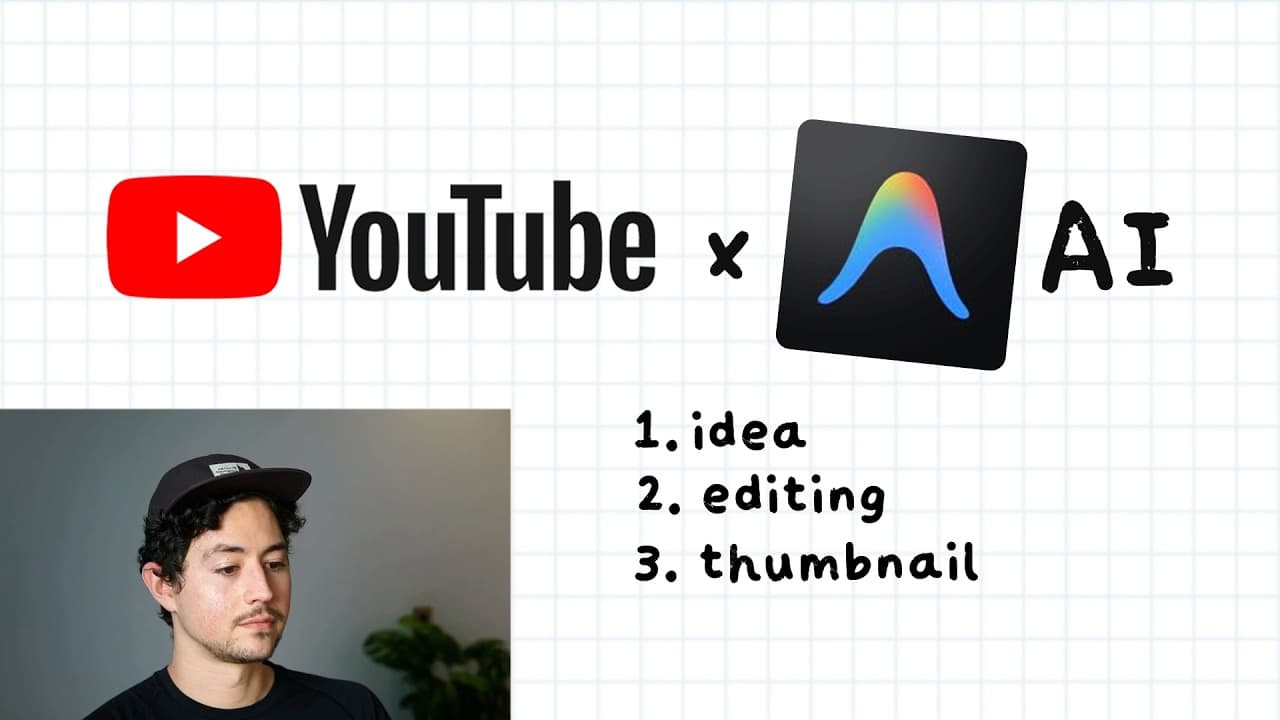
Automate a YouTube content pipeline by separating high-level directives, orchestration logic, and executable scripts, then letting an AI coding agent call those tools in sequence. The demonstrated workflows edit and enhance talking-head footage, generate thumbnails, detect unusually successful video ideas, and upload finished content, while plan-mode comparisons and repeated testing help identify the most reliable implementation.
Transcript
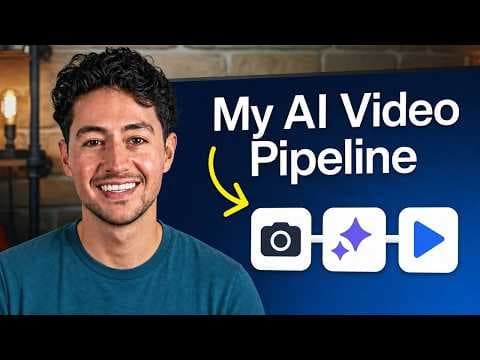
Hey everyone, I'm going to show you three agentic workflows for video. The first is an endto-end AI video editor that actually cuts up my content, mixes and masters it, and then uploads it to YouTube for me. That is what you guys are currently looking at right now, the byproduct of that flow. The second is an AI thumbnail generator. You guys are lo... Read More
Key Insights
- The automation system contains three creator workflows: an end-to-end video editor, an AI thumbnail generator, and an AI outlier detector. These respectively handle production, packaging, and idea discovery, covering several major stages of a YouTube content pipeline.
- The video editor automatically processes talking-head recordings by extracting audio, detecting speech, removing silent sections, cutting marked mistakes, enhancing audio, applying color grading, and adding an introductory swivel teaser before the finished content is uploaded to YouTube.
- Silero VAD is the neural voice activity detection module used to distinguish speech from silence. The workflow applies a 0.5-second threshold so it can remove unwanted gaps while accommodating ordinary pauses, tab changes, or moments when the presenter temporarily steps away.
- The directives-orchestration-execution framework separates high-level task instructions from the scripts that perform deterministic work. This division reduces the amount of probabilistic work assigned directly to the language model and lets the agent call tools that were built and tested for specific operations.
- The smart-edit directive describes the workflow, its inputs, required steps, parallel-processing preference, and expected outputs. The creator produced it after repeatedly testing the process, then asking the AI coding agent to convert the successful procedure into a reusable directive.
- Plan mode improves workflow design by requesting three possible approaches before implementation. Comparing multiple candidates helps prevent the AI from committing too early to an unproductive path and keeps the user involved in selecting the most promising technical direction.
- Existing solutions are useful starting points because web research can uncover prior implementations and compatible software. The demonstrated planning process considered a local software stack, a hybrid cloud approach, and a voice-activity-detection-first approach before testing the candidates.
- Real footage is necessary for validating an automated editor. The creator tested the workflow on an 8-minute-and-51-second recording containing pauses and off-screen setup activity, then compared the processed result to confirm that unwanted portions were removed and the teaser was added.
Install to Summarize YouTube Videos and Get Transcripts
Explore YouTube Video Summarizer or Get YouTube Transcript Extractor
Questions & Answers
Q: How can AI agents automate a YouTube channel?
AI agents can automate a YouTube channel by connecting reusable instructions with scripts that handle production tasks. The demonstrated system edits talking-head footage, enhances its sound and appearance, adds an introductory teaser, and uploads the result. Separate workflows generate thumbnails and detect unusually successful videos for idea research, allowing automation to support editing, packaging, publishing, and topic selection.
Q: How does the automated AI video editor work?
The editor begins by extracting audio from a recorded video and running Silero VAD to identify speech. It removes silence gaps, deletes mistake sections marked by designated spoken words, enhances the audio, applies color grading, and adds a swivel-style introductory teaser. Hardware acceleration is then used to process the complete edit faster than the creator's Premiere Pro workflow.
Q: What is the directives-orchestration-execution framework?
The directives-orchestration-execution framework organizes an agentic workflow into distinct responsibilities. A directives folder stores high-level instructions, while an execution folder contains Python scripts and related tools. Orchestration connects the requested task to the correct directive and scripts. This structure limits reliance on probabilistic language-model behavior and makes repeated operations more consistent and reusable.
Q: Why should an AI workflow begin with multiple implementation options?
An AI workflow should begin with multiple implementation options because an agent can otherwise pursue a technical path that does not produce a useful result. The creator asks for three alternatives in plan mode, reviews their high-level differences, and tests promising candidates. This keeps the user in control of the selection process and makes comparison possible before one approach becomes the reusable workflow.
Q: How can a non-programmer build an agentic video workflow?
A non-programmer can describe the desired input, transformations, and output in ordinary language, then ask an AI coding agent to research and propose several implementations. The creator specified silence detection, gap removal, mistake removal, and an intro animation without writing the underlying Python. After testing the generated solutions, the successful process was saved as directives and execution scripts for reuse.
Q: How should an automated video editor be tested?
An automated editor should be tested with real footage that contains the conditions it is expected to handle. The creator recorded an 8-minute-and-51-second clip with pauses, moments of looking away, and time spent setting up tabs. Running the workflow on that material made it possible to verify whether inactive sections were removed and whether the introductory teaser appeared correctly.
Q: What does Silero VAD do in the editing workflow?
Silero VAD acts as the neural voice activity detection component of the editing workflow. It analyzes extracted audio to determine where speech occurs, providing the timing information needed to remove silence from the corresponding video. The demonstrated configuration uses a 0.5-second threshold, while still accounting for situations in which a presenter pauses, changes tabs, or temporarily steps away.
Q: How are reusable AI workflow directives created?
Reusable directives can be created after a workflow has been run and refined enough times to establish a dependable procedure. The creator asked the AI coding agent to turn the completed process into a directive. That file records a description, relevant background information, execution steps, a preference for parallel processing where possible, referenced scripts, and the outputs the workflow should produce.
Summary & Key Takeaways
-
The creator presents three agentic workflows for YouTube production: an editor that cuts, enhances, and uploads videos, a thumbnail generator that matches faces and rebuilds designs, and an outlier detector that identifies high-performing ideas. Together, these systems automate much of the content pipeline without requiring the creator to understand the underlying programming.
-
The editing workflow extracts audio, detects speech with Silero VAD, removes silence gaps, cuts sections marked as mistakes, enhances audio, applies color grading, and adds an introductory swivel teaser. Hardware acceleration speeds processing, while a 0.5-second silence threshold preserves ordinary speaking pauses but removes longer inactive sections from talking-head recordings.
-
The recommended development process starts in plan mode, researches existing solutions, and produces three implementation options. Each candidate can be built and tested separately against real footage. Once a reliable approach emerges, its instructions become a reusable directive connected to execution scripts, allowing a short natural-language request to trigger the complete workflow.
Read in Other Languages (beta)
Share This Summary 📚
Summarize YouTube Videos and Get Video Transcripts with 1-Click
Try YouTube Summary with ChatGPT & Claude or YouTube Transcript Generator
Explore More Summaries from Nick Saraev 📚

Summarize YouTube Videos and Get Video Transcripts with 1-Click
Try YouTube Summary with ChatGPT & Claude or YouTube Transcript Generator