How to judge dark chocolate health by flavanols and metals?
TL;DR
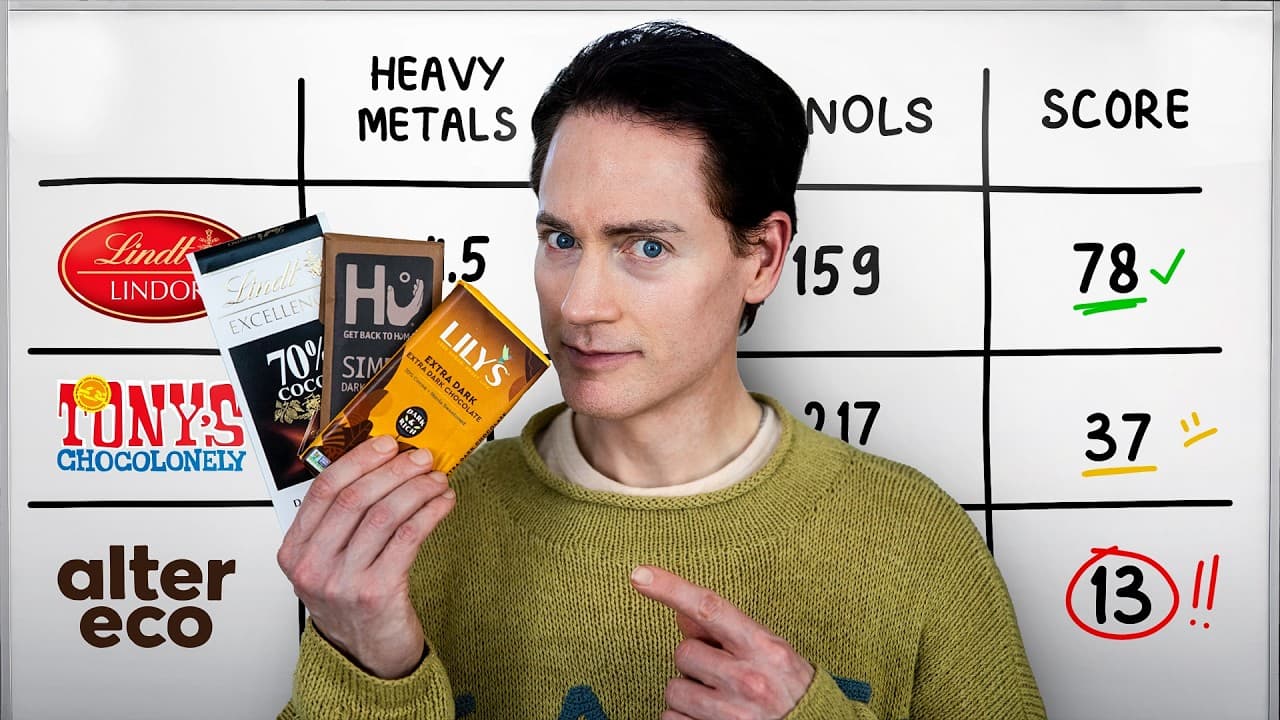
Flavanols indicate potential health benefits while heavy metals indicate risk. This video compares 10 supermarket chocolates by computing a score from flavanols minus heavy metals, showing wide variation and questionable transparency. The host emphasizes that higher flavanol content and lower heavy metals lead to better scores, but marketing does not predict safety.
Transcript
Today we're going to test 10 supermarket chocolates and determine how good or bad they are for you. Dark chocolate is good for cognitive function and heart health and many other things. What you want to look for is flavinols. On the bad side, they can be high in heavy metal content. The problem is companies don't tell you the heavy metals in the ch... Read More
Key Insights
- Flavanols are used as the metric for the good stuff in chocolate.
- Heavy metals are used as the metric for the bad stuff in chocolate.
- The scoring system multiplies the good content by the presence of heavy metals to determine overall quality.
- Several brands show high flavanol levels but also low or high heavy metal levels, affecting their score.
- 100 percent cacao options can have very high heavy metals, reducing their net score.
- A higher raw flavanol count does not guarantee a higher score if metals are also high.
- Brand marketing narratives do not reliably predict nutrient quality or safety.
- The video promotes transparency and data sharing to help consumers make healthier choices.
- More videos from this channel:
- More from this channel: Bryan Johnson
Install to Summarize YouTube Videos and Get Transcripts
Explore YouTube Video Summarizer or Get YouTube Transcript Extractor
Questions & Answers
Q: What is the basic method used to rate each chocolate bar in the video?
The host measures flavinols, which are the healthy components, and heavy metals, which are the risks, for each chocolate bar. He then assigns a score based on a ratio of good to bad elements, ranking the bars from best to worst. This approach highlights how content can vary independently of marketing.
Q: Why are heavy metals a concern when evaluating chocolate bars?
Heavy metals are a concern because the video notes they can contribute to cancer, high blood pressure, kidney disease, and low sperm count. The host emphasizes that these toxins may be present in chocolate and that consumer transparency about their levels is often lacking, which justifies ranking the bars to reflect safety.
Q: Which chocolate performed best in the video, and why?
Vge performer achieved the highest score with flavinols of 159 mg and very low metals at 2 micrograms, resulting in a score of 78. This combination of high healthy content and low contamination led to the top ranking, demonstrating how both factors influence overall quality.
Q: What misleading aspect of chocolate marketing does the video critique?
The video critiques marketing and packaging, arguing that they do not reliably indicate actual health value or safety. It points out that words, images, and brand promises can mask the true content, underscoring the need for quantified data on flavanols and heavy metals.
Q: How does the 100% cacao option perform, and what does this illustrate?
100% cacao options had high flavanol content but also very high heavy metals in one case, illustrating that even bars labeled as pure or simple can pose safety concerns. This demonstrates that low sugar or simple ingredients do not guarantee low risk from heavy metals.
Q: What lesson does the host draw about the public food supply from these tests?
The host concludes that transparency and a clean supply chain matter for everyone, as dirty chocolate harms overall health. He advocates sharing data so consumers can make informed choices and urges brands to improve sourcing and reporting of heavy metal content.
Q: Does the video recommend a specific brand or product?
The video presents rankings and scores rather than endorsing a specific brand. It emphasizes that the best choice depends on the balance of flavanols and heavy metals for each bar, and it suggests using data to compare options rather than relying on marketing alone.
Q: What additional product did the host mention to illustrate scoring beyond bars, and what was the result?
The host mentions Blueprint Coco powder as an additional product, noting it had a much higher flavanol content with relatively low heavy metals, resulting in a higher theoretical score. This comparison helps illustrate how different product forms can yield different health value assessments.
Summary & Key Takeaways
-
A practical test ranks 10 supermarket dark chocolates by a combined score of flavanols and heavy metals, showing a wide range of outcomes.
-
High flavanol content improves the score, but high heavy metal content can dramatically lower it, even for popular brands.
-
The overall message is that transparency in sourcing matters for both health and trust in the food supply.
Read in Other Languages (beta)
Share This Summary 📚
Summarize YouTube Videos and Get Video Transcripts with 1-Click
Try YouTube Summary with ChatGPT & Claude or YouTube Transcript Generator
Explore More Summaries from Bryan Johnson 📚

Summarize YouTube Videos and Get Video Transcripts with 1-Click
Try YouTube Summary with ChatGPT & Claude or YouTube Transcript Generator