How to Answer IELTS Speaking Questions at Band 9

TL;DR
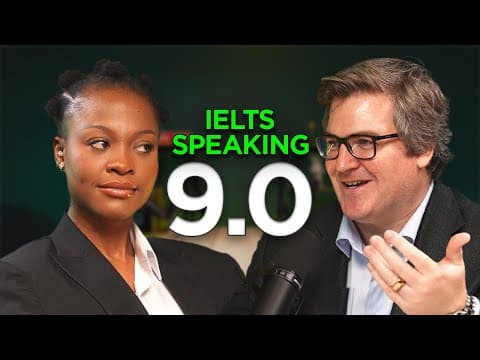
Strong IELTS Speaking answers directly address the question, add specific details, and use natural vocabulary without sounding memorized. The candidate develops responses with personal examples, balanced opinions, cultural context, and occasional self-correction, showing how fluent conversation can continue even when an answer is uncertain or a question is difficult.
Transcript
let's talk about friends do you have lots of friends I do have quite a few friends um I I feel like I have more acquaintances than friends the people who I really care about I think I can definitely count them on my fingers who is your best friend and why I don't know how to answer this question because if I say any one person the others are going ... Read More
Key Insights
- Strong IELTS Speaking answers are developed with reasons, examples, and personal details. The candidate rarely stops after a direct response, instead explaining distinctions such as friends versus acquaintances, acceptable versus irritating noise, or independent travel versus organized group tours.
- Natural vocabulary is used in context rather than presented as an isolated display. Expressions such as “closed off,” “sus out my environment,” “tried my hand at,” “get over the smell,” and “the pros outweigh the cons” support precise, conversational answers.
- Fluent speaking can include hesitation and self-correction. The candidate occasionally pauses, revises a phrase, questions a detail, or admits uncertainty, yet continues developing the answer without losing the central meaning or abandoning the topic.
- Personal examples make abstract answers more concrete. Experiences in Taiwan, Cambodia, Paris, London, Egypt, and other parts of Europe provide supporting evidence for opinions about food, tourism, museums, cultural customs, and different approaches to travel.
- Balanced opinions strengthen answers to discussion questions. On museum admission, the candidate first favors free access because collections belong to humanity, then acknowledges costly upkeep and proposes a small fee or periodic free entry as a reasonable compromise.
- Specific sensory language makes descriptions vivid. Stinky tofu smells “absolutely horrendous,” Siem Reap feels eerily beautiful, household sounds feel familiar and homey, and Thai food is associated with distinctive flavors such as turmeric and lemongrass.
- A difficult question can be handled by reframing its assumption. When asked to identify one best friend, the candidate explains that she has several very good friends whom she values for different reasons, producing a sincere answer without accepting an inaccurate premise.
- Extended answers remain relevant by connecting details to a clear position. The Siem Reap response includes temples, jungle scenery, a film connection, previous travel, and personal feelings, but every detail supports the recommendation to visit the Cambodian destination.
Install to Summarize YouTube Videos and Get Transcripts
Explore YouTube Video Summarizer or Get YouTube Transcript Extractor
Questions & Answers
Q: How should you develop answers in the IELTS Speaking test?
Develop an IELTS Speaking answer by responding directly and then adding a reason, example, comparison, preference, or personal experience. The candidate follows this pattern across topics including friends, flowers, cooking, noise, travel, and museums. Her added details make each response conversational and substantial while remaining connected to the examiner’s original question.
Q: How can you answer an IELTS question when its assumption does not fit you?
You can politely reframe the question and explain why its assumption does not match your experience. When asked who her best friend is, the candidate says she does not have only one. She then discusses three or four very good friends whom she values for help, counseling, advice, and different personal qualities.
Q: Is hesitation acceptable in a strong IELTS Speaking response?
Hesitation can appear within an otherwise fluent and well-developed response. The candidate pauses, repeats words, adjusts statements, and openly acknowledges uncertainty about details such as flower colors or a museum’s name. She still maintains meaning, continues speaking, and supports her answers with relevant explanations, which prevents these moments from stopping the conversation.
Q: What vocabulary choices make IELTS Speaking answers sound natural?
Natural vocabulary consists of words and expressions that precisely match the topic and the candidate’s intended meaning. The responses use phrases such as “more acquaintances than friends,” “closed off,” “tried my hand at,” “get over the smell,” “not really bothered,” and “pros outweigh the cons.” These expressions appear inside relevant personal explanations rather than as disconnected vocabulary.
Q: How does the candidate describe friendships and socializing?
The candidate says she has quite a few friends but believes many are better described as acquaintances. She can count the people she deeply cares about on her fingers and identifies three or four very good friends rather than one best friend. In new environments, she may initially seem reserved while she assesses the situation before speaking.
Q: Why does the candidate recommend visiting Siem Reap?
The candidate recommends Siem Reap because of its beautifully preserved temples in the Cambodian jungle, peaceful and quiet atmosphere, and distinctive sense of place. She also connects one temple with a memorable Tomb Raider scene involving a Buddha head and a tree. Her recommendation is reinforced by her strong personal connection with Cambodia.
Q: Should museums and art galleries charge admission fees?
The candidate’s first instinct is that museums and galleries should be free because their artifacts, historical paintings, books, and other collections belong to people and the human race. However, she recognizes that upkeep and maintenance are expensive. She therefore considers a small fee reasonable and appreciates the French approach of offering periodic free museum admission.
Q: Why do some travelers choose package holidays instead of independent travel?
Some people may choose package holidays because they do not enjoy planning every part of a trip. Group travel can also make the experience more social, particularly for senior citizens, and a guide may be required to access certain attractions. The candidate generally prefers independent travel but joined a group in Egypt for access-related reasons.
Summary & Key Takeaways
-
The candidate answers personal questions about friendships, flowers, cooking, food, and noise with specific preferences and explanations. She distinguishes close friends from acquaintances, describes herself as reserved in unfamiliar environments, discusses flower customs in Taiwan, shares her attempts at cooking and baking, and identifies ordinary household sounds as comforting.
-
The extended response recommends Siem Reap for its preserved temples, Cambodian jungle setting, peaceful atmosphere, and connection to a Tomb Raider film. The candidate also mentions a strong personal connection with Cambodia, contrasts that experience with previous European travel, and recommends Phnom Penh while making Siem Reap the essential destination.
-
The discussion addresses museum fees, gallery appeal, package holidays, and tourism. The candidate supports broad cultural access but accepts small admission fees because maintenance is costly. She prefers independent travel, recognizes that guided groups can offer convenience or necessary access, and concludes that tourism’s economic benefits can outweigh congestion and disorder.
Read in Other Languages (beta)
Share This Summary 📚
Summarize YouTube Videos and Get Video Transcripts with 1-Click
Try YouTube Summary with ChatGPT & Claude or YouTube Transcript Generator
Explore More Summaries from IELTS Advantage 📚

Summarize YouTube Videos and Get Video Transcripts with 1-Click
Try YouTube Summary with ChatGPT & Claude or YouTube Transcript Generator