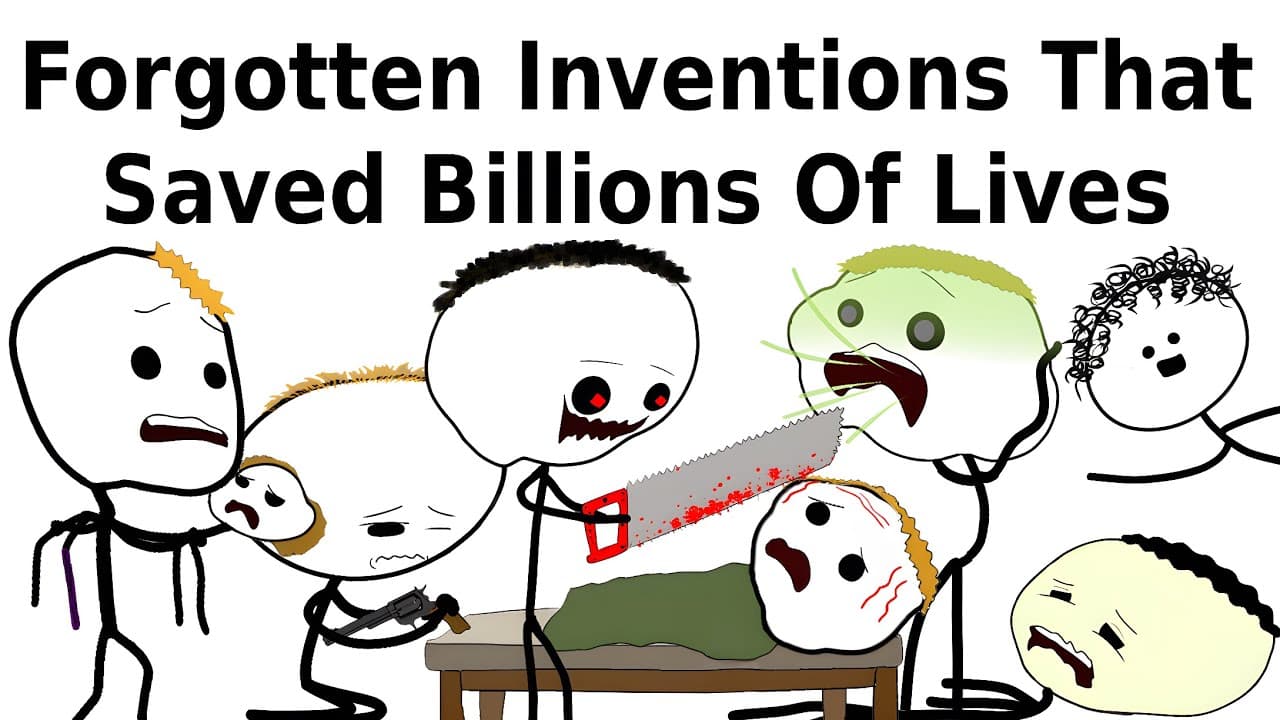
How Did Simple Inventions Save Billions of Lives?
TL;DR
Simple barriers, sterilization, clean water, rehydration, stronger materials, improved crops, efficient vaccination, and synthetic fertilizer prevented disease, hunger, infection, and infrastructure failures on an enormous scale. Their effectiveness came from practical mechanisms that could be deployed widely, including water seals, wire mesh, pressurized steam, salt and sugar solutions, chlorination, short wheat, bifurcated needles, and nitrogen fixation.
Transcript
Let's get right into it. Number nine, the Sbend plumbing trap. The S-bend was invented because houses kept exploding in 1850s London. Before this invention, houses were connected directly to the sewer. All those sewer gases, including explosive methane, would float up through the pipes and fill homes. One lit match would turn your morning routine i... Read More
Key Insights
- The S-bend plumbing trap is a curved pipe that retains water, forming a seal between homes and sewer gases containing methane and hydrogen sulfide. Although Alexander created it in 1775, widespread adoption followed London's Great Stink of 1858, when the severe sewage odor forced Parliament to evacuate.
- Wire window screens are physical barriers that prevent disease-carrying mosquitoes from entering homes. After cities began requiring screens, deaths from mosquito-borne diseases reportedly fell by 50% in some areas within a few years, even though early critics believed screens blocked healthy night air.
- The Bessemer process is a steelmaking method that blows air through molten iron so oxygen combines with impurities and burns them away. The process reduced production time from hours to about 30 minutes, lowered steel costs, and enabled stronger bridges, buildings, and railway tracks.
- Oral rehydration therapy works because the gut absorbs water effectively when sugar and salt are supplied together in the correct amounts. During cholera outbreaks in refugee camps, this simple treatment reduced the death rate from 30% to 1% and has since saved over 50 million lives.
- The autoclave is a tightly sealed device that uses high heat, pressure, and steam to sterilize medical instruments. It replaced inadequate practices such as wiping tools with cloth, helped reduce fatal surgical infections, and became standard equipment in hospitals, dental settings, and tattoo studios.
- Green Revolution wheat is a short, sturdy variety developed by Norman Borlaug to resist falling, disease, and varying temperatures. It produced three times more grain than tall wheat and helped India move within years from seeking food assistance to exporting surplus food.
- The bifurcated needle is a fork-shaped vaccination tool that holds one drop of vaccine between two prongs. It used one-quarter of the vaccine required by older methods, needed no electricity, and helped expand vaccination enough for smallpox to be eradicated within 12 years of its use.
- Water chlorination is a disinfection method that sharply reduced exposure to bacteria in municipal drinking water. Dr. John Leal ordered Jersey City's supply chlorinated in 1908, faced a lawsuit for allegedly poisoning the public, and prevailed after typhoid mortality fell almost immediately.
- The Haber-Bosch process is a method for combining atmospheric nitrogen with hydrogen under extreme pressure and heat. Fritz Haber established the reaction, Carl Bosch made it workable without repeated explosions, and the resulting fertilizer production now supports food for about 4 billion people.
Install to Summarize YouTube Videos and Get Transcripts
Explore YouTube Video Summarizer or Get YouTube Transcript Extractor
Questions & Answers
Q: How does an S-bend plumbing trap protect a home?
An S-bend protects a home by holding water inside a curved section of pipe. That retained water creates a seal between living spaces and the sewer, preventing methane and hydrogen sulfide from rising through drains. Methane could contribute to household explosions, while hydrogen sulfide could kill people within minutes. The trap therefore addressed both fire risk and toxic-gas exposure.
Q: Why did wire window screens reduce mosquito-borne deaths?
Wire screens reduced deaths by creating a physical barrier between people indoors and mosquitoes carrying diseases such as malaria and yellow fever. Some residents initially opposed screens because they believed the mesh would block healthy night air, although mosquitoes were present in that air. After some cities required screens, mosquito-borne disease deaths fell by 50% in certain areas within only a few years.
Q: How did the Bessemer process make steel faster and cheaper?
The Bessemer process replaced slow manual impurity removal with air blown through molten iron. Oxygen in the air combined with unwanted material and burned it away during a violent reaction. This shortened steel production from hours to about 30 minutes and reduced its cost from the price of a small house per ton to roughly the price of a fancy dinner.
Q: How does oral rehydration therapy treat severe cholera dehydration?
Oral rehydration therapy combines water with salt and sugar in the correct amounts. When the gut encounters sugar and salt together, it begins absorbing water efficiently instead of allowing it to pass through the body. This made treatment practical in places without hospitals or intravenous equipment. In refugee camps, it reduced cholera mortality from 30% to 1% and has saved over 50 million lives.
Q: Why is an autoclave more effective than wiping or boiling medical tools?
An autoclave sterilizes instruments with steam under high heat and pressure, producing conditions that destroy extremely resistant contaminants. Earlier surgeons sometimes wiped tools with cloth or reused bloody knives, leaving patients exposed to fatal infections. The transcript states that even boiling cannot eliminate the toughest prions, while autoclaves can. Hospitals, dentists, and tattoo artists now use the device for sterilization.
Q: How did short wheat help prevent famine in India?
Norman Borlaug developed wheat that was shorter and sturdier than traditional tall, top-heavy plants, which could fall in wind and rot. His variety resisted diseases, grew in both hot and cold conditions, and produced three times more grain. When India faced a major famine, the new wheat helped it move within years from requesting food from other countries to exporting surplus production.
Q: How did the bifurcated needle help eradicate smallpox?
The bifurcated needle held exactly one drop of smallpox vaccine between two fork-like prongs and delivered it through 15 quick jabs. It required only one-quarter of the vaccine used by previous methods, allowing the same supply to vaccinate four times as many people. It also needed no electricity or special storage. Within 12 years of its use, smallpox was eradicated.
Q: Why was chlorination added to municipal drinking water?
Chlorination was added to kill bacteria in drinking water, including Salmonella typhi, which causes typhoid fever. In 1908, Dr. John Leal ordered Jersey City's water supply chlorinated and was sued for allegedly poisoning the public. Typhoid deaths dropped almost immediately, supporting his defense in court and helping establish water disinfection as a major public health practice worldwide.
Q: How does the Haber-Bosch process support global food production?
The Haber-Bosch process makes atmospheric nitrogen usable for agriculture by forcing nitrogen and hydrogen together under extreme heat and pressure. Fritz Haber discovered how to carry out the reaction, although it repeatedly damaged his equipment. Carl Bosch then made the process workable without constant explosions. It replaced dependence on scarce guano as a nitrogen source and now feeds about 4 billion people.
Summary & Key Takeaways
-
Several overlooked inventions protected people by creating physical or chemical barriers against danger. S-bend plumbing traps blocked deadly sewer gases, wire screens reduced contact with disease-carrying mosquitoes, autoclaves sterilized medical equipment with pressurized steam, and chlorination sharply reduced waterborne typhoid deaths after its controversial introduction in Jersey City.
-
Other innovations made essential resources safer, cheaper, or easier to distribute. The Bessemer process removed impurities from molten iron with air, cutting steel production from hours to about 30 minutes. Oral rehydration therapy used water, salt, and sugar to reduce cholera mortality in refugee camps from 30% to 1%.
-
Agricultural and vaccination tools achieved wide impact through efficiency and simplicity. Norman Borlaug's short, resilient wheat produced three times more grain and helped India overcome an approaching famine. The bifurcated needle stretched vaccine supplies during smallpox eradication, while the Haber-Bosch process created fertilizer nitrogen that now feeds about 4 billion people.
Read in Other Languages (beta)
Share This Summary 📚
Summarize YouTube Videos and Get Video Transcripts with 1-Click
Try YouTube Summary with ChatGPT & Claude or YouTube Transcript Generator
Explore More Summaries from Chill Dude Explains 📚





Summarize YouTube Videos and Get Video Transcripts with 1-Click
Try YouTube Summary with ChatGPT & Claude or YouTube Transcript Generator