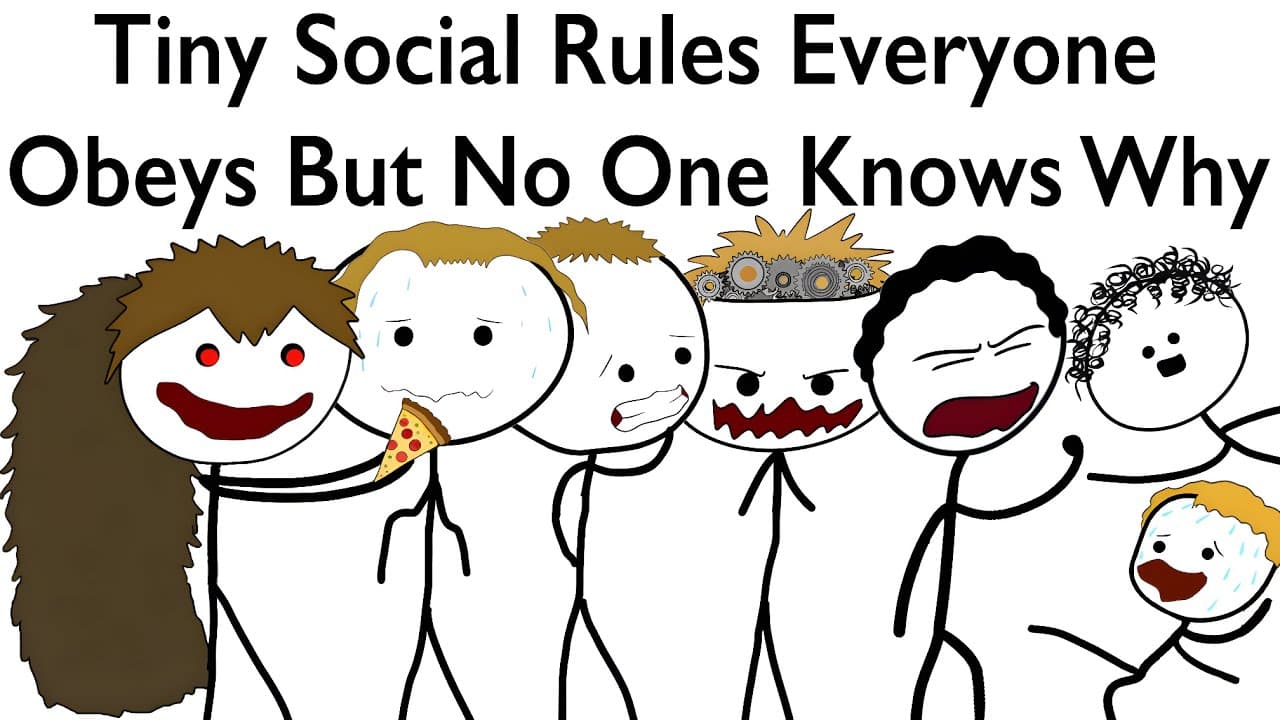
How do everyday social rules work and why we follow them?
TL;DR
The video explains that common rules guide our behavior in public spaces. We follow these patterns because our brains simulate social routines learned over time, reducing conflict and awkwardness. By recognizing the nine micro rules, we can navigate daily interactions with less mental effort and more predictability.
Transcript
Let's get right into it. Number nine, the elevator stare. You step into an elevator with strangers and suddenly everyone acts like the floor numbers are the most fascinating thing they've ever seen. Eyes go up, down, anywhere but at each other. An invisible force makes us all stare at anything except each other. We're running the same ancient softw... Read More
Key Insights
- The elevator stare is a universal avoidance of eye contact in confined spaces.
- The sidewalk shuffle results from mirror neurons and a delayed, mutual attempt to avoid collisions.
- The door holding calculus uses a built in distance and speed calculation to decide who should hold the door.
- The after you vortex is a polite stalemate that often requires body language to resolve.
- Public phone call muffling reflects caveman era privacy strategies still active today.
- The you too trap shows how fixed phrases become automatic responses in social exchanges.
- The last slice standoff reveals caveman origins of resource sharing and social perception.
- The library voice instinct demonstrates how environmental cues trigger behavioral settings even when empty.
- More videos from this channel:
- More from this channel: Chill Dude Explains
Install to Summarize YouTube Videos and Get Transcripts
Explore YouTube Video Summarizer or Get YouTube Transcript Extractor
Questions & Answers
Q: What is the elevator stare and why do people avoid eye contact there?
The elevator stare is the observed behavior where people in a confined elevator avoid looking at each other and instead fixate on elevator buttons or the ceiling. This happens because our brains are wired to minimize potential conflict and display nonverbal signals of peace. Ancient survival instincts favor non confrontational postures in close quarters, and this has persisted into modern elevator etiquette.
Q: Why do people mirror each other on sidewalks and how does it affect interaction?
People mirror each other on sidewalks due to mirror neurons trying to copy movements to avoid collisions. The drift into a left or right shuffle is a dynamic, delayed cooperative response that prevents direct contact. Overthinking can disrupt the flow, leading to awkward pauses, but the fundamental mechanism is a natural attempt to synchronize movements with a neighbor.
Q: What determines when we hold a door for someone behind us?
Door holding is guided by a built in rule described as distance divided by walking speed minus an awkwardness factor. If someone is close behind, you hold; if far away, you let it close. This internal calculation helps manage social friction and keeps door passage smooth in crowded spaces.
Q: What happens during the after you vortex and why does it occur?
During the after you vortex, two people simultaneously reach a mutual politeness where one says after you and the other disagrees, creating a repetitive loop. It occurs because social status and courtesy norms clash, leading to a choreographed standoff. The resolution usually comes from simple body language cues or one person proceeding through the doorway.
Q: Why do people whisper during public phone calls and is it effective?
People whisper on public calls due to an innate sense that overheard information is disruptive. Although the volume remains the same, whispering makes it harder for the other person to hear and can be frustrating. This behavior likely stems from an instinct to minimize drawing attention to private information, even if volumes are appropriate for the setting.
Q: What causes the you too trap and how do service workers perceive it?
The you too trap happens when people mirror standard phrases like enjoy your meal, mistakenly applying them to workers who are not diners. This automatic response arises from habitual politeness, not contextual awareness. Servers track the frequency of these misfires and sometimes use it as a humorous gauge of social reflexes.
Q: Why is there a last slice standoff in pizza sharing and what does it reveal?
The last slice standoff shows a social reluctance to claim the final piece, rooted in caveman era concerns about being perceived as greedy. People enact a ritual of polite refusal as a social buffer, which can lead to multiple smaller standoffs if the slice is divided rather than claimed.
Q: What triggers the library voice instinct and what does it imply about environmental cues?
The library voice instinct is triggered by environmental cues such as high ceilings and rows of books signaling quiet behavior. Even in empty libraries, the instinct makes people whisper, illustrating how environmental cues shape behavior through behavioral setting theory. This suggests our surroundings can override conscious decisions about noise levels.
Q: What is the waiting before eating commandment and its social purpose?
The waiting before eating commandment describes the tendency to delay eating until everyone at the table is served. This rule reduces social tension, prevents appearance of selfishness, and preserves harmony in group dining. It reflects a cultural norm that values collective pacing over individual gratification.
Summary & Key Takeaways
-
In this video, the nine social rules are presented as unspoken codes that shape our behavior in elevators, on sidewalks, and at doors, showing how subtle cues govern everyday interactions. The rules range from eye contact avoidance to the ritual of letting others pass, highlighting a deep, shared social intelligence.
-
The content explains that mirror neurons and caveman-era behaviors influence current habit patterns, like the elevator eye gaze and the door holding calculus. It connects modern etiquette to ancient survival strategies, illustrating how instincts persist in contemporary contexts.
-
A lighthearted, observational tone is used to explore why common courtesy feels automatic yet puzzling, suggesting that awareness of these patterns can reduce social anxiety and improve communication in crowded, public environments.
Read in Other Languages (beta)
Share This Summary 📚
Summarize YouTube Videos and Get Video Transcripts with 1-Click
Try YouTube Summary with ChatGPT & Claude or YouTube Transcript Generator
Explore More Summaries from Chill Dude Explains 📚


Summarize YouTube Videos and Get Video Transcripts with 1-Click
Try YouTube Summary with ChatGPT & Claude or YouTube Transcript Generator