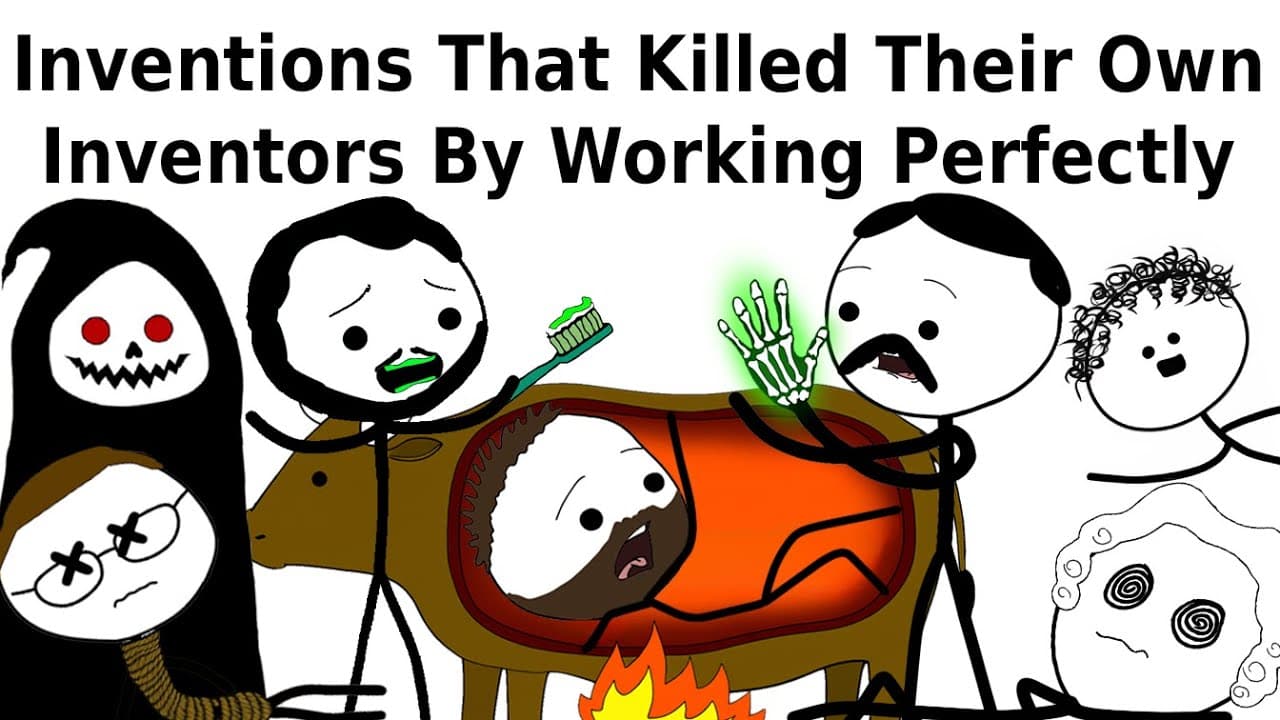
How did inventions kill their inventors when they worked
TL;DR
The direct answer is that several inventions killed their creators because the devices performed exactly as planned, amplifying risk rather than reducing it. The video details cases from ancient times to early 20th century where perfection led to fatal outcomes, including execution devices, life-supporting rigs, and dangerous prototypes that backfired.
Transcript
Let's get right into it. Number 10, the brazen bull. Imagine being so good at your job that it literally kills you. That's what happened to Pillos of Athens. Probably the unluckiest inventor in history. Back in 560 BC, Pillos had what he thought was a brilliant idea for a new execution device. He designed this massive hollow bull made of bronze. Bu... Read More
Key Insights
- The Brazen Bull worked perfectly, as designed, leading to the inventor’s death and continued use by rulers.
- The assistance harness for Thomas Midgley Jr. operated flawlessly but caused his own death through entanglement.
- Sylvester H. Roer’s steam velocipede achieved its speed but killed him in a crash, showing a success with fatal consequences.
- Georg Richmann’s fatal spark demonstrated that a device functioning as intended can still be deadly to the designer.
- The radium glow paint Undark performed exactly as promised yet poisoned its inventor with radiation.
- The Duesenberg car delivered incredible power and speed, ending in the creator’s fatal accident, despite its perfection.
- Franz Reichelt’s parachute suit deployed correctly but lacked enough altitude to save him, illustrating test failure under perfect mechanism conditions.
- Otto Lilienthal’s gliders worked well until wind and physics overwhelmed his body, proving perfection is not protection against nature.
- More videos from this channel:
- More from this channel: Chill Dude Explains
Install to Summarize YouTube Videos and Get Transcripts
Explore YouTube Video Summarizer or Get YouTube Transcript Extractor
Questions & Answers
Q: How did the Brazen Bull exemplify a perfect invention turning deadly
The Brazen Bull was designed to enclose a person and convert screams into sounds of an angry bull, achieving its intended effect exactly as planned. Pillos demonstrated it on others, and the ruler Faris used it repeatedly until his successor faced the same fate. This shows how a flawless mechanism can guarantee fatal outcomes for its creator and users alike.
Q: What happened with Thomas Midgley Jr.’s assistance harness
Midgley’s invention aimed to help him move after polio, functioning as a precise rope and pulley system to lift him from bed. However, the system failed to protect him from entanglement, and he was found strangled by his own invention, illustrating a perfect solution that became a deadly trap.
Q: Why did Sylvester H. Roer’s steam velocipede kill him
Roer built a fast steam powered bicycle and rode it at high speed, which performed as intended by reaching about 40 mph. A crash followed due to the machine’s instability, and Roer died as a result. The device’s success in speed became the cause of the inventor’s death.
Q: What makes Georg Richmann’s fatal spark notable
Richmann created a large lightning conductor designed to attract and measure lightning, and the device worked as planned by drawing a blue ball of lightning down the wire. The incident killed him, proving that a functioning instrument can directly cause the inventor’s death when probing dangerous phenomena.
Q: How did Saban Arnold von Sukaki’s glow paint cause his demise
The Undark paint glowed exactly as designed because it used radium, and Sukaki knew the dangers yet worked with it. The radiation slowly poisoned him, causing his bones to crumble. He died after acknowledging his invention was killing him, making a perfect glow into a fatal fate.
Q: Why did the Duesenberg car lead to its creator’s death
The car’s power and performance were achieved through meticulous design, delivering extreme speed. On a wet road, the car flipped and killed Fred Duesenberg. The invention’s perfection in power had a fatal consequence for the inventor, despite its acclaim.
Q: What happened with Franz Reichelt’s parachute suit test
Reyhilt tested a parachute coat that deployed correctly, but the jump’s altitude and timing were insufficient to catch air, causing a fatal impact. The mechanism worked perfectly, yet external conditions caused a fatal result, showing how test success does not guarantee safety.
Q: How did Otto Lilienthal’s gliders demonstrate perfect engineering with tragic results
Lilienthal’s gliders worked as designed, allowing him to fly and achieve numerous successes. A sudden gust caused the craft to fail, and Lilienthal died from the crash. The invention’s perfection in flight was overshadowed by physics and environmental factors, making the death a consequence of successful design.
Summary & Key Takeaways
-
In ancient Greece, the Brazen Bull killed its designer and later rulers who used it, showing how a perfect mechanism can become a fatal trap. The device worked as intended, turning victims’ screams into bull noises, but it sealed the inventor’s fate and served brutal purposes.
-
Several cases illustrate how well-engineered systems can surpass human safeguards, such as the intricate rope system that killed its user while helping him move, and a parachute coat that failed to open in time, despite correct design. Perfection here meant fatal misalignment with reality.
-
Aviation and propulsion pioneers faced deadly outcomes when their flight devices performed exactly as designed under dangerous conditions, from gliders that responded perfectly to gusts to steam powered machines pushing speeds that their bodies could not endure. These stories underline the limits of human safety when technology achieves its ideal form.
Read in Other Languages (beta)
Share This Summary 📚
Summarize YouTube Videos and Get Video Transcripts with 1-Click
Try YouTube Summary with ChatGPT & Claude or YouTube Transcript Generator
Explore More Summaries from Chill Dude Explains 📚






Summarize YouTube Videos and Get Video Transcripts with 1-Click
Try YouTube Summary with ChatGPT & Claude or YouTube Transcript Generator