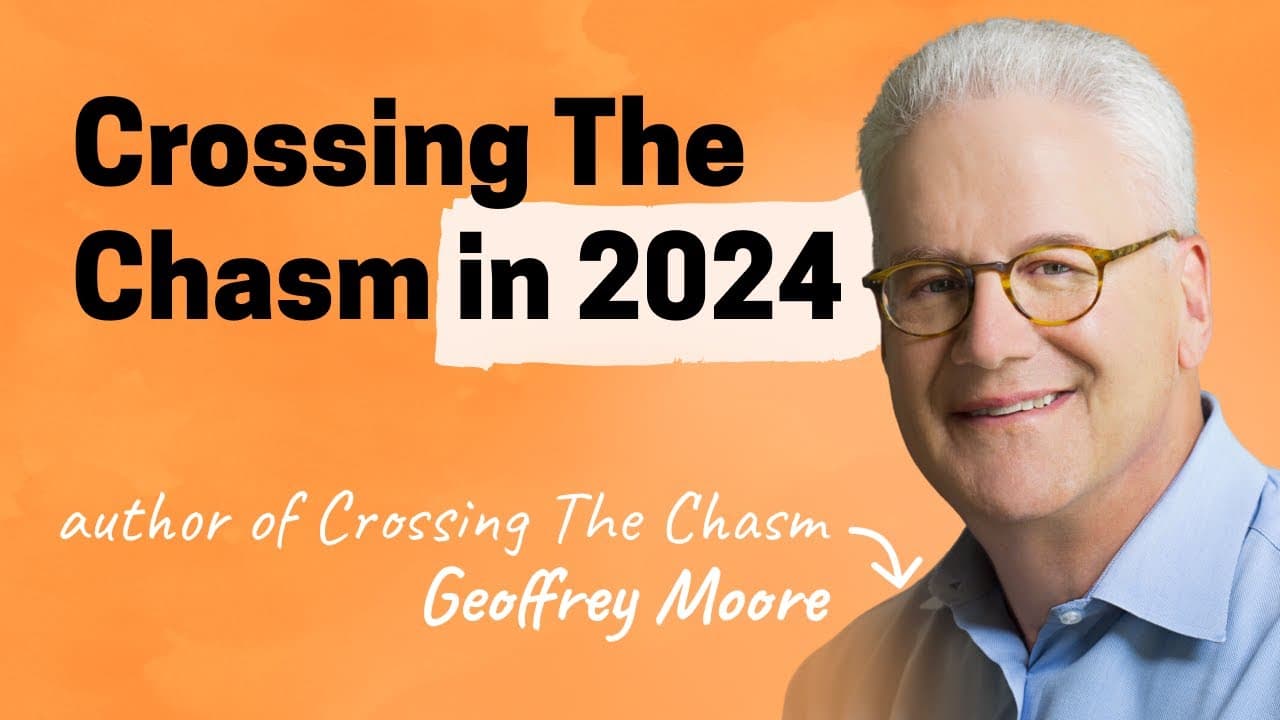
Geoffrey Moore on How to Cross the Chasm in B2B
TL;DR
To cross the chasm, pick one narrow beachhead segment you could win 30-50% market share in within two years, because ecosystems and partners only organize around a market leader. Pragmatists buy what their peers buy, so you need three or four reputable companies in a segment to all pick you before the rest follow.
Transcript
The tendency when you're in the chasm is, "I just need more customers. I should take any customer I could find," because we need revenue. It's like taking a match and running it back and forth under a log. It's not going to light the log. So how do you start a fire? Well, you start it by putting a little kindling, little crumpled up paper, and you ... Read More
Key Insights
- Crossing the Chasm is about creating a viable, repeatable business, not just landing customers. Geoffrey Moore says taking any customer you can find for revenue is like running a match under a log: it never lights the fire, so focus is essential.
- Company power in an early market comes from company power plus ecosystem together. Ecosystems only form around market leaders and never around the rest, so a startup must become the biggest fish in a small, targeted pond first.
- The right first beachhead is a segment where, at high growth rates, you could hold 30, 40, or 50% market share within two years. That fish-to-pond ratio forces partners to conclude they must work with you to serve that segment.
- Pragmatic customers buy what they see their peers buying. If different peers each buy a different product with no clear leader, the category goes sideways, so you need three or four reputable companies in one segment to all choose you.
- Chasing multiple segments at once fails like running in several primaries at once: votes in Vermont do not count in New Hampshire. Spreading across segments prevents you from consolidating leadership in any single one.
- Lighthouse or marquee customers create a story before you cross the chasm. Landing a name like the CIA using AWS does not by itself make a company, but it puts you on the map and gives people a reference point.
- Visionaries before the chasm buy because 'we believe what you believe,' sharing your vision of the future. Pragmatists after the chasm instead say 'we need what you have,' so the sales pitch must shift between these two mindsets.
- Frameworks in Moore's books are conceptual models for spotting patterns as a category evolves. Because disruptive innovation has no history, you project a possible future and try to make it come true, which invites people to misapply the model.
Install to Summarize YouTube Videos and Get Transcripts
Explore YouTube Video Summarizer or Get YouTube Transcript Extractor
Questions & Answers
Q: What does crossing the chasm mean in go-to-market strategy?
Crossing the chasm, per Geoffrey Moore, is the challenge of transitioning from serving early adopters to reaching mainstream customers. The Crossing the Chasm model asks whether you can create a viable, repeatable business, which requires an ecosystem of partners to consolidate your position. Moore describes it as the gap between visionaries who buy the vision and pragmatists who wait for social proof before adopting a disruptive product.
Q: Why should startups focus on one narrow beachhead segment first?
Moore explains that in an emerging category you need enough power to navigate your future on your own, and that power comes from company power plus an ecosystem. Ecosystems only form around market leaders, so a startup must become the biggest fish in a small pond. Chasing several segments at once is like running in multiple primaries simultaneously: votes in one do not count in another, so you never consolidate leadership anywhere.
Q: How do you choose the right target market segment?
Moore recommends targeting a segment where, at high growth rates, you could capture 30, 40, or 50% market share within the next two years. He calls this the fish-to-pond ratio: your first pond should be small enough to dominate quickly. That dominance makes partners conclude that to serve the segment they must work with you, which is how an ecosystem organizes around a small company rather than around a large incumbent.
Q: Why do pragmatist customers wait before adopting new products?
Moore says pragmatic people buy what they see their peers buying. If one peer buys product A and others buy B, C, and D with no clear leader, the category goes sideways and no one commits. But when three of four peers use the same product, like the iPhone, others conclude they are supposed to get it too. Pragmatists wait for references and social proof before deciding a product is worth using.
Q: What is the difference between selling to visionaries and pragmatists?
Before the chasm, visionaries buy because 'we believe what you believe,' sharing your vision of the future and wanting to use it before anyone else. After the chasm, pragmatists say 'I'm not sure about that, but we need what you have.' Moore frames the shift as moving from selling a shared belief to solving a concrete need, and using the wrong approach for the wrong audience slows you down.
Q: Why is landing a lighthouse or marquee customer important?
Moore says that even before crossing the chasm you should try to win one or more lighthouse customers who put you on the map. He gives the example of the CIA using AWS: people react with surprise and start referring to you as the company that did that project. A marquee customer does not by itself make a company, but it creates a story and a reference point that raises your credibility.
Q: What mistake do founders make when they need revenue in the chasm?
Moore warns that the tendency in the chasm is to think you just need more customers and should take any customer you can find because you need revenue. He compares this to running a match back and forth under a log, which never lights it. Instead you start a fire with concentrated kindling and crumpled paper, holding the match in one place. This is why adjacency and focus matter more than chasing scattered deals.
Q: What role do ecosystems and partners play in crossing the chasm?
Moore stresses that a viable, repeatable business needs an ecosystem of partners working with you to consolidate your position. Ecosystems form around market leaders and not around everyone else, which is why category leaders like Oracle in databases stay dominant for decades. A small company earns an ecosystem only by winning a segment where it is number one, prompting partners to decide they must align with you to serve that market.
Summary & Key Takeaways
-
Geoffrey Moore, author of Crossing the Chasm, argues the biggest mistake founders make is chasing revenue by taking any customer they can find. He compares it to running a match under a log: without concentrated kindling in one place, the fire never starts, so extreme focus on one beachhead is essential.
-
Power in an emerging category comes from combining company power with an ecosystem, and ecosystems only form around market leaders. A startup wins by dominating a narrow segment where it could reach 30-50% share within two years, making partners feel they must work with it to serve that segment.
-
Pragmatists buy what their peers buy, so founders need several reputable companies in one segment to all choose them before the rest follow. The sale shifts from visionaries who 'believe what you believe' to pragmatists who say 'we need what you have,' requiring a different pitch after the chasm.
Read in Other Languages (beta)
Share This Summary 📚
Summarize YouTube Videos and Get Video Transcripts with 1-Click
Try YouTube Summary with ChatGPT & Claude or YouTube Transcript Generator
Explore More Summaries from Lenny's Podcast 📚


Summarize YouTube Videos and Get Video Transcripts with 1-Click
Try YouTube Summary with ChatGPT & Claude or YouTube Transcript Generator