How to Use Arithmetic Operators in Python REPL
TL;DR
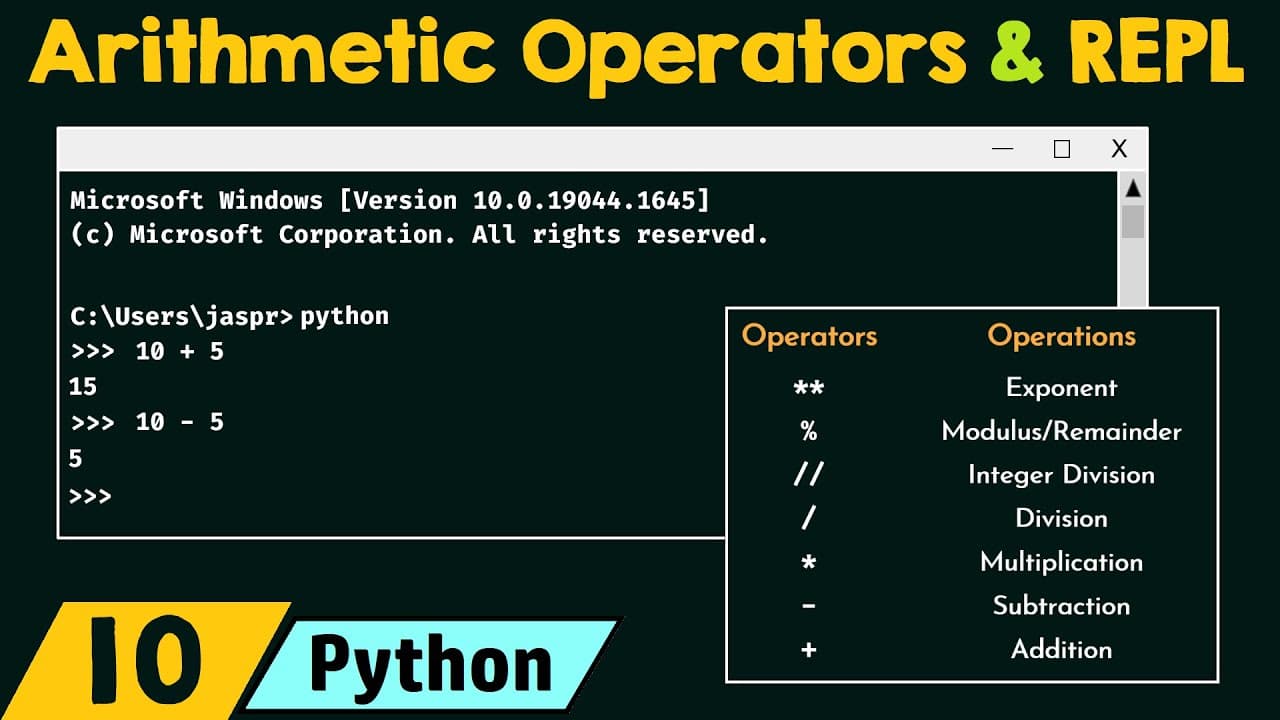
Python's interactive shell, REPL, allows users to perform arithmetic operations by reading, evaluating, and printing commands in a loop. Users can execute various arithmetic tasks like addition, subtraction, multiplication, and division using Python's operators. It also explains operator precedence, which determines the order of operations in complex expressions.
Transcript
foreign we will try to understand arithmetic operators through Ripple that is read evaluate print Loop so without any further delay let's get started in this presentation we will try to understand the following topics the first topic is understanding grapple the second topic is using repel as a calculator the third topic is arithmetic operators in ... Read More
Key Insights
- REPL stands for Read Evaluate Print Loop, a core feature of Python's interactive shell.
- Python interactive shell allows users to enter commands, which are then processed and the results displayed.
- REPL can be used as a calculator to perform basic arithmetic operations such as addition, subtraction, multiplication, and division.
- Python provides several arithmetic operators: exponent, modulus, floor division, division, multiplication, subtraction, and addition.
- Operator precedence in Python dictates the order in which operations are performed in expressions.
- The exponent operator has the highest precedence, while addition and subtraction have the lowest.
- Operators with the same precedence level, like multiplication and division, can be executed in any order.
- Understanding REPL and operator precedence is crucial for effectively performing calculations in Python.
Install to Summarize YouTube Videos and Get Transcripts
Explore YouTube Video Summarizer or Get YouTube Transcript Extractor
Questions & Answers
Q: How to use Python's REPL as a calculator?
To use Python's REPL as a calculator, open the command prompt, type 'python', and press enter to activate the interactive shell. You can then enter arithmetic expressions like '10 + 5' or '10 - 5', and REPL will evaluate and print the results. This process takes advantage of the read, evaluate, print loop functionality of REPL.
Q: What are the arithmetic operators available in Python?
Python provides several arithmetic operators: exponentiation (**), modulus (%), floor division (//), division (/), multiplication (*), subtraction (-), and addition (+). These operators allow users to perform various mathematical operations within Python's interactive shell or scripts, enabling complex calculations and data manipulation.
Q: What is operator precedence in Python?
Operator precedence in Python determines the order in which operations are performed in an expression. Operators like exponentiation have higher precedence and are executed before others like addition or subtraction. Understanding precedence is crucial for ensuring that complex expressions are evaluated correctly, avoiding unexpected results.
Q: Why is REPL called Read Evaluate Print Loop?
REPL is called Read Evaluate Print Loop because it continuously reads user input, evaluates the expression, prints the result, and then loops back to read the next input. This interactive cycle allows users to execute commands and see results in real-time, making it a powerful tool for learning and testing code snippets.
Q: How does Python handle operations with the same precedence?
In Python, when operations with the same precedence appear in an expression, they are evaluated from left to right. For example, in the expression '10 / 2 * 3', division and multiplication have the same precedence, so Python evaluates them sequentially from left to right, resulting in the value 15.
Q: What is the difference between floor division and regular division in Python?
Floor division (//) in Python returns the largest integer less than or equal to the division result, effectively discarding any fractional part. Regular division (/) returns a floating-point number that represents the exact division result. For instance, '7 // 2' results in 3, while '7 / 2' results in 3.5.
Q: How does REPL enhance learning Python?
REPL enhances learning Python by providing an interactive environment where users can experiment with code snippets, immediately see results, and understand concepts like arithmetic operations and operator precedence. This immediate feedback loop helps learners test hypotheses, debug code, and reinforce their understanding of Python syntax and behavior.
Q: What is the significance of understanding operator precedence?
Understanding operator precedence is crucial for writing correct and efficient code in Python. It helps programmers predict how expressions will be evaluated, ensuring that operations are performed in the intended order. This knowledge prevents logical errors and unexpected outcomes, particularly in complex calculations involving multiple operators.
Summary & Key Takeaways
-
REPL is a Python interactive shell that reads, evaluates, and prints commands in a loop, enabling users to perform various tasks. It acts as a calculator for performing arithmetic operations.
-
Python offers arithmetic operators like addition, subtraction, multiplication, division, modulus, and exponentiation. Operator precedence governs the order of operations in expressions.
-
The video explains how to use REPL for arithmetic tasks, emphasizing the importance of understanding operator precedence to correctly execute complex expressions.
Read in Other Languages (beta)
Share This Summary 📚
Summarize YouTube Videos and Get Video Transcripts with 1-Click
Try YouTube Summary with ChatGPT & Claude or YouTube Transcript Generator
Explore More Summaries from Neso Academy 📚
Summarize YouTube Videos and Get Video Transcripts with 1-Click
Try YouTube Summary with ChatGPT & Claude or YouTube Transcript Generator