How to Make Long AI Context Windows Work
TL;DR
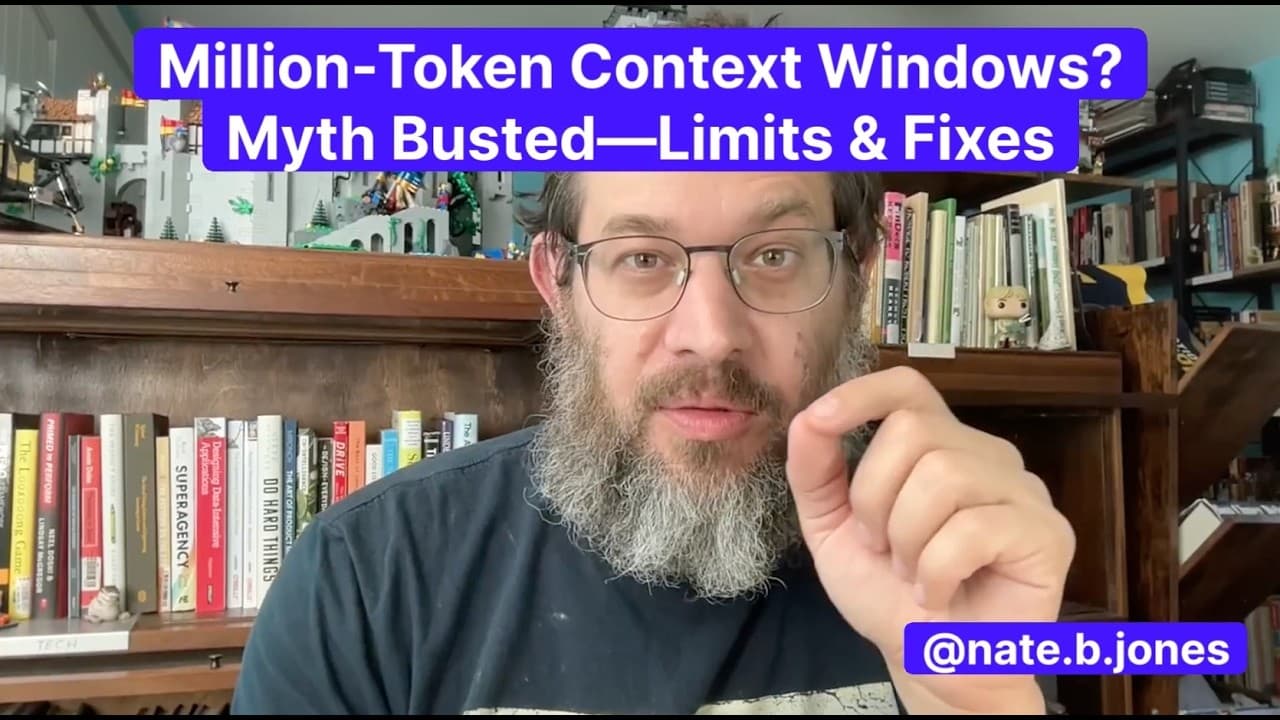
Large advertised context windows do not guarantee reliable understanding across every token, especially in the middle of long documents. Better results come from retrieval-augmented generation, summary chains, strategic chunking, context budgeting, and placing critical information near prompt edges, where attention can be at least three times greater.
Transcript
Every single AI company is not telling the truth about what its context window really does. And this video talks about context windows memory and what that means for AGI, artificial general intelligence. First, let's dive into the claims that are being made. These are big claims. Million token context windows. There's talk of 2 million, 5 million, ... Read More
Key Insights
- Advertised context size is not the same as effective comprehension. A model may technically accept a million tokens while delivering dependable performance over a much smaller portion, with the transcript citing roughly 128,000 tokens as a practical estimate for solid Gemini performance.
- Transformers receive long material as a sequence of tokens rather than as an explicitly understood document or codebase structure. Relationships spanning large sections can therefore disappear, especially when successful reasoning requires the model to connect several distant pieces of information.
- Needle-in-a-haystack scores measure retrieval under controlled conditions. Finding one planted fact in a large block of text does not demonstrate that a model can synthesize several specific facts, follow complex structure, or perform the higher-level reasoning required for document analysis.
- Long-context attention often follows a U-shaped pattern. Models tend to notice material near the beginning and end more reliably than material in the middle, and the described research indicates that attention can be at least three times greater at prompt edges.
- Retrieval-augmented generation works by fetching semantically relevant material from an external index instead of placing the entire source inside the active prompt. It is especially suitable for reference collections such as a wiki or an HR manual.
- Summary chains reduce cost and improve coverage by splitting a long report into sections, summarizing each section, and combining the resulting summaries. This approach prevents important material from being buried in the middle of one extremely large prompt.
- Strategic chunking filters a source through focused examination. Each small chunk is asked whether it contains information about a specific topic, and only positive chunks advance, using fewer tokens while forcing close attention to manageable sections.
- Context budgeting treats tokens as a limited resource, while position hacking uses their location deliberately. Reserve space for instructions, conversation history, retrieved documents, and working memory, then place critical instructions first, key facts last, and checkpoints throughout extended interactions.
Install to Summarize YouTube Videos and Get Transcripts
Explore YouTube Video Summarizer or Get YouTube Transcript Extractor
Questions & Answers
Q: Why do million-token context windows underperform?
A million-token capacity describes how much text a model can accept, not how reliably it understands every part. Transformers process the material as a token sequence, so large document structures and relationships can be lost. Performance also follows a U-shaped pattern in which the beginning and end receive more attention than the middle, making complete synthesis unreliable.
Q: What is the difference between context size and effective context?
Context size is the advertised maximum number of tokens that can be placed into a model request. Effective context is the smaller amount the model can use with solid, consistent performance. The transcript cites a running estimate of about 128,000 reliable tokens for a model advertised with a million-token window, while results become more questionable at greater lengths.
Q: Why are needle-in-a-haystack tests insufficient?
Needle-in-a-haystack tests place one isolated fact inside a large text block and ask the model to retrieve it. High scores show that a model can locate that fact under controlled conditions. They do not show whether it can connect multiple details, preserve a document's broader structure, or synthesize evidence across distant sections for higher-level reasoning.
Q: How does retrieval-augmented generation help with long documents?
Retrieval-augmented generation stores material outside the immediate context and uses a semantic index to fetch relevant passages when a prompt requires them. This keeps the active context smaller and more focused. It works particularly well for reference collections, including a wiki or HR manual, where users usually need specific information rather than complete analysis of every section.
Q: How do summary chains improve financial report analysis?
Summary chains split a long report into sections, summarize every section separately, and then combine those summaries. For a 200-page financial report, this ensures that each portion receives focused attention instead of leaving middle sections vulnerable to neglect. The method also uses fewer tokens than repeatedly processing the entire report and can produce higher accuracy.
Q: What is strategic chunking for AI document analysis?
Strategic chunking divides a large document into small sections and asks the model whether each section contains information about a defined topic. Only chunks with relevant information move forward for deeper analysis. Because each decision uses just a few thousand tokens, the model is pushed to inspect a manageable context closely while unnecessary material and token usage are removed.
Q: How should users budget an AI context window?
Context budgeting assigns limited token space to distinct purposes, such as system instructions, summarized conversation history, retrieved documents, and working memory. API users can control these allocations directly. Chat users have fewer controls, so they must monitor conversation length, reintroduce essential material when older documents disappear, and limit each request to the most relevant instructions and evidence.
Q: Where should critical information go in a long prompt?
Critical instructions should appear at the beginning, while key facts or the most relevant supporting material should appear near the end. Research described in the transcript indicates that attention is at least three times greater at prompt edges. During long conversations, checkpoints every few thousand tokens can also confirm that instructions remain active and the task is proceeding correctly.
Summary & Key Takeaways
-
Advertised context capacity differs from effective context performance. A model may accept hundreds of thousands or even a million tokens while failing to examine, connect, or synthesize all of them reliably. Reports about Gemini suggest solid performance around 128,000 tokens, with increasingly questionable results as the prompt approaches half a million tokens.
-
Long documents and codebases contain structures that transformers receive as token sequences. Needle-in-a-haystack tests can demonstrate retrieval of one planted fact, but they do not establish reliable synthesis across multiple facts. Models also show edge awareness, paying more attention to the beginning and end while overlooking information located in the middle.
-
Five practical techniques improve long-context work: retrieval-augmented generation, summary chains, strategic chunking, context budgeting, and position hacking. APIs can support all five approaches. Chat interfaces offer less control, but users can still split documents, filter relevant chunks, summarize sections separately, and deliberately position instructions and evidence.
Read in Other Languages (beta)
Share This Summary 📚
Summarize YouTube Videos and Get Video Transcripts with 1-Click
Try YouTube Summary with ChatGPT & Claude or YouTube Transcript Generator
Explore More Summaries from AI News & Strategy Daily | Nate B Jones 📚






Summarize YouTube Videos and Get Video Transcripts with 1-Click
Try YouTube Summary with ChatGPT & Claude or YouTube Transcript Generator