Continuous Probability Distributions - Basic Introduction
TL;DR
This video explains continuous probability distributions, such as the normal distribution, uniform distribution, and exponential distribution, and provides formulas to calculate probabilities and areas under the curves.
Transcript
in this video we're gonna talk about continuous probability distributions so here's an example of a type of continuous probability distribution this one is called the normal distribution now it has the continuous random variable X X could be anything it could be 2 it could be 3 point 5 it could be 4 point 6 8 it could be anything along the x axis n... Read More
Key Insights
- ☺️ Continuous probability distributions, like the normal distribution, allow for random variables that can take on any value along the x-axis.
- 👈 The probability density function (f(x)) gives the height of the curve above the x-axis at a specific point, indicating the relative likelihood of that value occurring.
- 🟰 The total area under the curve for any continuous probability distribution is always equal to 1.
- ❓ Calculating probabilities for continuous distributions involves finding the area under the curve between specific values, where the probability is represented by this area.
- ☺️ For a continuous distribution, the probability of X having a specific single value is always zero.
- 🟰 The probability that X is less than a specific value is the same as the probability that X is less than or equal to that value.
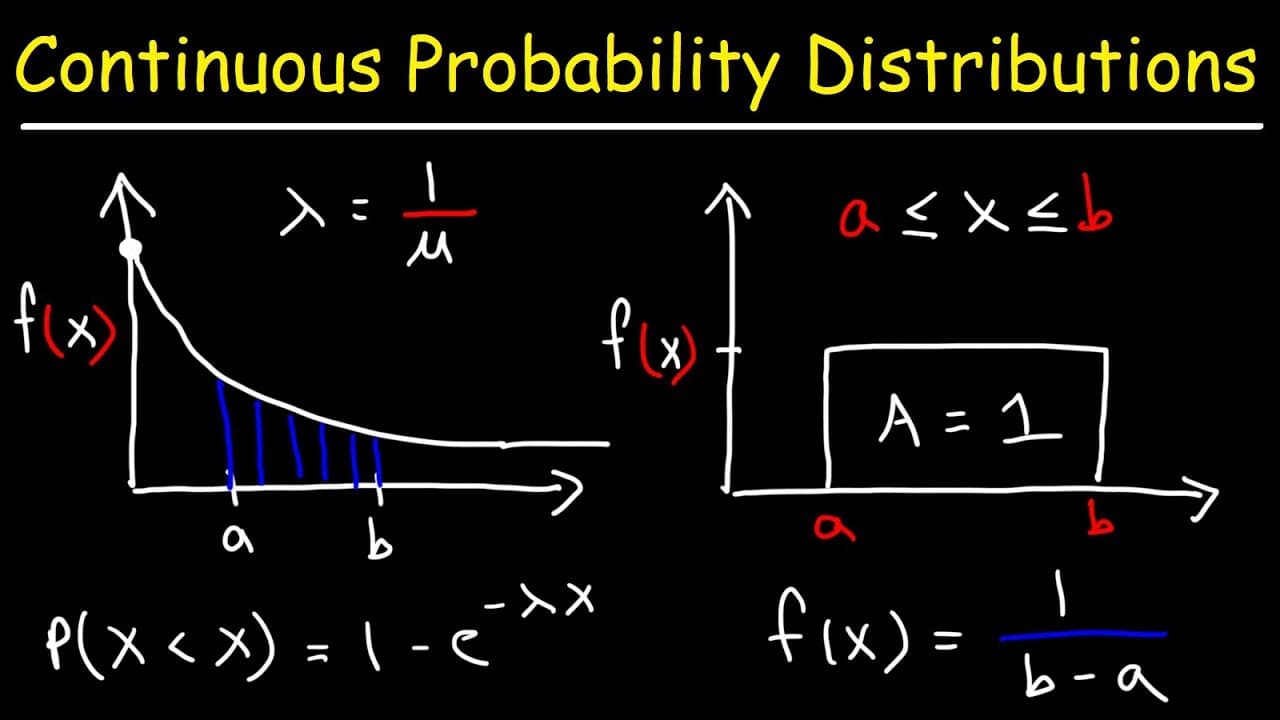
- 🥋 The uniform distribution is a type of continuous probability distribution with a constant probability density function and an area under the curve equal to 1.
- ⌛ The exponential distribution is another continuous probability distribution with a decreasing function that decreases over time or with increasing X, and its area under the curve is also equal to 1.
- 😃 Formulas for the uniform distribution include the probability density function (1/(B-a)), the mean ((a+B)/2), and the standard deviation ((B-a)/√12).
Install to Summarize YouTube Videos and Get Transcripts
Explore YouTube Video Summarizer or Get YouTube Transcript Extractor
Questions & Answers
Q: How do you calculate the probability that X is less than a certain value?
To calculate the probability that X is less than a, you need to find the area under the curve to the left of a. This can be done by integrating the probability density function (PDF) between negative infinity and a.
Q: What is the probability that X is equal to a specific value (e.g., B)?
For a continuous distribution, the probability of X having a single specific value is always zero. The area under a finite point (a line) is zero because there is no width, only height.
Q: Is the probability that X is less than a the same as the probability that X is less than or equal to a?
Yes, for a continuous probability distribution, the probability that X is less than a specific value is the same as the probability that X is less than or equal to that value. This is because the probability of X being exactly equal to a single value is zero.
Q: How can I calculate the probability that X is between two specific values (e.g., B and C)?
To calculate the probability that X is between B and C, find the area under the curve between B and C. This can be done by integrating the PDF between B and C.
Summary & Key Takeaways
-
Continuous probability distributions, like the normal distribution, have a random variable (X) that can take any value along the x-axis.
-
The probability density function (f(x)) gives the height of the curve above the x-axis at a specific point.
-
Calculating probabilities for continuous distributions involves determining the area under the curve between certain values. The total area under the curve is always equal to 1.
Read in Other Languages (beta)
Share This Summary 📚
Summarize YouTube Videos and Get Video Transcripts with 1-Click
Try YouTube Summary with ChatGPT & Claude or YouTube Transcript Generator
Explore More Summaries from The Organic Chemistry Tutor 📚
Summarize YouTube Videos and Get Video Transcripts with 1-Click
Try YouTube Summary with ChatGPT & Claude or YouTube Transcript Generator