Introduction to Logarithmic Differentiation
TL;DR
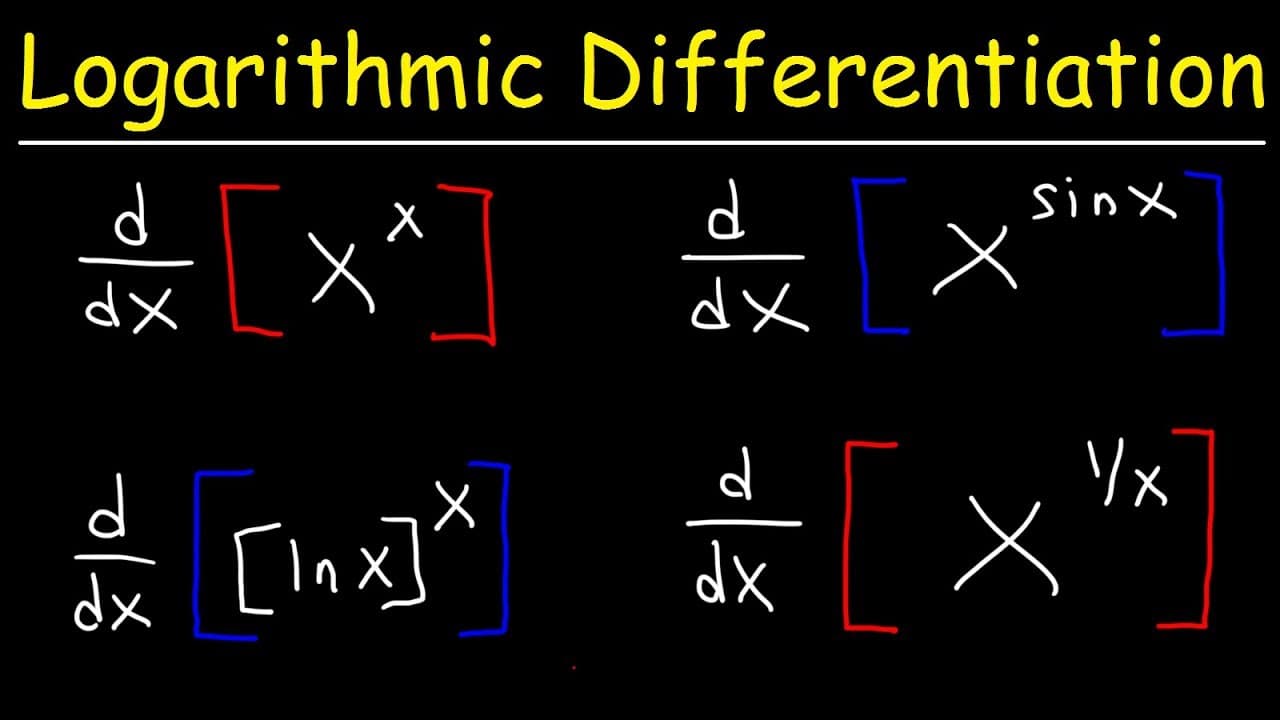
Logarithmic differentiation allows us to find the derivative of functions with variable exponents by taking natural logarithms, applying the product rule, and simplifying the expression.
Transcript
how can we differentiate a function that looks like this a variable raised to a variable what is the derivative of x raised to the x how can we find the answer well first we need to use a process called logarithmic differentiation let's set y equal to x to the x so we need to find d y d x now before you take the derivative of both sides of the equa... Read More
Key Insights
- ❓ Logarithmic differentiation is a useful technique for finding derivatives of functions with variable exponents.
- 🙃 Taking the natural log of both sides allows us to move the exponent to the front, simplifying the differentiation process.
- 😑 Applying the product rule is necessary when differentiating the logarithmic expression.
- ❓ The final step involves replacing the variable with the original function to obtain the derivative.
Install to Summarize YouTube Videos and Get Transcripts
Explore YouTube Video Summarizer or Get YouTube Transcript Extractor
Questions & Answers
Q: How do you use logarithmic differentiation to find the derivative of a function with a variable raised to another variable?
To find the derivative of a function with a variable exponent, set the function equal to a variable, take the natural log of both sides, move the exponent to the front, differentiate using the product rule, replace the variable with the original function, and simplify the expression.
Q: What is the derivative of x raised to the x using logarithmic differentiation?
By applying logarithmic differentiation to x raised to the x, the derivative is found to be x raised to the x times the natural log of x plus 1.
Q: How can logarithmic differentiation be used to find the derivative of x raised to the sine x?
To find the derivative of x raised to the sine x, set the function equal to a variable, take the natural log of both sides, differentiate using the product rule, replace the variable with the original function, and simplify the expression. The resulting derivative is x raised to the sine x times cosine ln x plus sine x divided by x.
Q: What is the derivative of ln x raised to the x using logarithmic differentiation?
To find the derivative of ln x raised to the x, set the function equal to a variable, take the natural log of both sides, differentiate using the product rule, replace the variable with the original function, and simplify the expression. The derivative is x raised to the power of ln x times cosine ln x plus sine x over x.
Summary & Key Takeaways
-
Logarithmic differentiation is a process used to find the derivative of functions with variable exponents.
-
To use logarithmic differentiation, set the given function equal to a variable, take the natural log of both sides, and move the exponent to the front.
-
Apply the product rule and simplify the expression by replacing the variable with the original function.
Read in Other Languages (beta)
Share This Summary 📚
Summarize YouTube Videos and Get Video Transcripts with 1-Click
Try YouTube Summary with ChatGPT & Claude or YouTube Transcript Generator
Explore More Summaries from The Organic Chemistry Tutor 📚



Summarize YouTube Videos and Get Video Transcripts with 1-Click
Try YouTube Summary with ChatGPT & Claude or YouTube Transcript Generator