How to Solve a Ballistic Pendulum Problem
TL;DR
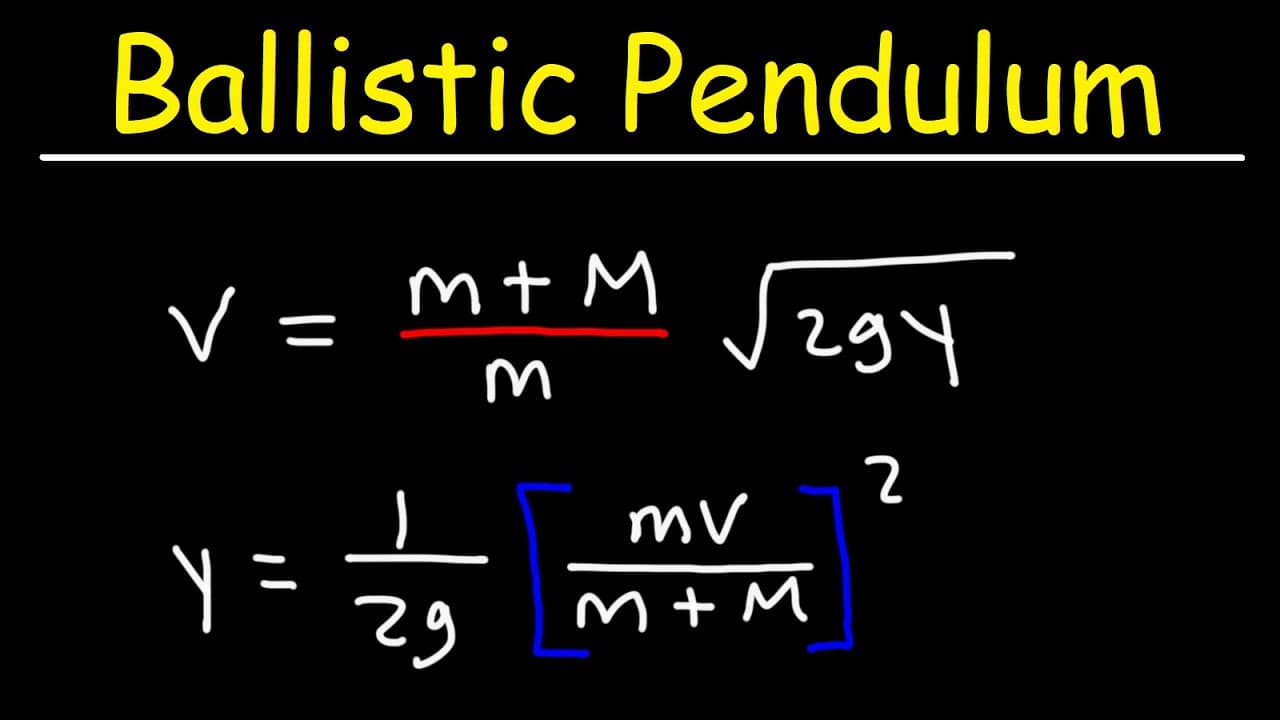
Use the bullet and block masses with the bullet’s initial speed to calculate the rise height, but only when the bullet becomes embedded in the block. The simplified formula combines the required relationships into one calculation, while its rearranged form finds the bullet’s initial speed when the rise height and both masses are known.
Transcript
in today's lesson I want to show you a simple formula that can help you solve this ballistic pendulum problem so we have a 70 G bullet moving East at 400 m/s and it strikes a 1.2 kg block on the right and becomes embedded in it now how high will the bullet block system Rises rise above its original point that is we need to calculate why for this sp... Read More
Key Insights
- A ballistic pendulum consists of a projectile that strikes a block, becomes embedded, and causes the combined system to rise. The simplified formulas presented apply specifically to this embedded-projectile situation and are not intended for a bullet that passes completely through the block.
- The rise height is calculated with the expression 1/2G times the square of the bullet’s momentum divided by the combined mass. In the stated notation, capital M represents the block’s mass, lowercase M represents the bullet’s mass, and V represents the bullet’s initial speed.
- The bullet’s mass must be converted from grams to kilograms before it is inserted into the formula. The lesson performs this conversion by dividing the gram value by th000, ensuring that the mass unit matches the kilogram unit used for the block.
- The total moving mass after impact is the sum of the bullet mass and the block mass. Because the bullet remains embedded, both objects move together, so the denominator in the simplified formula includes their combined mass rather than either mass by itself.
- The gravitational acceleration used in the calculations is 9.8. It appears in the denominator of the rise-height formula and inside the square-root term of the rearranged speed formula, linking the system’s vertical rise to the requested unknown quantity.
- The initial bullet speed can be found when the rise height and both masses are provided. The rearranged formula uses the combined mass divided by the bullet mass, multiplied by the square root of 2 times G times the vertical rise.
- The example with a 50 g bullet and a 1.3 kg block converts the bullet mass to 05 kg and uses a rise height of 4.5 M. Substitution into the rearranged expression gives an initial bullet speed of 25357 m/s.
- The simplified formulas provide a direct route to either the rise height or the initial bullet speed. An older method mentioned in the lesson uses both conservation of momentum and conservation of energy, while the presented formulas combine the necessary work into a shorter calculation.
Install to Summarize YouTube Videos and Get Transcripts
Explore YouTube Video Summarizer or Get YouTube Transcript Extractor
Questions & Answers
Q: How do you calculate the rise of a ballistic pendulum?
Calculate the rise by using the bullet mass, its initial speed, the block mass, and gravitational acceleration in the simplified height formula. Multiply the bullet mass by its initial speed, divide by the combined bullet and block mass, square the result, and apply the 1/2G factor. This formula applies when the bullet remains embedded in the block.
Q: When can the simplified ballistic pendulum formula be used?
The simplified formula can be used when the bullet strikes the block and remains embedded in it. After the collision, the bullet and block behave as a combined system that rises above its initial position. The lesson explicitly warns that this formula does not apply to a situation in which the bullet passes completely through the block.
Q: Why must bullet mass be converted to kilograms?
The bullet mass must be converted because it is provided in grams while the block mass is expressed in kilograms. Both masses need compatible units before they are added or substituted into the formulas. The demonstrated conversion divides the bullet’s gram value by th000, changing the 70 G example to 07 kg before the calculation proceeds.
Q: What masses are used after the bullet hits the block?
The calculation uses the sum of the bullet mass and the block mass after impact. This combined mass is required because the bullet becomes embedded, causing both objects to move and rise together. In the first example, the converted bullet mass is added to the 1.2 kg block mass before the remaining arithmetic is performed.
Q: How do you find the initial speed of a ballistic pendulum bullet?
Use the rearranged speed formula when the bullet mass, block mass, and rise height are known. Divide the sum of the bullet and block masses by the bullet mass, then multiply that value by the square root of 2 times G times the rise height. The resulting value represents the bullet’s speed before it collided with the block.
Q: What does each variable represent in the height formula?
Capital M represents the mass of the block, lowercase M represents the mass of the bullet in kilograms, V represents the bullet’s initial speed, G is 9.8, and Y represents how high the combined bullet-block system rises above its original point. The total mass term is formed by adding the bullet mass and block mass together.
Q: What initial speed is found in the second example?
The second example uses a 50 g bullet, a 1.3 kg block, and a rise height of 4.5 M. The bullet mass is converted to 05 kg, and the values are substituted into the rearranged ballistic pendulum formula. The stated result for the bullet’s initial speed before collision is 25357 m/s.
Q: How does the direct formula differ from the longer method?
The direct formula combines the required relationships into a single expression, allowing the rise height or initial bullet speed to be calculated with fewer separate steps. The lesson also mentions an older approach that uses both conservation of momentum and conservation of energy. That longer method remains available for learners who want to compare both calculation approaches.
Summary & Key Takeaways
-
A ballistic pendulum problem begins with a moving bullet striking a stationary block and becoming embedded. The bullet and block then move together and rise above their original position. The presented height formula uses the bullet mass, block mass, bullet speed, and gravitational acceleration to calculate that vertical rise directly.
-
Mass values must be expressed in kilograms before substitution into either formula. For the example involving a 70 G bullet, dividing the given mass by th000 produces 07 kg. That converted bullet mass is combined with the 1.2 kg block mass and the bullet’s speed in the simplified height expression.
-
The calculation can also be reversed when the vertical rise is known but the bullet’s original speed is unknown. The rearranged expression multiplies the total bullet-block mass divided by the bullet mass by the square root involving gravitational acceleration and rise height. The example produces an initial speed of 25357 m/s.
Read in Other Languages (beta)
Share This Summary 📚
Summarize YouTube Videos and Get Video Transcripts with 1-Click
Try YouTube Summary with ChatGPT & Claude or YouTube Transcript Generator
Explore More Summaries from The Organic Chemistry Tutor 📚


Summarize YouTube Videos and Get Video Transcripts with 1-Click
Try YouTube Summary with ChatGPT & Claude or YouTube Transcript Generator