How to Calculate Hydrostatic Force on Submerged Plates
TL;DR
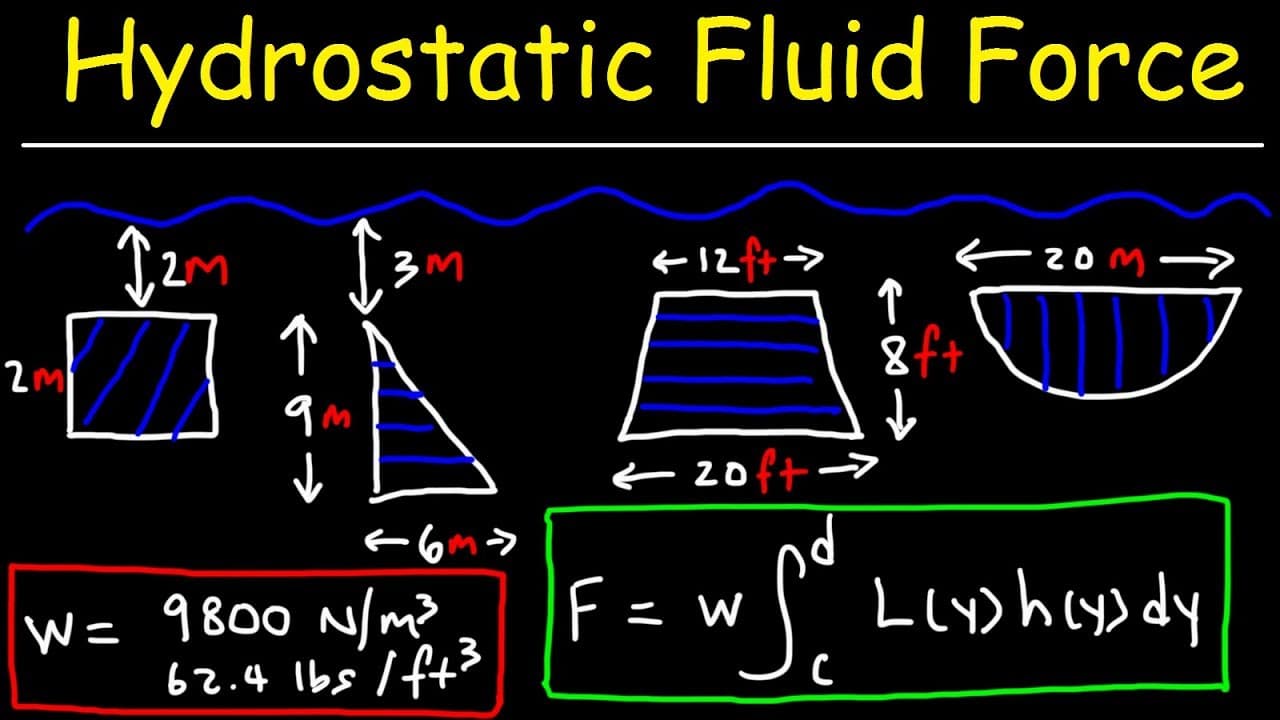
To calculate the hydrostatic force on submerged vertical plates, use the formula: fluid force = weight density of water × ∫(c to d) h(y) × l(y) dy. Employ a weight density of 9,800 N/m³ or 62.4 lb/ft³ depending on your unit system, and factor in the plate's depth and dimensions for accurate results.
Transcript
so let's say this is the water level and we have a square plate a square vertical plate and let's say it's 2 meters below the surface and the side length of the plate is 2 meters how can we determine the hydrostatic force on this vertical plate submerged in water well the first thing i would recommend doing is determining the x and y axis so i'm go... Read More
Key Insights
- 🍽️ Understanding the formula for calculating the hydrostatic force is essential for analyzing the pressure on submerged vertical plates.
- 🤒 The weight density of water is a crucial value that depends on the chosen units (Newtons per cubic meter or pounds per cubic foot).
- 🤽 The depth of water and dimensions of the plate play a significant role in determining the hydrostatic force.
- 🍽️ Different plate shapes (square, triangular, trapezoidal, semicircular) require different equations to find the hydrostatic force on them.
- ❣️ It is important to correctly assign the x and y axes to calculate the hydrostatic force accurately.
Install to Summarize YouTube Videos and Get Transcripts
Explore YouTube Video Summarizer or Get YouTube Transcript Extractor
Questions & Answers
Q: How can the hydrostatic force on a submerged plate be determined?
The hydrostatic force can be calculated using the formula fluid force = weight density of water * ∫(c to d) h(y) * l(y) * dy, where h(y) represents the depth of water below the surface, l(y) represents the length of the plate along the x-axis, and dy is the infinitesimal change in the y-axis.
Q: What is the weight density of water and how is it used?
The weight density of water is 9,800 Newtons per cubic meter (or 62.4 pounds per cubic foot). It is multiplied by the integral of the product of h(y) and l(y) to calculate the hydrostatic force on the submerged plate.
Q: How can the length of the plate along the x-axis be determined?
The length of the plate, l(y), along the x-axis is determined based on the dimensions of the specific plate. In the case of a square plate, where the side lengths are the same, l(y) is a constant value.
Q: Does the weight density of water change if different units are used?
The weight density of water depends on the units used. If the depth is measured in meters, the weight density is 9,800 Newtons per cubic meter. However, if the depth is measured in feet, the weight density is 62.4 pounds per cubic foot.
Summary & Key Takeaways
-
The hydrostatic force on a submerged vertical plate can be determined using the weight density of water, depth of water, and the plate's dimensions.
-
The formula for calculating the hydrostatic force is fluid force = weight density of water * ∫(c to d) h(y) * l(y) * dy.
-
The weight density of water is 9,800 Newtons per cubic meter (or 62.4 pounds per cubic foot if using feet as units).
Read in Other Languages (beta)
Share This Summary 📚
Summarize YouTube Videos and Get Video Transcripts with 1-Click
Try YouTube Summary with ChatGPT & Claude or YouTube Transcript Generator
Explore More Summaries from The Organic Chemistry Tutor 📚




Summarize YouTube Videos and Get Video Transcripts with 1-Click
Try YouTube Summary with ChatGPT & Claude or YouTube Transcript Generator