How to Solve Mole to Mole Conversions in Chemistry
TL;DR
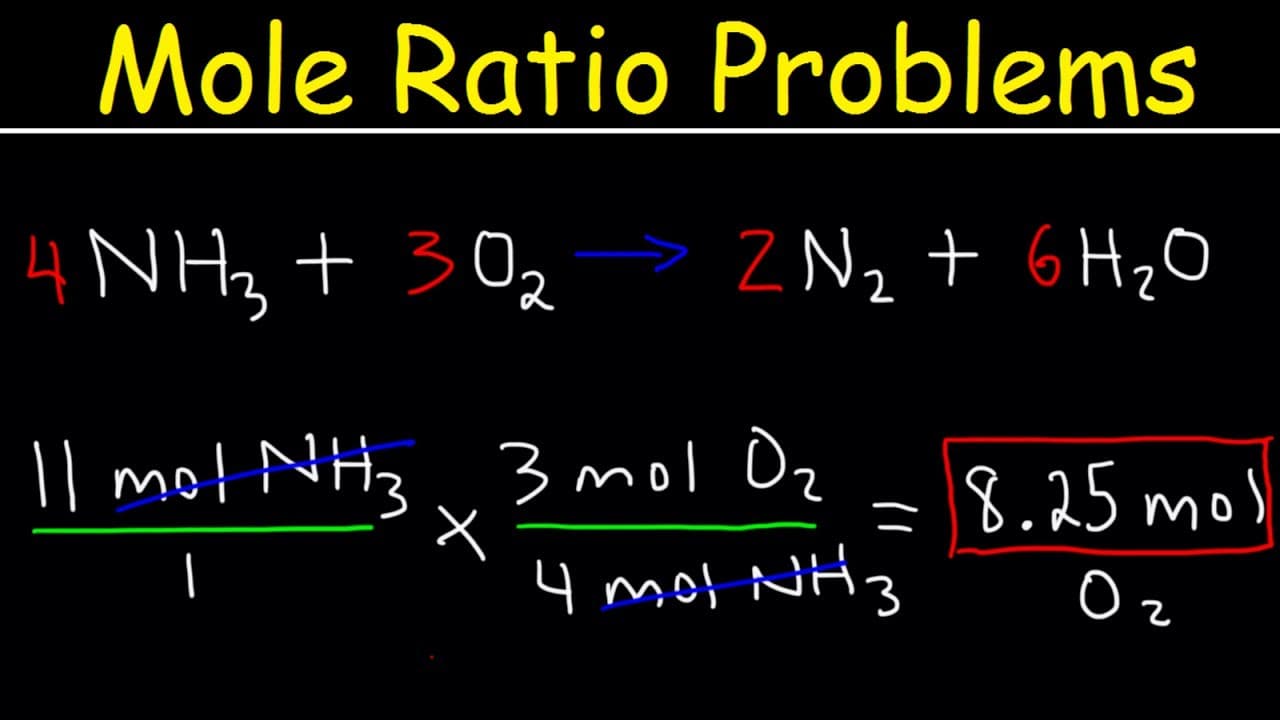
To convert moles of one compound to moles of another, multiply the moles you have by the mole ratio taken from the coefficients of a balanced equation. For example, in N2 + 3H2 → 2NH3, 1.5 moles of N2 react with 1.5 × 3 = 4.5 moles of H2. The video also works a propane combustion problem, finding 17.5 moles of O2 are needed to produce 14 moles of water. See each worked example step by step.
Transcript
in this video we're going to talk about mole ratio and we're going to solve some problems related to it but let's understand it first so consider this reaction let's say that nitrogen gas reacts with hydrogen gas to produce ammonia which is uh NH3 and let's balance it so we have two nitrogen atoms on the left side so need to put a two in front of a... Read More
Key Insights
- 🥳 Mole ratios between compounds are obtained from the coefficients in a balanced chemical equation.
- 🥳 Converting between moles of different compounds involves multiplying by the mole ratio.
- 🫀 Balancing a chemical equation requires adjusting coefficients to achieve equal numbers of atoms of each element.
- 🥳 Given moles of a compound can be converted to moles of another compound using the mole ratio.
- 💆 Balancing equations ensures the conservation of mass in chemical reactions.
- ❓ O2 is a diatomic molecule.
- ⚖️ Fractions can be used as coefficients to balance equations.
Install to Summarize YouTube Videos and Get Transcripts
Explore YouTube Video Summarizer or Get YouTube Transcript Extractor
Questions & Answers
Q: How do you convert moles of one substance to moles of another?
Start with the moles you are given and multiply by the mole ratio between the two compounds, which comes from the coefficients of the balanced equation. Set up the ratio so the unit you start with cancels. For example, with a 5:4 ratio of O2 to H2O, 14 moles of water × (5 moles O2 / 4 moles H2O) = 17.5 moles of O2.
Q: How do you calculate the mole ratio between compounds?
The mole ratio is read directly from the coefficients in front of each compound in a balanced chemical equation. In N2 + 3H2 → 2NH3, the numbers 1, 3, and 2 mean 1 mole of N2 reacts with 3 moles of H2 to produce 2 moles of NH3, giving ratios like 1:3 for N2 to H2.
Q: How many moles of H2 react with 1.5 moles of N2?
Using the balanced equation N2 + 3H2 → 2NH3, the mole ratio of N2 to H2 is 1:3. Multiply 1.5 moles of N2 by 3 to get 4.5 moles of H2. This makes sense because 1.5 is between 1 and 2, so the answer 4.5 falls between 3 and 6.
Q: How many moles of oxygen are required to produce 14 moles of water from propane?
First balance the reaction: C3H8 + 5O2 → 3CO2 + 4H2O, giving a 5:4 ratio of O2 to water. Then multiply 14 moles of water by 5/4: 14 × 5 = 70, and 70 ÷ 4 = 17.5 moles of O2. This matches the estimate, since 14 moles of water falls between the 12 and 16 mole checkpoints.
Q: What does it mean to balance a chemical equation?
Balancing means adjusting the coefficients in front of each compound so there is an equal number of atoms of each element on both sides of the equation. This ensures the conservation of mass in the reaction. Only the coefficients are changed, never the chemical formulas themselves.
Q: How do you balance a chemical equation step by step?
Adjust coefficients one element at a time so each side has equal atoms. For C3H8 + O2 → CO2 + H2O, put 3 in front of CO2 for the three carbons and 4 in front of H2O for the eight hydrogens, leaving 10 oxygen atoms on the right, so a 5 goes in front of O2 since 10 ÷ 2 = 5.
Q: How do you handle a fraction when balancing an equation like ammonia burning in oxygen?
For NH3 + O2 → N2 + H2O, balancing oxygen first gives an odd count that needs a fraction in front of O2. To avoid the fraction, double every coefficient, producing 4NH3 + 3O2 → 2N2 + 6H2O so all atoms balance with whole numbers.
Q: Why is O2 written as a diatomic molecule in these reactions?
Oxygen gas is diatomic, meaning it naturally exists as O2 with two oxygen atoms bonded together. Because of this, each O2 molecule contributes two oxygen atoms, which is why you divide the total oxygen atoms by 2 to find the coefficient for O2 when balancing.
Summary & Key Takeaways
-
Mole ratios are obtained from the coefficients in a balanced chemical equation and represent the ratio in which compounds react.
-
To find the number of moles of a compound in a reaction, use the given moles and the mole ratio between the compounds.
-
Balancing a chemical equation requires adjusting coefficients to ensure the same number of atoms of each element on both sides of the equation.
Read in Other Languages (beta)
Share This Summary 📚
Summarize YouTube Videos and Get Video Transcripts with 1-Click
Try YouTube Summary with ChatGPT & Claude or YouTube Transcript Generator
Explore More Summaries from The Organic Chemistry Tutor 📚



Summarize YouTube Videos and Get Video Transcripts with 1-Click
Try YouTube Summary with ChatGPT & Claude or YouTube Transcript Generator