What Is the Unit Circle and How Is It Used in Trigonometry?
TL;DR
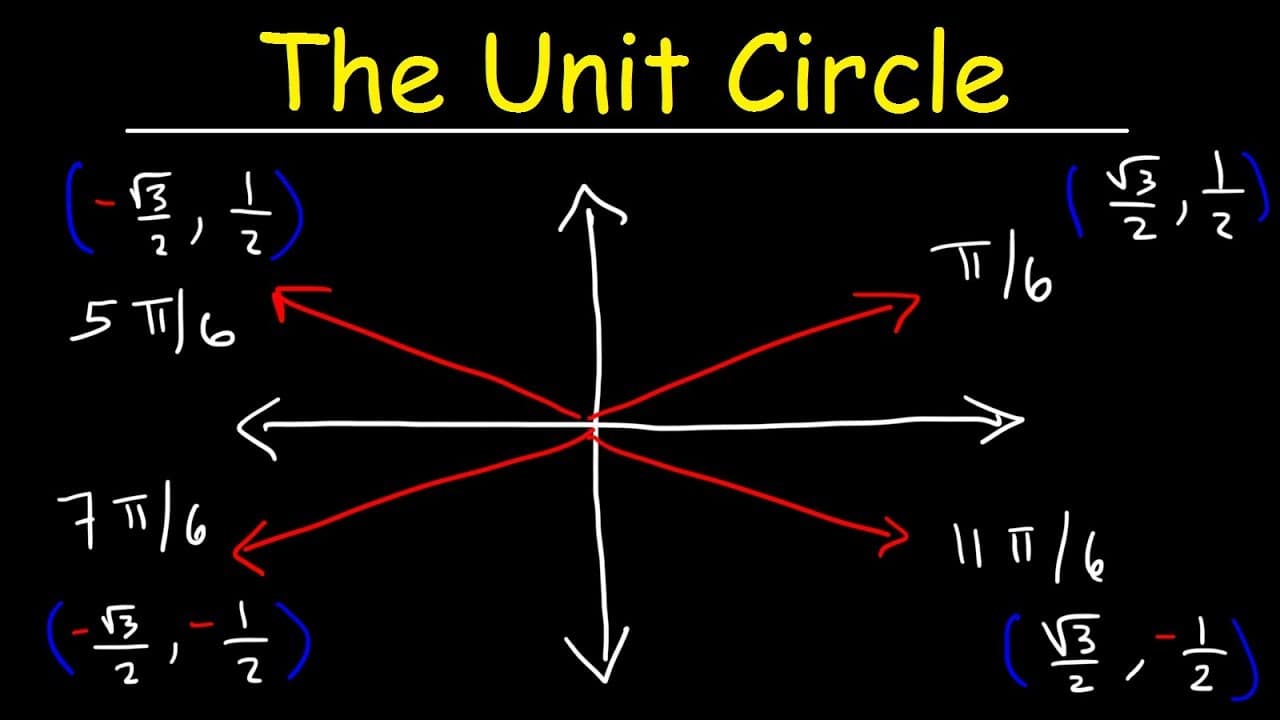
The unit circle is a circle with a radius of one used to evaluate sine and cosine functions by referring to coordinates on the circle. Key angles to remember include 30, 45, and 60 degrees, with sine represented by the y-coordinate and cosine by the x-coordinate. Understanding values in the first quadrant enables finding values for angles in other quadrants due to symmetry.
Transcript
now let's talk about the unit circle so what exactly is the unit circle the unit circle is a circle with a radius of one so if we draw a ray at a 45 degree angle and let's say if we turn it into a triangle the hypotenuse of that triangle will be equal to 1. at a 45 degree angle the x and y portion of the triangle have the same value so therefore th... Read More
Key Insights
- 👨💼 The unit circle is a valuable tool in trigonometry as it helps in evaluating sine and cosine functions.
- ❣️ The x coordinate represents the cosine value, while the y coordinate represents the sine value on the unit circle.
- 🔺 Understanding the values in quadrant one is sufficient in finding the values for angles in other quadrants.
- ⭕ The symmetry of the unit circle allows for easily determining the values for angles not directly shown on the circle.
- 🤩 The key angles to remember on the unit circle include 30, 45, and 60 degrees.
- ❣️ The values of sine and cosine depend on the x and y coordinates respectively.
- ❣️ Angles with the same reference angle on the unit circle have similar x and y values, just with a different sign.
Install to Summarize YouTube Videos and Get Transcripts
Explore YouTube Video Summarizer or Get YouTube Transcript Extractor
Questions & Answers
Q: What is the unit circle and why is it important in trigonometry?
The unit circle is a circle with a radius of one and is important in trigonometry because it helps in evaluating trigonometric functions based on the x and y values of points on the circle.
Q: How do you determine the value of sine and cosine using the unit circle?
To determine the value of sine, you look at the y coordinate of a point on the unit circle, while for cosine, you look at the x coordinate.
Q: Why do some values on the unit circle repeat in different quadrants?
Some values on the unit circle repeat in different quadrants because of the symmetry of the circle. The x and y values change sign depending on the quadrant.
Q: How can you find the values of trigonometric functions for angles not shown on the unit circle?
By knowing the values in the first quadrant and understanding the symmetry of the unit circle, you can determine the values for angles in other quadrants without memorizing the entire unit circle.
Summary & Key Takeaways
-
The unit circle is a circle with a radius of one and is used to evaluate sine and cosine functions based on the x and y values of points on the circle.
-
The values of sine and cosine can be determined by looking at the y and x coordinates respectively on the unit circle.
-
Common values on the unit circle include 30, 45, and 60 degrees, which have specific x and y values.
Read in Other Languages (beta)
Share This Summary 📚
Summarize YouTube Videos and Get Video Transcripts with 1-Click
Try YouTube Summary with ChatGPT & Claude or YouTube Transcript Generator
Explore More Summaries from The Organic Chemistry Tutor 📚





Summarize YouTube Videos and Get Video Transcripts with 1-Click
Try YouTube Summary with ChatGPT & Claude or YouTube Transcript Generator