How to Use Lagrange Multipliers for Optimization
TL;DR
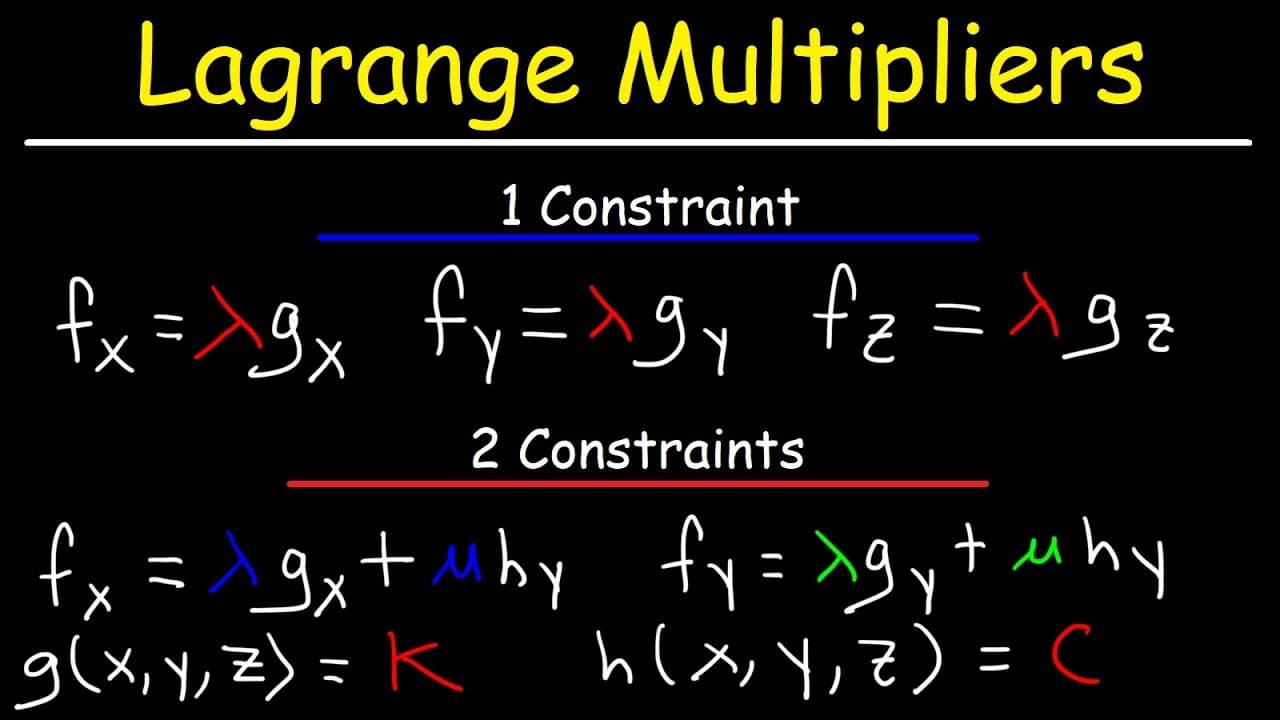
To use Lagrange multipliers for optimization, set up a system of equations involving the function's partial derivatives and the constraint equation. Solve these equations to find the values of the variables that yield maximum or minimum values of the function under the given constraints.
Transcript
in this video we're going to talk about how to use lagrange multipliers to find the maximum or minimum values so in a problem like this we're given a multivariable function in this case f contains three variables and we're given a constraint which is g of x comma y comma z and that's equal to some constant k and you can see that g is 3x plus 2y min... Read More
Key Insights
- ✖️ Lagrange multipliers help solve optimization problems with constraints by introducing a Lagrange multiplier to account for the constraint.
- 🆘 Writing a system of equations that includes the partial derivatives of the function and the constraint helps to solve for the variables.
- 😥 Evaluating the function at different points that satisfy the constraint helps to determine if a point is a maximum or minimum value.
- 😥 The Lagrange multiplier can have multiple solutions, resulting in multiple maximum or minimum points.
Install to Summarize YouTube Videos and Get Transcripts
Explore YouTube Video Summarizer or Get YouTube Transcript Extractor
Questions & Answers
Q: What is the purpose of using Lagrange multipliers?
Lagrange multipliers are used to find the maximum or minimum values of multivariable functions with a given constraint. They help to optimize the function while adhering to the constraint.
Q: How do you write the system of equations using Lagrange multipliers?
The system of equations includes the partial derivatives of the function with respect to each variable, multiplied by a Lagrange multiplier, and set equal to the partial derivatives of the constraint equation.
Q: How do you solve the system of equations?
The system of equations can be solved by isolating the Lagrange multiplier first, and then substituting the values of the Lagrange multiplier back into the equations to solve for the variables.
Q: How can you determine if a point is a maximum or minimum using Lagrange multipliers?
To determine if a point is a maximum or minimum, you can evaluate the function at that point and compare it to other points that satisfy the constraint. If the evaluated function is the highest or lowest among those points, it is the maximum or minimum value.
Summary & Key Takeaways
-
Lagrange multipliers can be used to find maximum or minimum values of multivariable functions with a given constraint.
-
The process involves writing a system of equations that includes partial derivatives of the function with respect to each variable and the constraint equation.
-
Solving the system of equations helps to determine the values of the variables that correspond to maximum or minimum values of the function.
Read in Other Languages (beta)
Share This Summary 📚
Summarize YouTube Videos and Get Video Transcripts with 1-Click
Try YouTube Summary with ChatGPT & Claude or YouTube Transcript Generator
Explore More Summaries from The Organic Chemistry Tutor 📚



Summarize YouTube Videos and Get Video Transcripts with 1-Click
Try YouTube Summary with ChatGPT & Claude or YouTube Transcript Generator