What AI means for McKinsey’s future strategy
TL;DR
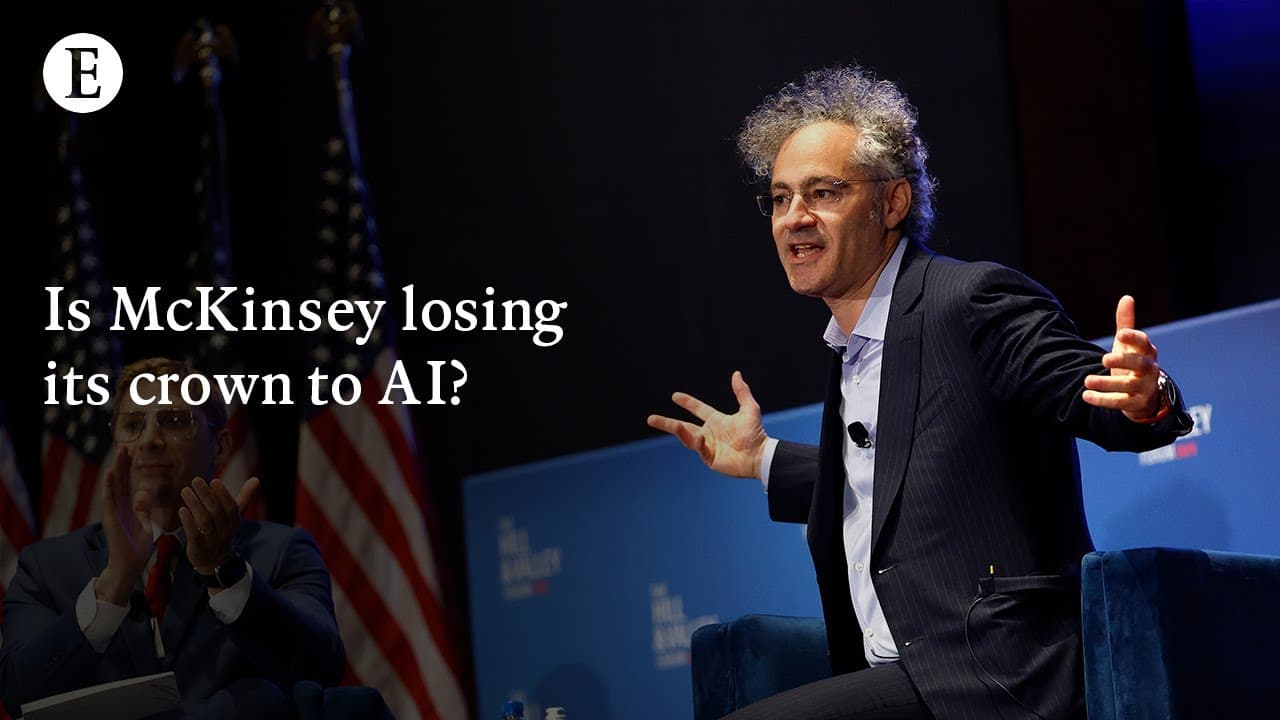
McKinsey’s growth has cooled after a period of expansion, with headcount cuts and slower revenue growth. Rivals like BCG have pursued similar digital expansion, while new AI driven competitors and tools push traditional strategy work toward a more hands on, tech enabled model. Firms expect AI to reshape offerings, pricing, and execution in the coming years.
Transcript
[Applause] I don't have to tell you that it's a period of great global and technological change. It's exhausting and confusing. One industry absolutely thrives on that kind of widespread confusion, consultancy. There should be plenty of work for the folks who parachute in and tell companies how to navigate this confusing world. And yet, McKenzie, t... Read More
Key Insights
- McKinsey built a large digital and technology consulting practice during an expansion phase, but recent growth stalled.
- BCG has maintained stronger growth by retaining and deploying needed specialists, narrowing the gap with McKinsey.
- AI is enabling clients to access tools directly, which could compress consulting fees and shift value toward intellectual property and execution libraries.
- New AI focused entrants are competing by embedding engineers with clients, signaling a shift from pure advisory to hands on AI deployment.
- Executives are placing emphasis on AI, which may push traditional consultants to collaborate or compete with software style offerings.
- The long term risk for McKinsey is that AI democratization could flatten the competitive advantage of proprietary methods.
- Despite AI pressure, the cohost notes that the core advisory role could reemerge as the tools democratize, sustaining demand for strategic thinking.
- The industry is anticipated to undergo significant change as AI tools become more common and integrated into client operations.
Install to Summarize YouTube Videos and Get Transcripts
Explore YouTube Video Summarizer or Get YouTube Transcript Extractor
Questions & Answers
Q: What is causing McKinsey to slow growth and cut headcount?
McKinsey experienced a slowdown in growth after a period of rapid expansion that included a heavy investment in digital capabilities and multiple acquisitions of technology consultancies. The combination of macroeconomic uncertainty and increased competition from rivals who expanded similarly has contributed to slower revenue growth and a reduction in staff since the end of 2023, signaling a pivotal moment for the firm as it reassesses strategic priorities.
Q: How did McKinsey grow in the past and what changed?
In the past McKinsey grew by broadening its services, investing in digital capabilities, and expanding into technology, operations, and procurement. This expansion made the firm larger than rivals like BCG. Recently, growth has tailed off due to macro conditions and competition, and the firm reduced headcount by about 5,000 since late 2023, suggesting a strategic retrenchment.
Q: How does McKinsey compare to BCG right now?
BCG has continued to grow more robustly than McKinsey by expanding similarly into digital services but has been better at deploying and retaining the necessary specialists. As a result, BCG narrowed the gap and could overtake McKinsey in revenue if current trends persist, illustrating how execution and talent management matter in a competitive landscape.
Q: Why are AI and new competitors a threat to traditional consulting firms?
AI and new competitors threaten traditional consultancies by offering automation, data integration, and in some cases hands on deployment with clients. Clients want practical results and may favor firms that combine advisory with direct AI implementation. This shifts the value proposition toward execution capability and scalable tools, potentially compressing fees for conventional strategy work.
Q: What is Palanteer and why is it mentioned in the discussion about McKinsey?
Palanteer is highlighted as a rapidly growing entrant that sells AI tools and deploys engineers with clients to embed AI into operations. It represents a new form of competition that blends software with consulting services, challenging traditional firms like McKinsey by delivering actionable AI capabilities in client environments.
Q: Could AI fundamentally rewrite how strategy work is priced and delivered?
Yes, AI has the potential to automate substantial portions of the analytic and presentation work that underpins many strategy projects. If a bot can handle junior level grunt work and data crunching, firms may need to rethink pricing models and emphasize proprietary intellectual property and higher value strategic advisory that remains difficult to automate.
Q: What long term changes are anticipated for McKinsey due to AI?
Industry observers anticipate a long term shift where AI democratizes data and analysis, requiring firms to adapt by focusing on core strategic advisory while leveraging AI tools. McKinsey may reemphasize its libraries of intellectual property and develop new AI assisted offerings, while also competing with software powered firms that embed AI capabilities directly into client operations.
Q: What should McKinsey do to maintain leadership in a changing market?
McKinsey should balance maintaining core strategic advisory strengths with accelerated AI integration, ensuring robust deployment capabilities and value delivery. This includes investing in trusted AI libraries, cultivating specialists who can translate AI insights into business actions, and forming partnerships that enhance execution without eroding traditional advisory credibility. Consistent client outcomes will be critical.
Summary & Key Takeaways
-
McKinsey expanded aggressively by building digital capabilities and acquiring technology consultancies, but growth has slowed and headcount was reduced, signaling a pivotal moment for the firm.
-
BCG has continued to grow by deploying specialists effectively, challenging McKinsey as the leading strategy firm and potentially overtaking it in revenue if trends persist.
-
AI is redefining how clients access advisory services, with new players like Palanteer showing how engineering driven, in house deployment of AI can compete with traditional consulting offerings and threaten the core model of strategy firms.
Read in Other Languages (beta)
Share This Summary 📚
Summarize YouTube Videos and Get Video Transcripts with 1-Click
Try YouTube Summary with ChatGPT & Claude or YouTube Transcript Generator
Explore More Summaries from The Economist 📚






Summarize YouTube Videos and Get Video Transcripts with 1-Click
Try YouTube Summary with ChatGPT & Claude or YouTube Transcript Generator