How to Coordinate AI Agents With a Shared Queue
TL;DR
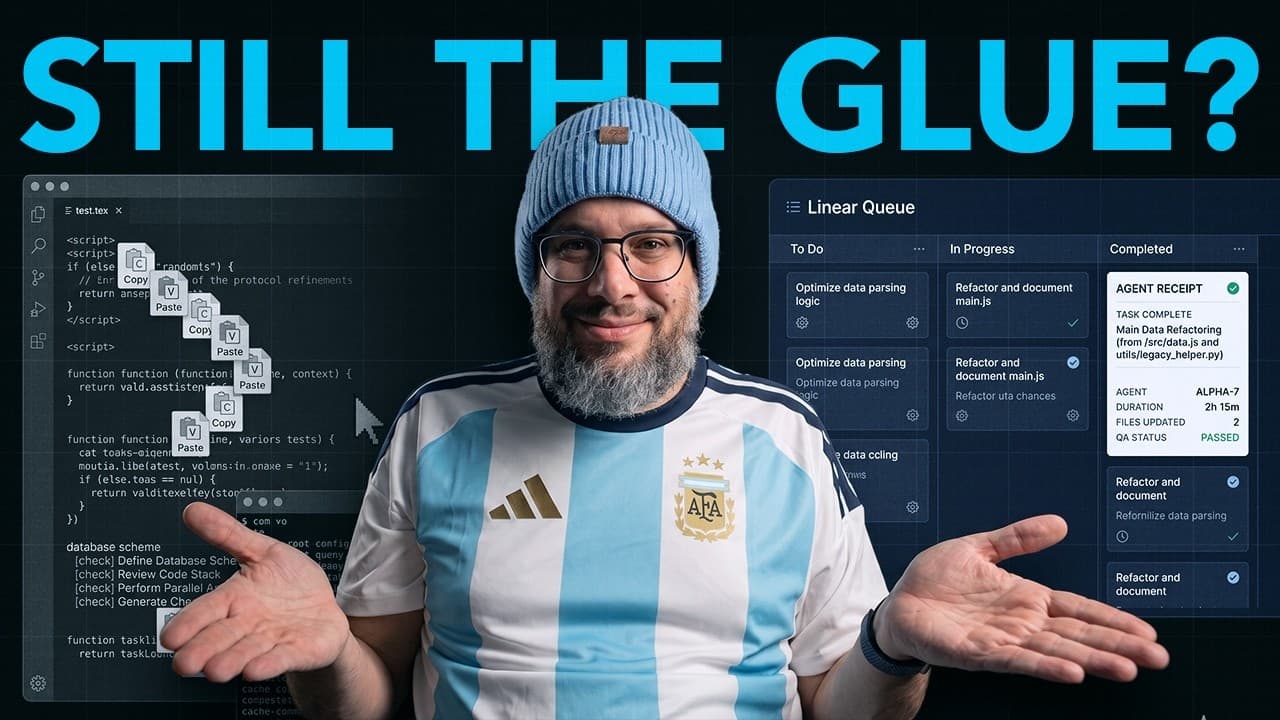
Put work in a shared task queue that every person and AI agent can read and update. Each ticket should identify the required result, owner, relevant background, permitted actions, stopping point, and completion evidence, allowing Claude, ChatGPT, Codex, OpenClaw, or Hermes to exchange context and work without direct integrations or constant human coordination.
Transcript
By the end of this video, you're going to know how to make Claude, Codeex, Chad, GPT, and OpenClaw or Hermes work together without waiting for any of them to start to integrate with each other. And yes, I'm going to show demos. I'm going to show what I built. I'm going to talk to you about why. I'm going to give you real stories. I'm going to tell ... Read More
Key Insights
- • The main AI coordination bottleneck is the handoff between tools, because context, source material, progress, and review responsibilities otherwise fall back on the human. Capable agents still operate as isolated products unless a shared system gives their work somewhere structured to move.
- • A shared task queue is the central coordination layer because people and agents can both read it, update it, and inspect its history. Linear is the creator's preferred option, but Jira or a custom Kanban system can serve the same purpose.
- • A well-formed ticket is a job specification that states the required result, owner, relevant background, permitted actions, stopping point, and completion evidence. These fields let another person or agent continue the work without reading an entire chat transcript.
- • A ticket differs from a prompt because a prompt generally requests an answer, while a ticket assigns a result that must be completed. The ticket can support several agents that do not know one another by becoming the durable place where they communicate.
- • Chat histories are poor state-management systems because they make completed actions, changed files, drafts, task status, and next steps difficult to audit. A visible queue preserves operational state in a form that humans, teammates, and agents can inspect from their tools.
- • Agent autonomy is insufficient when every workflow remains isolated, because the human still becomes the hallway between separate rooms. Research, writing, support, product, coding, scheduling, and review loops need a shared mechanism for passing changes and original materials onward.
- • Open Engine extends the Open Brain memory concept by addressing how remembered work moves between agents. Controlled memory prevents every AI from starting at zero, while the shared queue turns that context into assignments, handoffs, visible progress, and reviewable outcomes.
- • The complete Open Engine approach has five components: a shared queue plus setup, status, queue-running, and smoke-test skills. The skills teach agents the operating protocol, while the smoke test checks whether the system can perform useful work as intended.
Install to Summarize YouTube Videos and Get Transcripts
Explore YouTube Video Summarizer or Get YouTube Transcript Extractor
Questions & Answers
Q: How can different AI agents work together without direct integrations?
Different AI agents can coordinate through a shared task queue that each agent and participating person can read and update. Work moves through structured tickets rather than direct agent-to-agent connections. Each ticket carries the required outcome, source material, relevant context, ownership, permitted actions, stopping conditions, and completion evidence, so the next agent can continue from an inspectable record instead of relying on copied chat transcripts.
Q: What information should an AI agent handoff ticket contain?
An AI agent handoff ticket should state what needs to happen, who owns the work, which background information matters, what the agent is allowed to do, where the agent must stop, and what it must show when finished. This structure turns an informal request into a durable job that another person or agent can understand, execute, review, and continue without reconstructing context from previous conversations.
Q: Why is a shared queue better than coordinating AI agents through chat?
A shared queue makes ownership, status, source material, completed actions, and next steps visible in one inspectable place. Chat boxes do not reliably expose operational state, especially when agents change files, create tasks, move statuses, or draft materials. A queue lets people and agents audit what happened and continue the work without searching conversations or depending on a person's memory to connect separate systems.
Q: What is the difference between prompting an AI and assigning it a ticket?
A prompt asks an AI to produce an answer or response, while a ticket assigns a result that must be completed and documented. A ticket also records the owner, background, permissions, stopping point, and required proof of completion. Because that state persists in a shared queue, several agents can contribute to the same workflow even when they are separate products and have no direct integration.
Q: Which task management tools can be used for Open Engine?
Open Engine can use Linear, Jira, or a custom Kanban board, provided the system functions as a queue that agents can write to and people can read. The creator prefers Linear because it has a generous free plan and works with the AI systems discussed. The specific product is less important than maintaining shared, accessible, and inspectable task state for every handoff.
Q: What are the five components of the Open Engine system?
The Open Engine system consists of a shared queue and four skills that teach agents how to operate it. The transcript identifies a setup skill, a status skill, a skill for running a queue through the AI, and a smoke test. Together, these five components establish the workspace, define a common operating protocol, support execution and reporting, and test whether the system is useful.
Q: Why is agent autonomy alone not enough for coordinated work?
Agent autonomy does not solve coordination when each workflow remains isolated. A research agent can finish without informing the writing workflow, a support workflow can detect a pattern without transferring original messages to product work, and a coding agent can change a file without giving the reviewer adequate evidence. Without a shared handoff mechanism, the human still carries context and work between these separate loops.
Q: How does Open Engine help teams use multiple AI agents?
Open Engine gives teams of humans and agents a shared place to see assignments, source materials, progress, completed actions, and next steps. Team members can inspect work performed by people, team agents, or personal agents without receiving a vague summary or a large chat transcript. The queue therefore supports collaboration and review while allowing each task to use the agent considered most suitable for that work.
Summary & Key Takeaways
-
Open Engine addresses the invisible labor created when people must manually transfer work, context, and source material among separate AI tools. Instead of forcing one model to handle every task, it lets users choose their preferred agent for each job while maintaining an inspectable record of ownership, progress, and next steps.
-
The core mechanism is a shared queue, such as Linear, Jira, or a custom Kanban board, that both humans and agents can read and update. Each issue defines the desired outcome, responsible owner, relevant background, allowed actions, stopping conditions, and evidence required when the assigned work has been completed.
-
The proposed system combines a queue with four operational skills: setup, status reporting, queue execution, and a smoke test. Together, these components teach different agents a common ticketing protocol, support repeatable workflows, and create visible handoffs without requiring Claude, Codex, ChatGPT, OpenClaw, or Hermes to integrate directly with one another.
Read in Other Languages (beta)
Share This Summary 📚
Summarize YouTube Videos and Get Video Transcripts with 1-Click
Try YouTube Summary with ChatGPT & Claude or YouTube Transcript Generator
Explore More Summaries from AI News & Strategy Daily | Nate B Jones 📚






Summarize YouTube Videos and Get Video Transcripts with 1-Click
Try YouTube Summary with ChatGPT & Claude or YouTube Transcript Generator