The Factory of Ideas: Working at Bell Labs - Computerphile
TL;DR
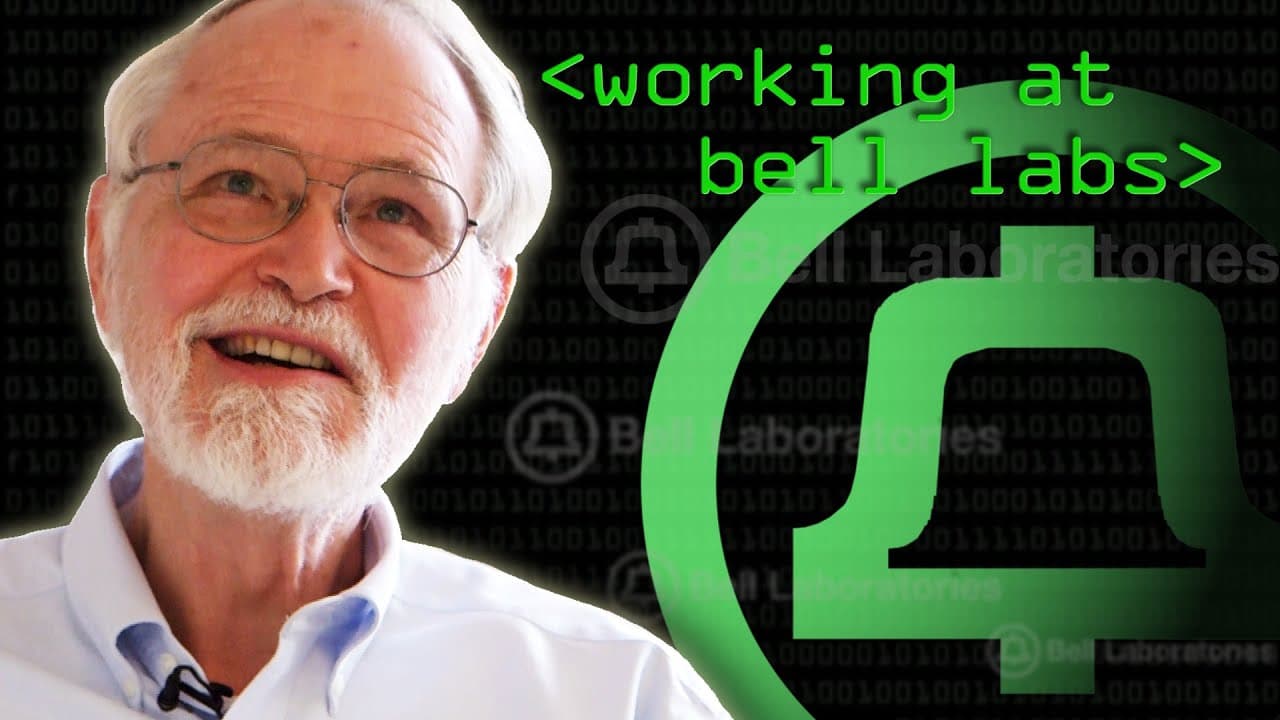
Bell Labs was a “factory of ideas” because talented researchers had abundant resources, freedom from management direction, and time to pursue long-term work without pressure for immediate results. The speaker joined as a summer employee around 1967, stayed for over 30 years, and was never told what to work on. Read on to see how that environment and early time-sharing systems transformed his experience of computing.
Transcript
i first went to bell labs i think in 1967 i had i was at the time a graduate student in computer science except it was before computer science it was electrical engineering at princeton and i was lucky enough to get a summer job at bell labs but it was a wonderful place because there were an enormous number of really good people doing really intere... Read More
Key Insights
- 🤗 Bell Labs provided an open and supportive environment, encouraging collaboration and idea-sharing among employees.
- 👻 The time sharing system revolutionized computing, allowing for greater productivity and eliminating the need for punch cards.
- 🥺 Bell Labs' decision to withdraw from the Multics project led to the development of Unix by Ken Thompson and Dennis Ritchie.
- 💦 Working at Bell Labs was a motivating experience due to the stimulating environment and the abundance of interesting projects.
- 👨🔬 Bell Labs' research output had a significant impact on various fields, including communications, semiconductors, and lasers.
- ◀️ The author highlights the compression and compactness of Bell Labs' fonts, which made them difficult to reverse-engineer.
- 🫦 The format of Bell Labs' fonts had mechanisms in the language to specify different data types, such as 8-bit and 16-bit quantities.
Install to Summarize YouTube Videos and Get Transcripts
Explore YouTube Video Summarizer or Get YouTube Transcript Extractor
Questions & Answers
Q: What made working at Bell Labs such a rewarding experience?
Bell Labs brought together an enormous number of talented people working on interesting problems while giving them freedom to choose their own work. Its stable funding meant researchers had ample resources and could pursue long-term ideas whose immediate applications were not obvious.
Q: When did the speaker first work at Bell Labs?
The speaker first went to Bell Labs around 1967 while studying electrical engineering at Princeton, before computer science was established there as a separate field. He started with a summer job and accepted a permanent position after graduating without interviewing anywhere else.
Q: How large was the Bell Labs research community described by the speaker?
The speaker recalls roughly 4,000 people working in one large building, including about 2,000 PhDs. Their fields included physics, chemistry, materials, mathematics, and the relatively new discipline of computer science.
Q: Why could Bell Labs support long-term research without immediate commercial results?
Bell Labs was part of AT&T, which the speaker describes as a regulated monopoly with an effectively guaranteed rate of return. A small portion of that stable revenue funded research intended to improve national telephone service, so resources were plentiful and quarterly savings were not the overriding demand.
Q: How much freedom did researchers have at Bell Labs?
The speaker says he spent over 30 years there and was never once told what he should work on. At the end of each year, he summarized his accomplishments on one side of a single sheet of paper, which was then used to help determine his pay for the next year.
Q: How did the speaker get his summer job at Bell Labs?
The previous year, he had worked at MIT's Project MAC with CTSS, the Compatible Time-Sharing System. That experience connected him indirectly with people from Bell Labs and helped him secure summer work, build contacts, and find a thesis topic.
Q: How did time-sharing make computing more productive?
Time-sharing connected multiple terminals to a central computer and gave each user brief turns so quickly that everyone felt they had the machine to themselves. Users could edit stored files, compile them, see errors within seconds, and retry immediately, work that could take days with punch cards, operators, and paper output could instead take minutes.
Q: Could time-sharing be considered an early form of cloud computing?
The speaker says it could be viewed that way because computation and information storage occurred on a central machine that users accessed remotely. The terminals might be nearby, but telephone systems also allowed genuinely remote connections to the central resources.
Summary & Key Takeaways
-
The author joined Bell Labs as a graduate student and found it to be a rewarding environment with many talented individuals working on interesting projects.
-
Bell Labs provided ample resources and no management direction, allowing employees to work on long-term projects without the pressure of immediate results.
-
Time sharing systems revolutionized computing and provided an early version of cloud computing, allowing users to remotely access and utilize the resources of a central computer.
Read in Other Languages (beta)
Share This Summary 📚
Summarize YouTube Videos and Get Video Transcripts with 1-Click
Try YouTube Summary with ChatGPT & Claude or YouTube Transcript Generator
Explore More Summaries from Computerphile 📚





Summarize YouTube Videos and Get Video Transcripts with 1-Click
Try YouTube Summary with ChatGPT & Claude or YouTube Transcript Generator