Which Opus 5.5 Effort Level Builds the Best App?
TL;DR
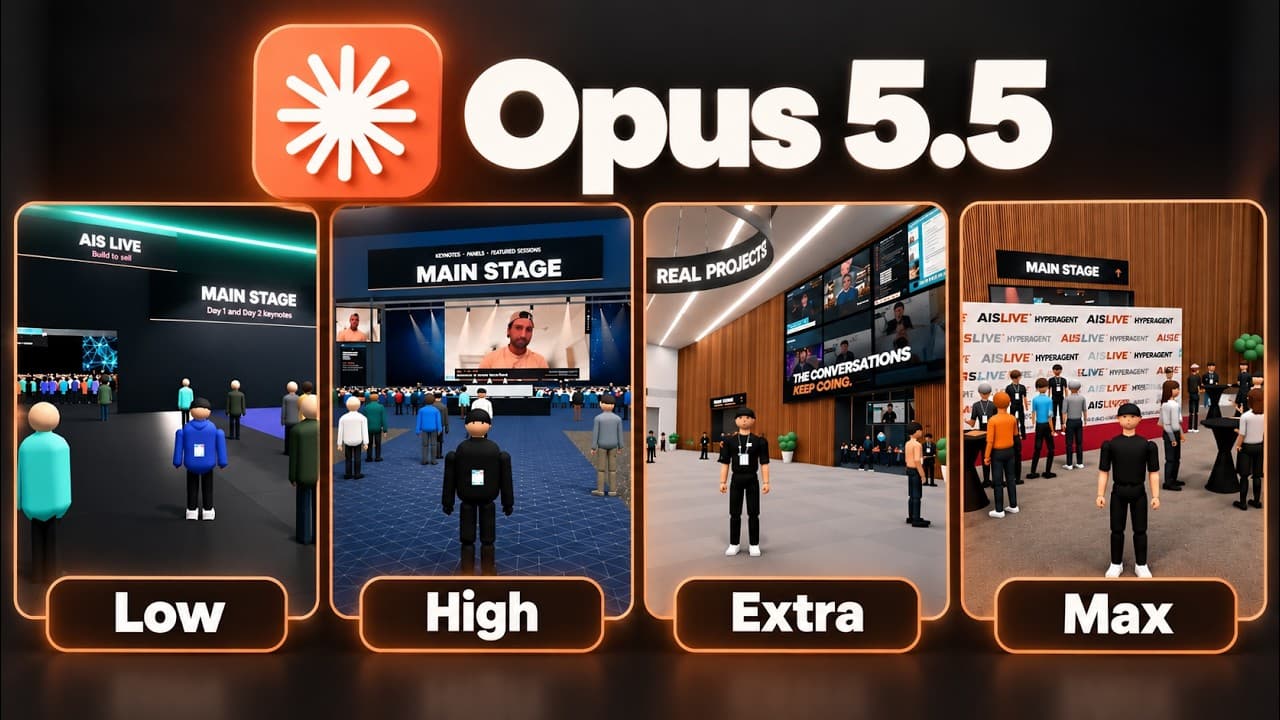
Medium effort produced a much stronger 3D conference experience than low effort, with accurate branding, playable event videos, stable attendees, track rooms, resources, and a VIP area. It also required far more time and tokens, showing that higher effort can improve a complex creative build while sharply increasing resource use, and the description states that the most expensive run was not the best.
Transcript
Opus 5.5, Opus 5.5, Opus 5.5, Opus 5.5, Opus 5.5. This model is literally everywhere and for very good reason. It's smart. It's cheap. It has amazing taste. It is an incredible AI model. But with every AI model, you have a choice of effort. Whether that be low, medium, high, extra, max, or ultra code. So in this video, I gave Opus 5.5 the same exac... Read More
Key Insights
- The experiment controlled the main input by giving every Opus 5.5 effort level the same prompt. Each run had to transform virtual AIS Live recordings into a realistic, third-person conference world and was evaluated using the same creativity, design, physics, and exploration criteria.
- Low effort created a recognizable conference structure with a synchronized map, registration information, a two-day agenda, sponsor booths, workshop rooms, a main stage, swag, and a VIP lounge. Its breadth showed that even the lowest tested setting could assemble a functional, explorable prototype.
- The low-effort build suffered from visible quality problems. It used incorrect branding and colors, displayed overly bright screens, made attendees disappear or glitch, and generally presented session content as still images or slideshow-like sequences rather than reliable moving video.
- The low-effort run finished in 16 minutes and 43 seconds, used 191,000 tokens, performed 22 categories of browser-based verification checks, and asked zero questions. Its estimated API-equivalent cost was $3.91, although the creator ran it through a subscription.
- The medium-effort build used the actual AIS Live visual identity and added a personalized badge before entry. Its venue included a lobby, conference tracks, an expo hall, a coffee bar, a large branded stage, a VIP lounge, and a city-like exterior environment.
- Medium effort integrated source assets more effectively by playing real event recordings in workshop rooms, booths, community spotlights, the main stage, and the VIP area. It also surfaced speaker slides and event takeaways, making the world function as an explorable interface to conference materials.
- The medium-effort run took 1 hour and 13 minutes, used 419,000 tokens, completed 23 checks, and asked zero questions. Its estimated API-equivalent cost was $12.44, creating a major increase in runtime, tokens, and cost compared with low effort.
- The central comparison shows that effort level is not a simple guarantee of proportional quality. The description states that the most expensive run was not the best, so selecting an effort setting requires comparing actual usability and design quality against runtime, token consumption, checks, and estimated cost.
- More videos from this channel:
- More from this channel: Nate Herk | AI Automation
Install to Summarize YouTube Videos and Get Transcripts
Explore YouTube Video Summarizer or Get YouTube Transcript Extractor
Questions & Answers
Q: How was the Opus 5.5 effort-level comparison conducted?
The creator submitted the same open-ended prompt to Opus 5.5 at low, medium, high, extra, max, and Ultracode effort. Every run had access to event recordings and other project assets and was asked to build a realistic, explorable 3D conference. The comparison examined output quality alongside runtime, estimated API-equivalent cost, token consumption, verification checks, and questions asked during execution.
Q: What app was Opus 5.5 asked to build?
Opus 5.5 was asked to turn AIS Live, a completely virtual event, into a realistic 3D conference that a user could explore from a third-person perspective. The requested world needed different rooms, tracks, and stages and could draw from a folder containing 105 GB of recordings, plus other resources inside the creator's AI operating system project.
Q: What did the low-effort build include?
The low-effort result included an explorable venue, a live-position map, registration information, a two-day agenda, sponsor booths, swag, several workshop rooms, a main stage, a coffee area, and a restricted VIP lounge. It also recognized actual agenda entries and exhibitors from the source material, demonstrating broad content discovery despite weak presentation and inconsistent media playback.
Q: What problems appeared in the low-effort app?
The low-effort app did not accurately reflect the AIS Live logo or color palette, and several screens were too bright. Attendees disappeared or glitched as the user moved through the venue. Workshop sessions appeared mainly as still images, while main-stage content resembled an unreliable slideshow rather than continuous video, reducing realism and weakening the conference atmosphere.
Q: How did medium effort improve the 3D conference?
Medium effort applied the correct AIS Live branding, gave the user a personalized badge, and created a more polished venue with clear tracks, an expo hall, a main lobby, a stage, and a VIP area. It also played actual event recordings in multiple locations, displayed post-event resources, and populated rooms with stable attendees who appeared engaged with presentations.
Q: How much time, money, and processing did low effort use?
The low-effort run took 16 minutes and 43 seconds and consumed 191,000 tokens. It performed 22 categories of checks by opening the browser and running different forms of verification. It asked the creator zero questions during the process. Based on API-equivalent billing, its estimated cost was $3.91, although the creator used a subscription.
Q: How much time, money, and processing did medium effort use?
The medium-effort run took 1 hour and 13 minutes, consumed 419,000 tokens, and completed 23 verification checks. Like the low-effort run, it asked zero questions. Its estimated API-equivalent cost was $12.44. These figures show that the stronger output required substantially more runtime and tokens, even though the number of checks increased only from 22 to 23.
Q: Does the highest effort level always produce the best app?
The supplied description explicitly states that the most expensive run was not the best. This means effort level and spending did not translate directly into the strongest result across the full comparison. The experiment therefore recommends judging an effort setting through several dimensions, including creative quality, design, physics, usability, runtime, token consumption, verification activity, and estimated API-equivalent cost.
Summary & Key Takeaways
-
The experiment gave Opus 5.5 one open-ended prompt at low, medium, high, extra, max, and Ultracode effort. The requested app was a realistic, third-person 3D conference derived from AIS Live recordings and other project assets, with outputs judged on creativity, design, physics, and the overall exploration experience.
-
Low effort created an explorable venue with a map, agenda, conference rooms, booths, swag, a main stage, and a VIP lounge. However, its branding was inaccurate, screens were excessively bright, attendees disappeared or glitched, and event presentations generally appeared as still images or slideshows instead of dependable video playback.
-
Medium effort delivered accurate AIS Live branding, a personalized badge, functioning event videos, stable attendees, multiple learning tracks, sponsor content, downloadable resources, a main stage, and VIP programming. The improvement carried a substantial resource cost: runtime increased from 16 minutes 43 seconds to 1 hour 13 minutes, while token use rose from 191,000 to 419,000.
Read in Other Languages (beta)
Share This Summary 📚
Summarize YouTube Videos and Get Video Transcripts with 1-Click
Try YouTube Summary with ChatGPT & Claude or YouTube Transcript Generator
Explore More Summaries from Nate Herk | AI Automation 📚





Summarize YouTube Videos and Get Video Transcripts with 1-Click
Try YouTube Summary with ChatGPT & Claude or YouTube Transcript Generator