How to Build Lasting Happiness Through Purpose
TL;DR
Lasting happiness comes from pursuing expanding goals, elevating immediate pleasure into stable enjoyment, and orienting life toward love, meaning, and service. Discernment requires an upward aim, freedom from distraction, and enough quiet for the mind to wander, helping a person clarify both what a better future means and how to move toward it.
Transcript
do you want to have progress in your life do you want to be a happier person do you want to have a life full of meaning what you want is a sequence of expanding goals with no upper limit and that's exactly what you see in Jacob's lad there's another weird angle on this though I've been trying to think about prayer technically that's a complicated t... Read More
Key Insights
- Expanding goals are a foundation for progress and happiness because they give life a continuing upward direction without imposing a final ceiling. The desired life is not a static state of comfort, but a sequence of meaningful aims that keep developing as a person matures.
- Happiness is not reducible to immediate pleasure because momentary gratification can be pursued in destructive, antisocial, or shortsighted ways. A useful account of happiness must consider future consequences, relationships, stability, reciprocity, and whether an experience supports a person's interests across time.
- Enjoyment is elevated pleasure that becomes repeatable, reciprocal, social, future-oriented, permanent, and stable. It functions as a gift that continues producing value, combining the appeal of pleasure with the perspective of wisdom rather than treating every gratifying impulse as inherently good.
- Discernment is a process of clarifying both an upward goal and a practical route toward it. A person can begin with an unspecified desire for things to become as good as possible, then allow perception and imagination to identify what improvement means and how it might be pursued.
- Prayer can operate as a deliberate form of attention that sets perception and imagination toward an upward aim. In the discussion, praying during a long pilgrimage provides sustained time for contemplation, allowing purpose and meaning to emerge through reflection rather than through immediate analytical answers.
- Undistracted mind wandering supports engagement with life's complex questions. Brooks connects contemplation with the brain's default network and notes that boredom feels uncomfortable, which helps explain why people often resist the quiet mental conditions that can support deeper understanding.
- Complex problems differ from complicated problems because complicated problems can be solved and converted into repeatable procedures, while complex questions invite understanding rather than final answers. Questions about love, purpose, identity, and direction therefore require a different kind of attention than technical production problems.
- Career transition can reveal a deeper organizing purpose when practical skills are redirected toward fundamental human concerns. Brooks moved from music to economics, behavioral science, psychology, and neuroscience, eventually identifying happiness as the central thread connecting his interest in unusual human motivations, love, charity, beauty, and meaning.
- Related book: Build the Life You Want
- Export your Kindle highlights to Glasp: How to Download Highlights and Notes from Kindle
Install to Summarize YouTube Videos and Get Transcripts
Explore YouTube Video Summarizer or Get YouTube Transcript Extractor
Questions & Answers
Q: How can expanding goals create lasting happiness?
Expanding goals create lasting happiness by giving life a continuing direction rather than making fulfillment depend on reaching one final endpoint. The discussion describes a desirable life as a sequence of goals with no upper limit. Each aim can clarify the next one, sustain progress, and connect daily effort with a broader pursuit of meaning, maturity, and improvement.
Q: What is the difference between pleasure and enjoyment?
Pleasure is immediate gratification in the moment, while enjoyment is pleasure elevated into something reciprocal, social, repeatable, future-oriented, permanent, and stable. This distinction matters because gratification alone can be destructive or shortsighted. Enjoyment incorporates wisdom and consequences across time, making the satisfying experience more compatible with relationships, responsibility, and a person's enduring well-being.
Q: Why is immediate pleasure not a sufficient definition of happiness?
Immediate pleasure is insufficient because a gratifying experience is not necessarily good for the person, other people, or society. The discussion uses psychopathic pleasure seeking to show that pleasure can accompany destructive conduct and social failure. A defensible account of happiness must therefore include stability, future consequences, reciprocity, relationships, and alignment with long-term interests.
Q: How does discernment help someone find purpose?
Discernment helps someone find purpose by beginning with an upward aim and gradually clarifying what that aim requires. A person may initially know only that life should become better, without knowing the destination or method. Contemplation then gives perception and imagination a defined task: identify what improvement means, recognize a possible path, and translate aspiration into direction.
Q: How can prayer contribute to making life decisions?
Prayer can contribute to decision-making by focusing attention on an upward aim while leaving room for uncertainty. In the discussion, prayer is not presented merely as demanding an immediate answer. It creates a sustained orientation toward what is good, invites clarification of purpose, and allows perception, imagination, and reflection to work on both the destination and the path forward.
Q: Why can pilgrimage support reflection and discernment?
Pilgrimage can support discernment because extended walking provides time, physical movement, repetition, and distance from ordinary distractions. Brooks describes walking hundreds of kilometers across northern Spain while praying daily for guidance. That setting created sustained space for contemplation, helping him conclude that he should return to behavioral science and study what people most deeply want from life.
Q: What is the difference between complex and complicated problems?
Complicated problems may be difficult, but once their solutions are discovered, those solutions can often be repeated or converted into an algorithm. Complex problems are different because they concern questions that do not yield final technical answers. Matters such as love, purpose, personal direction, and meaning require broad understanding, contemplation, and continued engagement rather than a single replicable procedure.
Q: Why is undistracted mind wandering important for understanding purpose?
Undistracted mind wandering is important because it allows attention to engage with broad questions that cannot be settled through constant production or technical problem-solving. Brooks connects this state with stimulation of the brain's default network. Although boredom can feel intensely uncomfortable, quiet and reduced distraction can create the mental conditions needed to understand purpose, love, direction, and meaning.
Summary & Key Takeaways
-
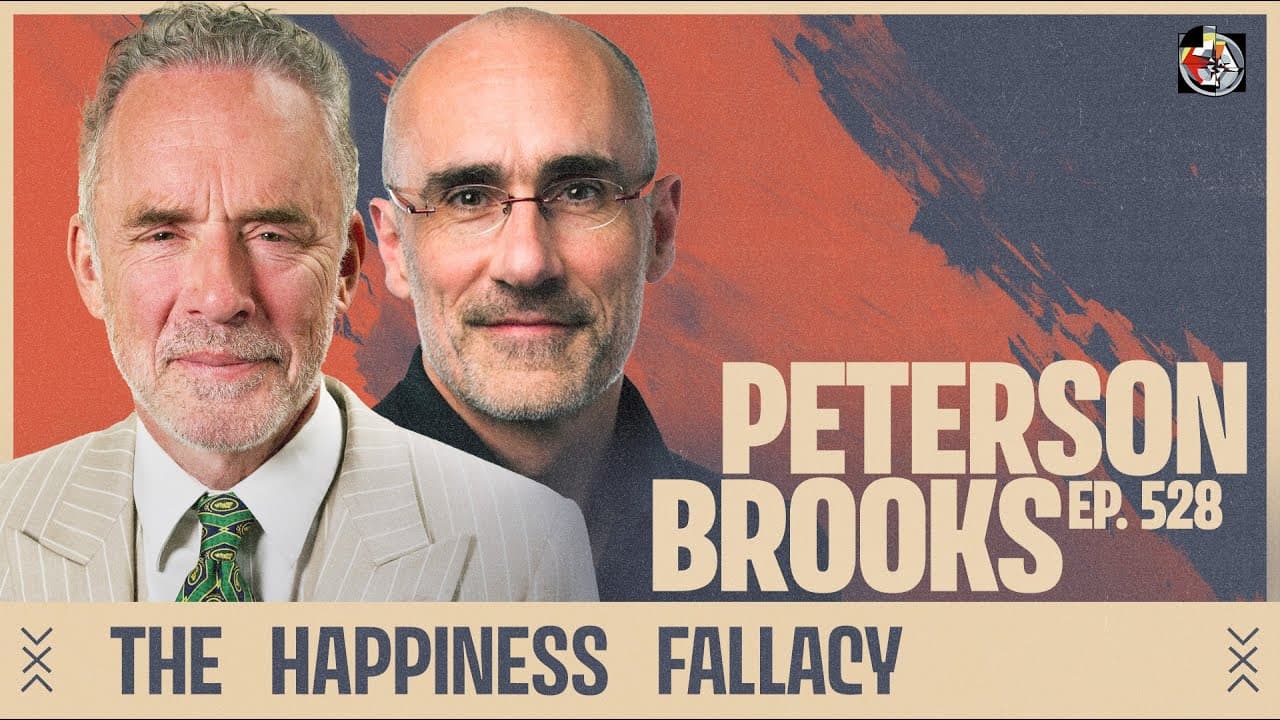
Arthur Brooks studies happiness through behavioral science, psychology, and neuroscience. His central concern is how people can gain greater access to love, happiness, meaning, and purpose. He distinguishes durable well-being from immediate gratification and presents happiness as something that can be understood and pursued through disciplined thought, mature goals, and practical action.
-
Immediate pleasure is not automatically good because pleasure seeking can become antisocial, unstable, and harmful over time. Brooks describes enjoyment as pleasure elevated into something reciprocal, social, future-oriented, repeatable, and stable. This transformation connects present satisfaction with wisdom, relationships, personal responsibility, and consequences that endure beyond a single gratifying moment.
-
Discernment begins by aiming upward even before the final destination is fully understood. Prayer, pilgrimage, contemplation, and undistracted mental space can help clarify both the goal and the path toward it. The discussion connects this process with the brain's capacity for broad understanding, imagination, mind wandering, and engagement with complex questions that resist simple solutions.
Read in Other Languages (beta)
Share This Summary 📚
Summarize YouTube Videos and Get Video Transcripts with 1-Click
Try YouTube Summary with ChatGPT & Claude or YouTube Transcript Generator
Explore More Summaries from Jordan B Peterson 📚





Summarize YouTube Videos and Get Video Transcripts with 1-Click
Try YouTube Summary with ChatGPT & Claude or YouTube Transcript Generator