What Are CSMA/CD and CSMA/CA Protocols?
TL;DR
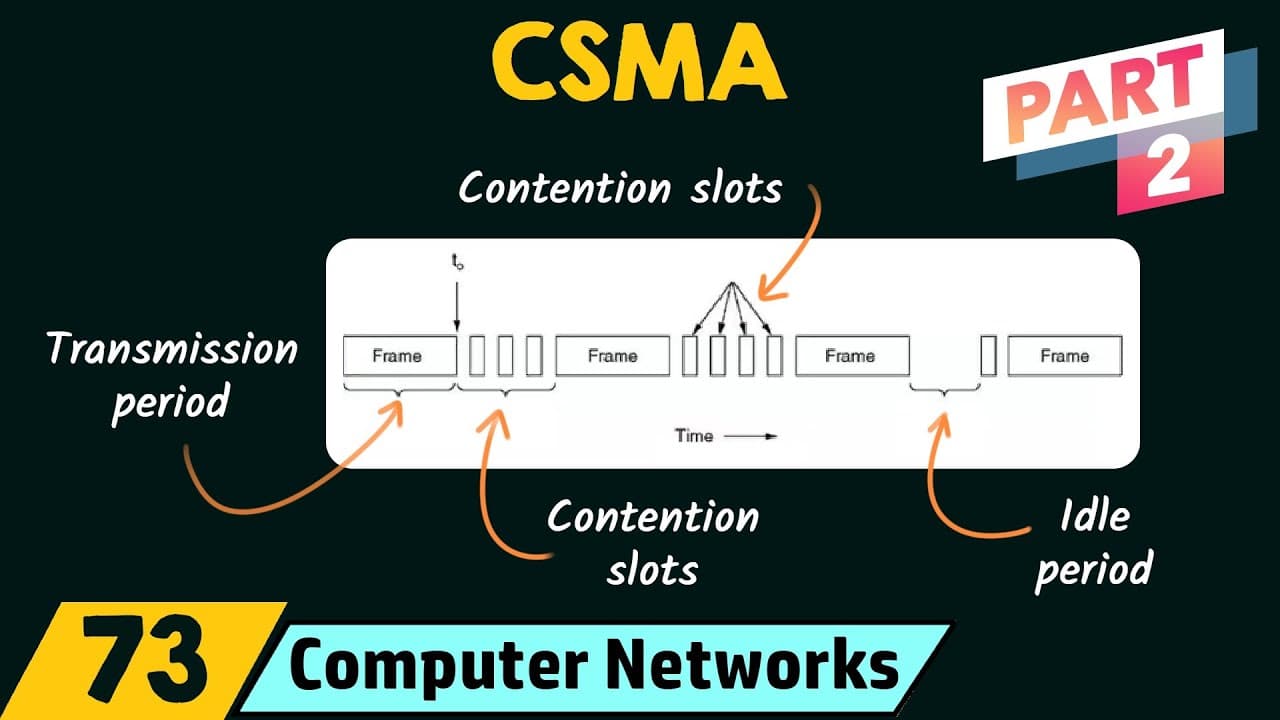
CSMA/CD (Carrier Sense Multiple Access with Collision Detection) is used in Ethernet networks to manage data transmission and halt when collisions occur. CSMA/CA (Carrier Sense Multiple Access with Collision Avoidance) is utilised in Wi-Fi networks, utilising RTS/CTS communication to prevent collisions before they happen. Both protocols enhance network efficiency but operate under different conditions.
Transcript
hello everyone welcome back in today's lecture we will see the part two of carrier sense multiple access CSMA in today's lecture we will be focusing on csma/cd and csma/ca as usual let's start the session with the outcomes upon the completion of the session the learner will be able to outcome number one we will know the various multiple access prot... Read More
Key Insights
- 🇭🇲 CSMA/CD and CSMA/CA are multiple access protocols used in wired and wireless LANs, respectively.
- 💥 CSMA/CD relies on collision detection, while CSMA/CA uses collision avoidance techniques.
- 🇫🇮 CSMA/CD is used in Ethernet networks, while CSMA/CA is used in Wi-Fi networks.
- 💥 CSMA/CD stops transmitting immediately upon collision detection, while CSMA/CA avoids collisions by exchanging RTS/CTS signals.
Install to Summarize YouTube Videos and Get Transcripts
Explore YouTube Video Summarizer or Get YouTube Transcript Extractor
Questions & Answers
Q: What is the difference between CSMA/CD and CSMA/CA?
CSMA/CD is used in wired LANs like Ethernet, where collision detection is possible. In CSMA/CD, stations detect collisions and stop transmission. CSMA/CA is used in wireless LANs like Wi-Fi, where collision detection is not possible. CSMA/CA avoids collisions by using an RTS/CTS exchange.
Q: Why is CSMA/CD not suitable for long-distance networks?
CSMA/CD is not suitable for long-distance networks because as the distance increases, the efficiency of CSMA decreases. It is better suited for local area networks (LANs) like Ethernet.
Q: How does CSMA/CD handle collisions?
In CSMA/CD, if two stations begin transmitting simultaneously and detect a collision, they abruptly stop transmitting. This avoids wasting time and bandwidth on corrupted frames.
Q: What is the solution for the hidden terminal and exposed terminal problems in CSMA/CA?
The solution for hidden terminal and exposed terminal problems in CSMA/CA is the RTS/CTS (Request to Send/Clear to Send) exchange. This helps avoid collisions in wireless networks.
Key Insights:
- CSMA/CD and CSMA/CA are multiple access protocols used in wired and wireless LANs, respectively.
- CSMA/CD relies on collision detection, while CSMA/CA uses collision avoidance techniques.
- CSMA/CD is used in Ethernet networks, while CSMA/CA is used in Wi-Fi networks.
- CSMA/CD stops transmitting immediately upon collision detection, while CSMA/CA avoids collisions by exchanging RTS/CTS signals.
- CSMA/CD is suitable for LANs, while CSMA/CA is designed for wireless networks and addresses the limitations of collision detection in such environments.
Summary & Key Takeaways
-
CSMA/CD (Carrier Sense Multiple Access with Collision Detection) is used in wired LAN technology, specifically in Ethernet networks.
-
CSMA/CD ensures that stations sense the channel before transmitting, and if a collision is detected, the transmission is stopped abruptly.
-
CSMA/CA (Carrier Sense Multiple Access with Collision Avoidance) is used in wireless LAN technology, such as Wi-Fi networks, where collision detection is not possible. It uses a RTS/CTS exchange to avoid collisions.
Read in Other Languages (beta)
Share This Summary 📚
Summarize YouTube Videos and Get Video Transcripts with 1-Click
Try YouTube Summary with ChatGPT & Claude or YouTube Transcript Generator
Explore More Summaries from Neso Academy 📚


Summarize YouTube Videos and Get Video Transcripts with 1-Click
Try YouTube Summary with ChatGPT & Claude or YouTube Transcript Generator