How Does a Turing Machine Read and Write Tape?
TL;DR
A Turing machine processes symbols on an infinite tape by reading or rewriting the symbol beneath its tape head, then moving the head one position left or right. Its tape provides greater computational power than the input-only structure of finite state machines and the input-plus-stack structure of pushdown automata, and it accepts recursively enumerable languages.
Transcript
till now in this lecture series we have been studying about finite state machines and pushed on automata we have studied about these two machines and we have also seen the class of languages they accept and now as we move one step ahead we are going to study about the next topic which is Turing machine so if you remember in the very first lecture o... Read More
Key Insights
- Finite state machines accept regular languages and use only an input string, together with a control that moves forward in one direction. This limited data structure gives them less memory and computational power than the other machines discussed in the lecture.
- Pushdown automata accept context-free languages and supplement the input string with a stack. The presence of this stack distinguishes them from finite state machines and allows them to accept a higher class of languages than regular languages.
- Turing machines are more powerful than both finite state machines and pushdown automata. The class of languages accepted by Turing machines is called recursively enumerable languages, which the lecture identifies as a topic for more detailed discussion later in the module.
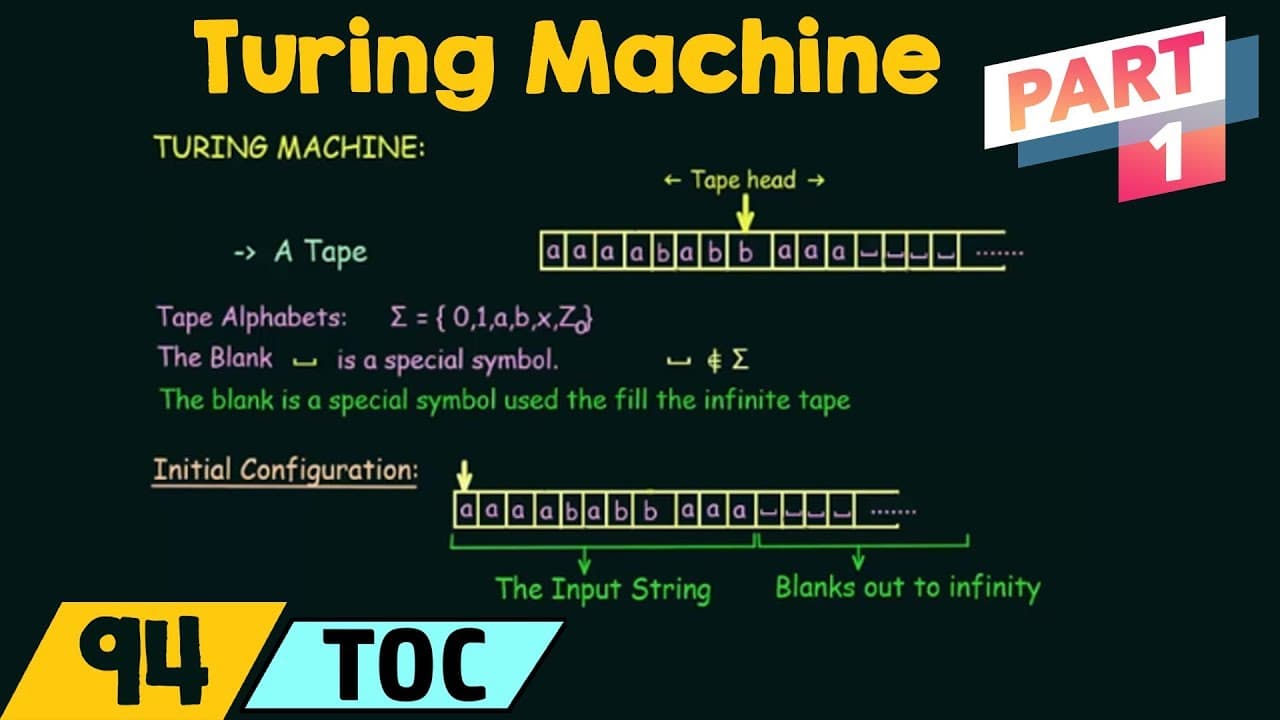
- A Turing machine tape is an infinite sequence of cells containing symbols. Input symbols are placed into some of these cells, while all remaining cells are filled with a designated blank symbol rather than being left without any symbol.
- The tape head identifies the cell where the machine's current control is positioned. Reading and writing are restricted to the single symbol directly beneath this head, so the machine must move the head to access another tape cell.
- The blank symbol is a special symbol used to fill otherwise empty cells across the infinite tape. According to the lecture, it does not belong to Sigma, which represents the collection of input symbols used on the tape.
- The initial tape configuration places the input symbols into consecutive cells and fills the continuing cells with blank symbols. The tape head begins at the leftmost end of the input before the machine starts performing its tape operations.
- A Turing machine can scan the current symbol, overwrite it with another symbol, and move its tape head. Each movement is limited to exactly one position, either left or right, with the direction determined by the computation being performed.
Install to Summarize YouTube Videos and Get Transcripts
Explore YouTube Video Summarizer or Get YouTube Transcript Extractor
Questions & Answers
Q: What is a Turing machine in theory of computation?
A Turing machine is a computational machine that uses an infinite tape and a movable tape head. The head marks the current control position, reads or rewrites the symbol directly beneath it, and moves one position left or right. It is presented as more powerful than finite state machines and pushdown automata, and it accepts recursively enumerable languages.
Q: How does a Turing machine tape work?
A Turing machine tape is an infinite sequence divided into cells. The input symbols are written into cells, and the remaining cells are filled with a special blank symbol. A tape head is positioned over one cell at a time. The machine can read or overwrite only that cell before moving the head one position left or right.
Q: What operations can a Turing machine perform on its tape?
A Turing machine can perform three basic kinds of tape operations. It can read or scan the symbol directly beneath the tape head, update or overwrite that symbol with another symbol, and move the tape head exactly one cell to the left or one cell to the right. The required computation determines which operation and direction are used.
Q: What is the purpose of the tape head in a Turing machine?
The tape head indicates the tape position where the machine's current control is present. It determines which symbol can be scanned or changed because the machine can read and write only the cell directly below the head. To access another symbol, the head must move exactly one position to the left or right.
Q: What is the blank symbol on a Turing machine tape?
The blank symbol is a special symbol used to fill the cells of the infinite tape that do not contain input symbols. The lecture states that the blank symbol does not belong to Sigma, which represents the input symbols. Filling unused cells with this symbol gives every illustrated tape cell a defined content rather than leaving it empty.
Q: How is a Turing machine different from a finite state machine?
A finite state machine has only an input string and a control that moves forward, so it has limited memory and accepts regular languages. A Turing machine instead has an infinite tape and a head that can read, overwrite, and move left or right. The lecture therefore describes the Turing machine as more powerful than the finite state machine.
Q: How is a Turing machine different from a pushdown automaton?
A pushdown automaton uses an input string together with a stack, and it accepts context-free languages. A Turing machine uses an infinite tape whose symbols can be read and overwritten by a movable head. The lecture identifies the Turing machine as more powerful than the pushdown automaton and associates it with recursively enumerable languages.
Q: What is the initial configuration of a Turing machine tape?
In the initial configuration shown in the lecture, the input symbols occupy cells on the tape, while the cells extending beyond the input are filled with blank symbols. The tape continues infinitely, and the tape head starts at the leftmost end of the input. Computation then proceeds through reading, writing, and one-position head movements.
Summary & Key Takeaways
-
Finite state machines accept regular languages and operate with only an input string and a control that moves forward. Pushdown automata add a stack, making them more powerful than finite state machines and enabling them to accept the higher class of languages known as context-free languages.
-
A Turing machine uses an infinite tape divided into cells. Input symbols occupy some cells, while the remaining cells contain a special blank symbol. A tape head identifies the current position of control and determines which single cell the machine can read or modify during an operation.
-
The tape head initially appears at the leftmost end of the input. At each operation, the machine can scan the symbol beneath the head, overwrite that symbol with another symbol, or move the head exactly one position to the left or right, depending on the required computation.
Read in Other Languages (beta)
Share This Summary 📚
Summarize YouTube Videos and Get Video Transcripts with 1-Click
Try YouTube Summary with ChatGPT & Claude or YouTube Transcript Generator
Explore More Summaries from Neso Academy 📚




Summarize YouTube Videos and Get Video Transcripts with 1-Click
Try YouTube Summary with ChatGPT & Claude or YouTube Transcript Generator