What Is Electric Potential Energy and How Is It Calculated?
TL;DR
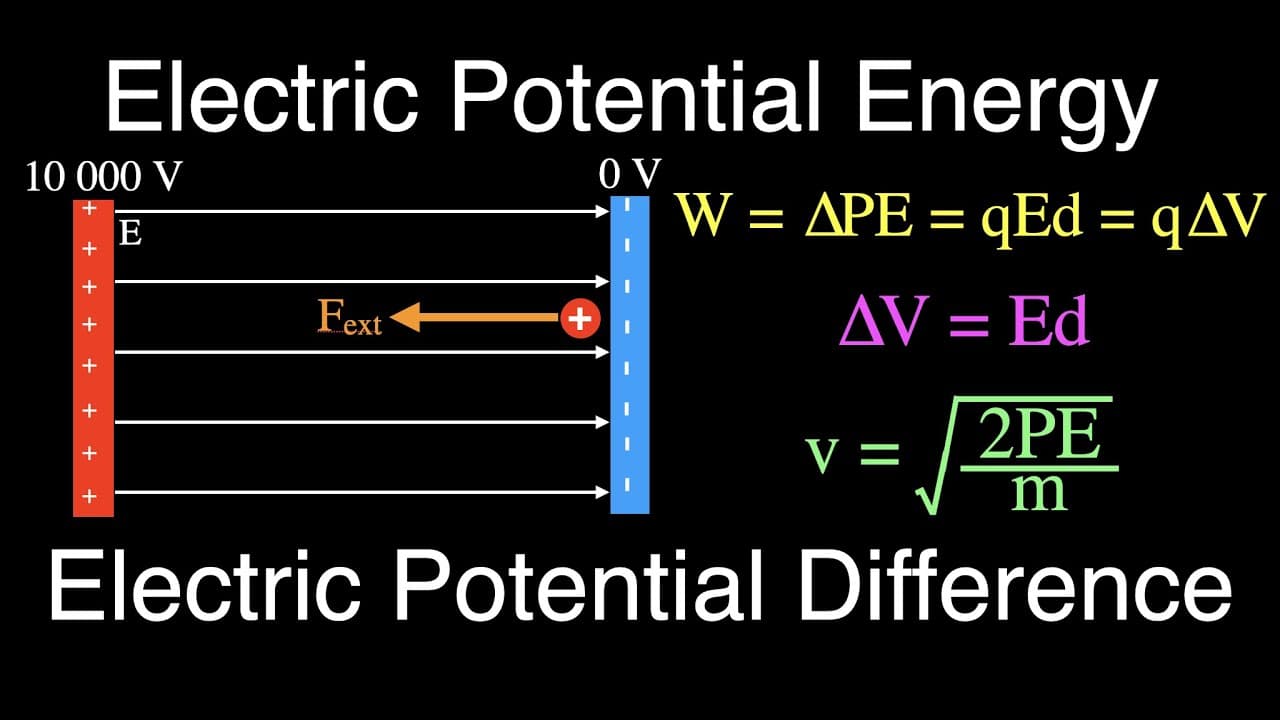
Electric potential energy is the work done on a charged particle when moving it through an electric field. It can be calculated using the formula W = qEd, where W is work, q is the charge, E is the electric field strength, and d is the distance moved. The change in potential energy equals the kinetic energy gained as the particle falls back to the lower potential.
Transcript
in today's video we're going to go over an explanation and two very interesting example problems for electric potential energy and electric potential difference when we're moving a charged particle through a uniform electric feel all right now before we get started please don't forget to subscribe to my channel step by step science get all my excel... Read More
Key Insights
- 🔌 Electric potential energy is the work done on a charged particle when moving through an electric field.
- 🈂️ Conservation of energy principles relate initial potential energy to final kinetic energy for charged particles.
- 🔌 Understanding electric potential difference provides insights into energy transformations in an electric field.
- 💦 Calculating work done, potential energy changes, and particle velocities requires knowledge of charge, electric field strength, and distance.
- 🔌 Electric potential difference is crucial in determining the energy per unit charge in an electric field.
- 👻 Application of work-energy concepts allows for the calculation of potential energy changes and kinetic energy of charged particles.
- 💦 Utilizing equations for work done, potential energy, and kinetic energy enables precise calculations in electric potential scenarios.
Install to Summarize YouTube Videos and Get Transcripts
Explore YouTube Video Summarizer or Get YouTube Transcript Extractor
Questions & Answers
Q: How is electric potential energy related to the work done when moving a charged particle in an electric field?
Electric potential energy is equal to the work done on a charged particle as it moves in an electric field, representing the energy transferred to the particle.
Q: What is the significance of electric potential difference in understanding the behavior of charged particles?
Electric potential difference measures the change in potential energy per unit charge in an electric field, providing insights into the energy dynamics of charged particle movements.
Q: How can conservation of energy principles be applied to calculate the velocity of charged particles in electric fields?
By equating initial potential energy to final kinetic energy, conservation of energy principles allow the calculation of particle velocity as potential energy converts to kinetic energy.
Q: Why is the concept of electric potential critical in analyzing the behavior of charged particles in an electric field?
Electric potential reflects the energy distribution in an electric field, influencing the movement of charged particles and enabling calculations of work done and potential energy changes.
Summary & Key Takeaways
-
Explanation of electric potential energy and electric potential difference in a uniform electric field.
-
Calculation of work done, potential energy change, and velocity of charged particles moving through electric fields.
-
Conservation of energy concept applied to calculate potential energy and kinetic energy transformations.
Read in Other Languages (beta)
Share This Summary 📚
Summarize YouTube Videos and Get Video Transcripts with 1-Click
Try YouTube Summary with ChatGPT & Claude or YouTube Transcript Generator
Explore More Summaries from Step by Step Science 📚
Summarize YouTube Videos and Get Video Transcripts with 1-Click
Try YouTube Summary with ChatGPT & Claude or YouTube Transcript Generator