Lecture 1 | Programming Paradigms (Stanford)

Transcript
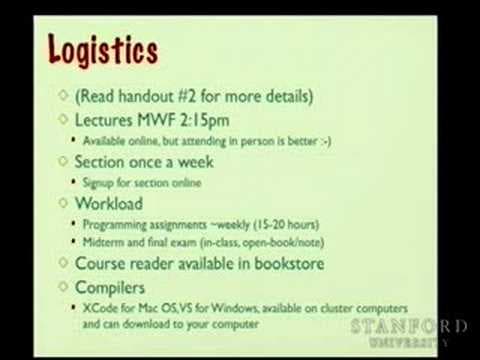
[music playing] >> This presentation is delivered by the Stanford Center for Professional Development. Jerry Cain: Okay. Here is, uh, in a nutshell, a reduced version of what's presented in handout two. This is the syllabus. I have, umm, several languages I'm gonna put on the board and, uh, one concept: C, Assembly, C++, Concurrent Programming-- th... Read More
Install to Summarize YouTube Videos and Get Transcripts
Explore YouTube Video Summarizer or Get YouTube Transcript Extractor
Summary
In this video, Jerry Cain introduces the different programming languages and paradigms that will be covered in the course. He emphasizes that the goal is not just to learn the languages, but to understand the paradigms they represent. He explains the procedural and object-oriented paradigms of C and C++, the compilation process of C and C++ code, the concept of concurrent programming, and the functional paradigm in Scheme. He also mentions the benefits of using Python for web programming and introduces the idea of building a miniature web server for the final project.
Questions & Answers
Q: What is the main goal of learning multiple programming languages?
The main goal is not to simply learn the languages themselves, but to understand the different paradigms that they represent.
Q: How is the thought process different when programming in C or C++ compared to Scheme or Python?
When programming in C or C++, the thought process is more procedure-oriented, focused on organizing functions and manipulating shared data through side effects. On the other hand, programming in Scheme or Python follows a functional paradigm, where the return value of a function is relied upon to move forward and side effects are avoided.
Q: Why are C and C++ still popular languages?
Despite the availability of newer languages, many people still stick with C and C++ because they are familiar with them and can write clean, readable code. However, it is easier to make memory errors in C due to the lack of error checking compared to C++.
Q: What is the purpose of learning assembly language in the course?
Learning assembly language is not about programming in assembly, but rather about understanding how C and C++ code compiles to assembly code. It provides insight into how variables, functions, and objects are translated into a collection of zeros and ones.
Q: What is concurrent programming and why is it useful?
Concurrent programming involves getting two or more functions to seemingly run simultaneously. Although they don't actually run at the same time, they switch back and forth so quickly that the difference is not noticeable. Concurrent programming can be useful in situations where multiple functions need to be executed concurrently, such as in networking.
Q: What challenges can arise in concurrent programming?
One challenge in concurrent programming is ensuring data integrity when multiple processes have access to shared resources. For example, when withdrawing money from an ATM, it is important to have directives in place to prevent two withdrawals from occurring simultaneously.
Q: What is the functional paradigm in Scheme?
The functional paradigm in Scheme involves relying on the return value of functions to move forward and avoiding side effects. It is a synthesis-based approach, where results or partial results are combined to produce the desired final result.
Q: Why is Python a popular language?
Python has gained popularity at significant companies due to its modern object-oriented design and its extensive libraries. It is especially useful for web programming, as it allows for dynamic generation of web pages based on database content. Python also supports procedural and even functional programming.
Q: What will the final project involve?
The final project will involve building a miniature web server in Python, which will demonstrate the use of Python's libraries and the client/server paradigm in web programming. It will also cover concepts such as parsing XML and understanding HTTP protocol.
Q: What other paradigms are briefly mentioned in the course?
There are a few other paradigms that are briefly mentioned in the course, but they all have some overlap with the paradigms covered in the course.
Read in Other Languages (beta)
Share This Summary 📚
Summarize YouTube Videos and Get Video Transcripts with 1-Click
Try YouTube Summary with ChatGPT & Claude or YouTube Transcript Generator
Explore More Summaries from Stanford 📚

Summarize YouTube Videos and Get Video Transcripts with 1-Click
Try YouTube Summary with ChatGPT & Claude or YouTube Transcript Generator