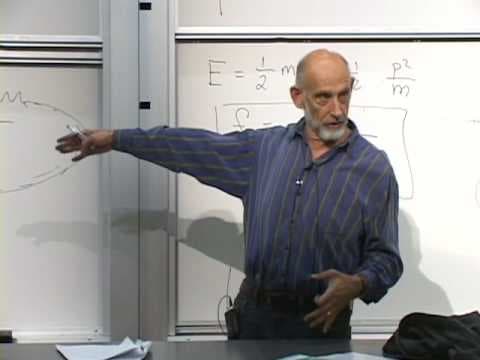
Lecture 3 | Modern Physics: Classical Mechanics (Stanford)

TL;DR
Explores the principle of least action and its role in classical mechanics.
Transcript
Read and summarize the transcript of this video on Glasp Reader (beta).
Key Insights
- The lecture focuses on the principle of least action, a fundamental concept in physics that states the true trajectory of a system minimizes the action, a quantity dependent on the entire trajectory.
- Integration by parts is a mathematical technique used in the lecture to manipulate integrals, particularly when dealing with functions and their derivatives.
- The Euler-Lagrange equation is derived from the principle of least action and provides a local description of the trajectory, equivalent to the global least action principle.
- Momentum conservation is discussed as a consequence of translation symmetry, where the potential energy only depends on the distance between particles.
- The lecture introduces the concept of rotational symmetry, which leads to the conservation of angular momentum when the potential energy depends only on the radial distance.
- The principle of least action is coordinate-independent, allowing its application to any coordinate system, including polar coordinates.
- The lecture emphasizes the deep connection between symmetries and conservation laws, a key theme in theoretical physics.
- Leonard Susskind uses various examples, including particles in gravitational fields and systems with rotational symmetry, to illustrate the application of the principle of least action.
Install to Summarize YouTube Videos and Get Transcripts
Explore YouTube Video Summarizer or Get YouTube Transcript Extractor
Questions & Answers
Q: What is the principle of least action?
The principle of least action is a fundamental concept in physics stating that the true trajectory of a system minimizes the action, a quantity that depends on the entire trajectory. It provides a global description of the system's behavior, equivalent to local laws like Newton's equations.
Q: How does integration by parts relate to the lecture?
Integration by parts is a mathematical technique used in the lecture to manipulate integrals, particularly when dealing with functions and their derivatives. It is employed to derive the Euler-Lagrange equation from the principle of least action, allowing the conversion of a global statement into a local differential equation.
Q: What is the Euler-Lagrange equation?
The Euler-Lagrange equation is derived from the principle of least action and provides a local description of a system's trajectory. It is a differential equation that relates the derivatives of the Lagrangian with respect to the coordinates and their velocities, serving as a foundation for deriving equations of motion in classical mechanics.
Q: What is the relationship between symmetries and conservation laws?
Symmetries in a physical system lead to conservation laws. For example, translation symmetry, where the potential energy depends only on the distance between particles, results in momentum conservation. Rotational symmetry, where the potential energy depends only on radial distance, leads to angular momentum conservation.
Q: How does the lecture illustrate momentum conservation?
Momentum conservation is illustrated through the example of translation symmetry. When the potential energy depends only on the distance between particles, the forces on each particle are equal and opposite, leading to the conservation of linear momentum, as shown in the equations derived from the Euler-Lagrange framework.
Q: What is the significance of rotational symmetry in the lecture?
Rotational symmetry is significant because it leads to the conservation of angular momentum. When the potential energy depends only on the radial distance, the system exhibits rotational symmetry, resulting in a conserved angular momentum, as demonstrated in the Euler-Lagrange equations for systems with rotational invariance.
Q: How does the principle of least action apply to different coordinate systems?
The principle of least action is coordinate-independent, meaning it can be applied to any coordinate system, including polar coordinates. The lecture demonstrates this by rewriting the Lagrangian and action in polar coordinates, showing that the principle still holds and provides the correct equations of motion for the system.
Q: What is the role of the Lagrangian in the principle of least action?
The Lagrangian is a function of the coordinates and velocities of a system, typically defined as the difference between kinetic and potential energy. In the principle of least action, the action is the integral of the Lagrangian over time, and the trajectory that minimizes this action is the true path of the system, leading to the Euler-Lagrange equations.
Summary
In this video, the speaker discusses the structure of the laws of physics and introduces the principle of least action. They explain that the laws of physics have a common form, which is the principle of least action. They also introduce the concept of Lagrangian, which is the difference between kinetic and potential energy, and show how it can be used to derive the equations of motion for a system.
Questions & Answers
Q: What is the principle of least action?
The principle of least action is a fundamental concept in physics that states that the true trajectory of a physical system is the one that minimizes the action, where action is defined as the integral of the Lagrangian along the trajectory.
Q: What is the Lagrangian?
The Lagrangian is a function that describes the difference between the kinetic and potential energy of a system. It is defined as L = T - U, where T is the kinetic energy and U is the potential energy. The Lagrangian is used to derive the equations of motion for a system.
Q: How does the principle of least action relate to the laws of physics?
The laws of physics can be derived from the principle of least action. The principle states that the true trajectory of a physical system is the one that minimizes the action. By varying the action with respect to the trajectory, we can derive the equations of motion for the system, which describe how the system evolves over time.
Q: How do the Lagrangian and the principle of least action relate to each other?
The Lagrangian is used to define the action of a system. The action is the integral of the Lagrangian along the trajectory of the system. The principle of least action states that the true trajectory of a system is the one that minimizes the action. In other words, the true trajectory is the one that makes the action as small as possible.
Q: Can you give an example of how the principle of least action is used to derive the equations of motion?
Let's consider a simple example of a particle moving in one dimension. The Lagrangian for this system is L = (1/2)m(x_dot)^2 - U(x), where m is the mass of the particle, x_dot is the velocity of the particle, and U(x) is the potential energy. By varying the action with respect to the position of the particle, we can derive the equation of motion as m(x_double_dot) = -dU/dx, which is Newton's second law.
Q: How does the principle of least action apply to systems with multiple particles?
The principle of least action can be applied to systems with multiple particles by considering the Lagrangian that describes the entire system. The Lagrangian is the sum of the Lagrangians for each individual particle. By varying the action with respect to the coordinates of each particle, we can derive the equations of motion for the system as the time derivative of the momentum of each particle is equal to the force acting on it.
Q: What are the Euler-Lagrange equations?
The Euler-Lagrange equations are a set of differential equations that are derived from the principle of least action. They describe the equations of motion for a system. In general, the Euler-Lagrange equations state that the time derivative of the derivative of the Lagrangian with respect to the velocity of a coordinate is equal to the derivative of the Lagrangian with respect to the coordinate.
Q: Why is the Lagrangian subtracted from the potential energy?
The Lagrangian is subtracted from the potential energy to ensure that the principle of least action is satisfied. By subtracting the Lagrangian, which represents the kinetic energy, from the potential energy, we ensure that the true trajectory of a system is the one that minimizes the action.
Q: Can the principle of least action be applied to other areas of physics besides mechanics?
Yes, the principle of least action can be applied to other areas of physics besides mechanics. It is a fundamental concept that can be used to describe the behavior of physical systems in various fields, such as electromagnetism, quantum mechanics, and even general relativity. In each case, the Lagrangian is defined differently based on the specific system, but the principle of least action still holds.
Q: Does the Lagrangian depend on the choice of coordinates or variables used to describe the system?
Yes, the Lagrangian can depend on the choice of coordinates or variables used to describe the system. The Lagrangian is a function of the coordinates and their derivatives, and the choice of coordinates can affect the form of the Lagrangian. However, the equations of motion derived from the Lagrangian are invariant under coordinate transformations, meaning that they hold true regardless of the choice of coordinates.
Takeaways
The principle of least action is a fundamental concept in physics that states that the true trajectory of a physical system is the one that minimizes the action, which is defined as the integral of the Lagrangian along the trajectory. The Lagrangian is a function that describes the difference between the kinetic and potential energy of a system and is used to derive the equations of motion for the system. The principle of least action can be applied to various areas of physics and is a powerful tool for understanding the behavior of physical systems. The Lagrangian and the principle of least action provide a unified framework for describing the laws of physics and can be used to derive the equations of motion for a wide range of systems.
Summary & Key Takeaways
-
Leonard Susskind's lecture delves into the principle of least action, a core concept in classical mechanics, explaining how it provides a global description of trajectories. He derives the Euler-Lagrange equation, showing its equivalence to local laws like Newton's equations.
-
The lecture highlights the connection between symmetries and conservation laws, using examples such as translation symmetry leading to momentum conservation and rotational symmetry resulting in angular momentum conservation.
-
Susskind discusses the coordinate independence of the principle of least action, applying it to various coordinate systems, including polar coordinates, and demonstrating its versatility in describing mechanical systems.
Read in Other Languages (beta)
Share This Summary 📚
Summarize YouTube Videos and Get Video Transcripts with 1-Click
Try YouTube Summary with ChatGPT & Claude or YouTube Transcript Generator
Explore More Summaries from Stanford 📚
Summarize YouTube Videos and Get Video Transcripts with 1-Click
Try YouTube Summary with ChatGPT & Claude or YouTube Transcript Generator