Advanced Quantum Mechanics Lecture 3
TL;DR
This content analyzes the concept of angular momentum and its applications in quantum mechanics, specifically in the context of the central force problem. It also explores the harmonic oscillator and its significance in various physical systems.
Transcript
Stanford University okay if we're ready let's go then we talked last time about angular momentum operators and I started to show you how the algebra of the angular momentum operators works how multiplets with different angular momentum have certain numbers of states and the states form the code multiplets I'll come back to them in a minute but let'... Read More
Key Insights
- 🏑 Angular momentum is a conserved quantity in systems with rotational symmetry and determines the behavior of particles in central force fields.
- 👋 The wave function in quantum mechanics describes the behavior of particles and incorporates both the radial and angular dependence of the system.
- 📐 The energy levels and wave functions in quantum systems are determined by the angular momentum, which is characterized by its magnitude and angular dependence.
Install to Summarize YouTube Videos and Get Transcripts
Explore YouTube Video Summarizer or Get YouTube Transcript Extractor
Questions & Answers
Q: What is the relationship between angular momentum and the orbital plane in classical mechanics?
In classical mechanics, angular momentum is conserved, and the angular momentum vector is always perpendicular to the orbital plane, which remains unchanged as the radial position of the particle changes.
Q: How does the angular momentum operator affect the wave function in quantum mechanics?
The angular momentum operator determines the angular dependence of the wave function, which describes the behavior of a quantum particle in a central force field. It helps determine the energy levels and wave functions in the system.
Q: What role does the radial dependence of the wave function play in the angular momentum operator?
The radial dependence of the wave function is separate from the angular momentum in quantum mechanics. While the angular momentum is determined by the angular dependence of the wave function, the radial dependence is irrelevant to the angular momentum and is more related to the energy of the system.
Q: How does the structure of the angular momentum operators in quantum mechanics differ from momentum operators in classical mechanics?
In quantum mechanics, the angular momentum operators do not commute with each other, leading to additional terms in the algebra. This difference arises due to the wave nature of particles, and it impacts the behavior and properties of angular momentum in quantum systems.
Summary
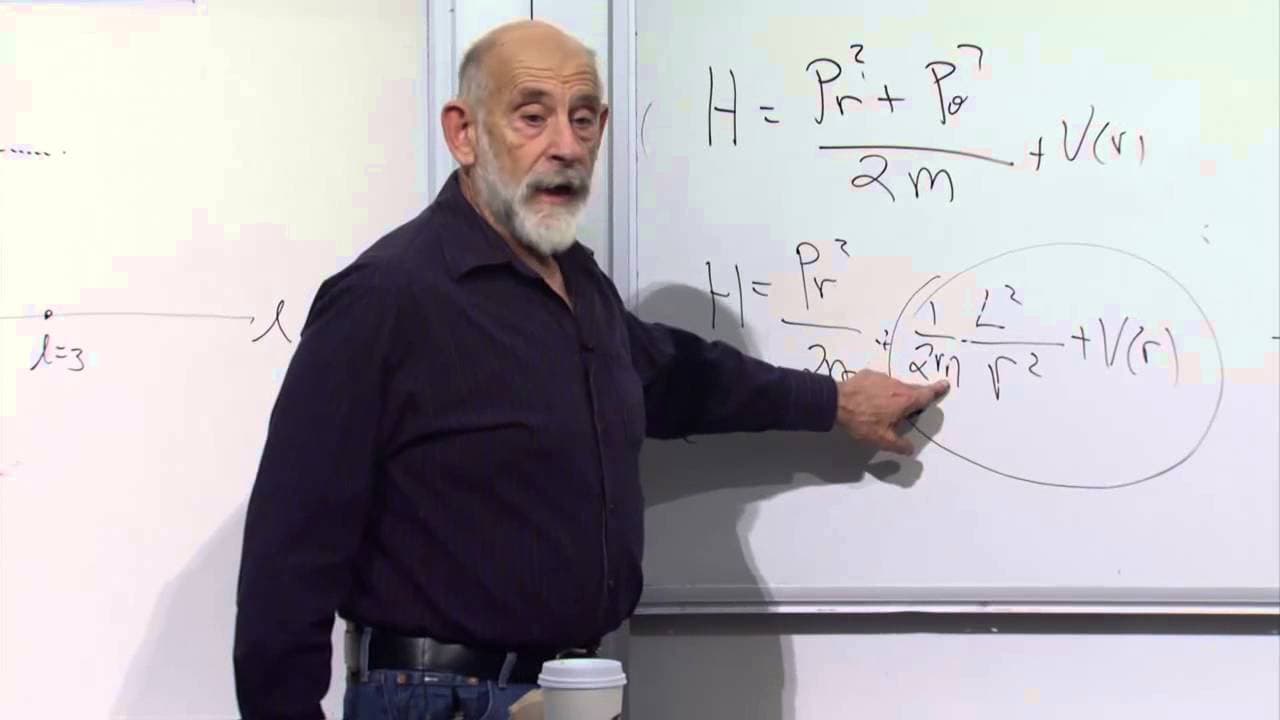
In this video, the speaker discusses angular momentum in quantum mechanics. They explain that angular momentum is conserved and that the orbital plane of an object moving in a central force field is also conserved. The speaker then introduces the concept of angular momentum operators and their algebra. They show how the square of the magnitude of the angular momentum can be expressed in terms of angular momentum operators. The speaker also discusses multiplets and how they relate to the angular dependence of wave functions. Finally, they explore the central force problem and the effective potential energy associated with it.
Questions & Answers
Q: What is conserved in a central force field?
In a central force field, angular momentum is conserved. The orbital plane of the object is also conserved.
Q: What are angular momentum operators?
Angular momentum operators are mathematical operators that represent the angular momentum of a particle. They have specific algebraic relationships, such as the commutation relations LX with LY equals I LZ.
Q: How does the angular momentum affect the wave function in a central force field?
The angular momentum operator has to do with the angular dependence of the wave function. Angular momentum eigenstates are functions that satisfy a differential equation involving the derivative with respect to the angular position.
Q: What determines the angular momentum of a state?
The angular momentum of a state is determined by the functions Y(theta, phi), which are analogous to e to the IL theta in two dimensions. These functions change when the configuration is rotated, and thus determine the angular momentum of the state.
Q: What are multiplets?
Multiplets are collections of states with different angular momentum values. Each multiplet has 2L + 1 states, where L is the maximum value of the angular momentum for that multiplet.
Q: What is the significance of the square of the magnitude of the angular momentum?
The square of the magnitude of the angular momentum is an operator that characterizes the angular dependence of wave functions. It is equal to L times (L + 1), where L is the maximum value of the angular momentum for a given multiplet.
Q: How does the central force problem impact the motion of a particle?
In the central force problem, the motion of a particle is restricted to a two-dimensional plane. The motion can be circular or oscillatory, depending on the potential energy and angular momentum of the system.
Q: How does the Schrodinger equation help us understand the central force problem?
The Schrodinger equation describes the behavior of wave functions in a given potential. By solving the equation for the central force problem, we can determine the energy levels and wave functions of the system.
Q: What determines the energy levels of a system in the central force problem?
The number of nodes in the wave function characterizes the energy levels of a system. Higher energy levels correspond to wave functions with more nodes.
Q: What is the effective potential energy in the central force problem?
The effective potential energy in the central force problem combines the original potential energy with an additional term related to the angular momentum. This term is repulsive and prevents the particle from getting too close to the origin.
Summary & Key Takeaways
-
Angular momentum is a conserved quantity in systems with rotational symmetry, and it is characterized by its magnitude, direction, and angular dependence.
-
The angular momentum operator plays a role in determining the angular dependence of the wave function in quantum mechanics.
-
The central force problem involves solving the Schrodinger equation for a particle in a central force field, with the angular momentum determining the energy levels and wave functions.
Read in Other Languages (beta)
Share This Summary 📚
Summarize YouTube Videos and Get Video Transcripts with 1-Click
Try YouTube Summary with ChatGPT & Claude or YouTube Transcript Generator
Explore More Summaries from Stanford 📚



Summarize YouTube Videos and Get Video Transcripts with 1-Click
Try YouTube Summary with ChatGPT & Claude or YouTube Transcript Generator