Lecture 2 | New Revolutions in Particle Physics: Basic Concepts

Transcript
Stanford University alright um as I said the basic tool of the trade is quantum field theory and that is what we're going to spend a little bit of time learning I'm going to teach you a very elementary version of what a quantum field is I think tonight but I do want to get up on the blackboard some basic mathematical facts just to review and to rem... Read More
Install to Summarize YouTube Videos and Get Transcripts
Explore YouTube Video Summarizer or Get YouTube Transcript Extractor
Summary
In this video, the lecturer discusses the basic concepts of quantum field theory and quantum mechanics. He explains the relationship between waves and particles, the mathematical facts of sines and cosines, and the properties of exponential functions. He also covers the concepts of frequency, wavelength, energy, and momentum for both photons and non-relativistic particles.
Questions & Answers
Q: What is the meaning of an exponential function?
An exponential function is a function that grows or decays by a constant factor over equal intervals of its independent variable. It is characterized by the property that its derivative is proportional to itself, and it is denoted as e to the power of some constant times the independent variable. Exponential functions can be used to describe various phenomena, such as population growth or decay.
Q: How are sines and cosines related to waves?
Sines and cosines are mathematical functions that describe wave-like oscillations. When plotted on a graph, a sine function looks like a wave with peaks and troughs, while a cosine function is a shifted version of the sine function. Both functions can be differentiated to obtain expressions for their rates of change, which have unique properties.
Q: How are sines and cosines different from exponential functions?
Unlike exponential functions, sines and cosines do not have the property that their derivatives are proportional to themselves. Instead, the derivatives of sine and cosine functions are related to each other and have a periodic nature. For sine of KX, the derivative with respect to X is equal to K times the cosine of KX, while the derivative of cosine of KX is equal to minus K times the sine of KX.
Q: Can exponential functions be derived from sine and cosine functions?
Exponential functions can be derived from combinations of sine and cosine functions. By taking the combination of cosine KX and I times sine KX, where I is the square root of -1, and differentiating it with respect to X, we obtain a function that is equal to I times K times the original combination. This leads to the conclusion that cosine KX plus I sine KX is equivalent to e to the power of I times KX.
Q: How are frequency and wavelength related for waves in general?
For any wave, the frequency and wavelength are inversely related. The frequency of a wave is the number of cycles that pass by a point in one second, while the wavelength is the distance traveled by the wave in one complete cycle. These two quantities are related by the equation frequency times wavelength equals the speed of light (or the speed of sound, depending on the type of wave).
Q: What is the energy of a single photon of an electromagnetic wave?
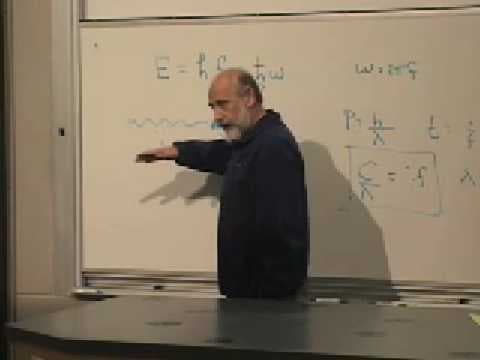
The energy of a single photon of an electromagnetic wave is given by the equation energy equals Planck's constant times the frequency of the wave. This equation holds true for any electromagnetic wave, whether it is visible light or a wave of a different frequency. The energy of a photon is always proportional to its frequency and inversely related to its wavelength.
Q: How does the momentum of a photon depend on its wavelength?
The momentum of a photon is inversely proportional to its wavelength. This relationship follows from the equation for momentum, which is Planck's constant divided by the wavelength of the photon. A shorter wavelength corresponds to a larger momentum for the photon.
Q: Is the amplitude of a wave related to the number of photons?
The amplitude of a wave, which describes the maximum displacement of the wave from its equilibrium position, is related to the number of photons in the wave. The square of the amplitude is proportional to the number of photons in the wave. This means that a wave with a larger amplitude contains a larger number of photons.
Q: How can momentum be conserved in a wave that reflects at the boundary?
Momentum can be conserved in wave motion by considering a periodic space or a closed circle instead of an infinite space. In this case, when a wave reaches the end, it continues to propagate along the periodic space, effectively preserving its momentum. This approach allows for the conservation of momentum and avoids the violation of momentum conservation that occurs with a reflecting boundary condition.
Q: How is momentum quantized in a periodic space?
In a periodic space or a closed circle, momentum is quantized, meaning it can only take on discrete multiples of a certain unit. This quantization arises due to the periodic nature of the space, where the wave continues to cycle around instead of reflecting at the boundary. The quantization of momentum is a consequence of considering waves in a finite system with periodic boundary conditions.
Takeaways
In this video, the lecturer discussed the basics of quantum field theory and quantum mechanics. He explained the relationships between waves and particles, the mathematical properties of exponential functions, and the concepts of frequency, wavelength, energy, and momentum for photons and non-relativistic particles. The video emphasized the importance of using periodic boundary conditions to preserve momentum conservation and avoid the issue of boundary reflections. Overall, these concepts lay the groundwork for understanding quantum mechanics and its applications to particle physics.
Read in Other Languages (beta)
Share This Summary 📚
Summarize YouTube Videos and Get Video Transcripts with 1-Click
Try YouTube Summary with ChatGPT & Claude or YouTube Transcript Generator
Explore More Summaries from Stanford 📚


Summarize YouTube Videos and Get Video Transcripts with 1-Click
Try YouTube Summary with ChatGPT & Claude or YouTube Transcript Generator