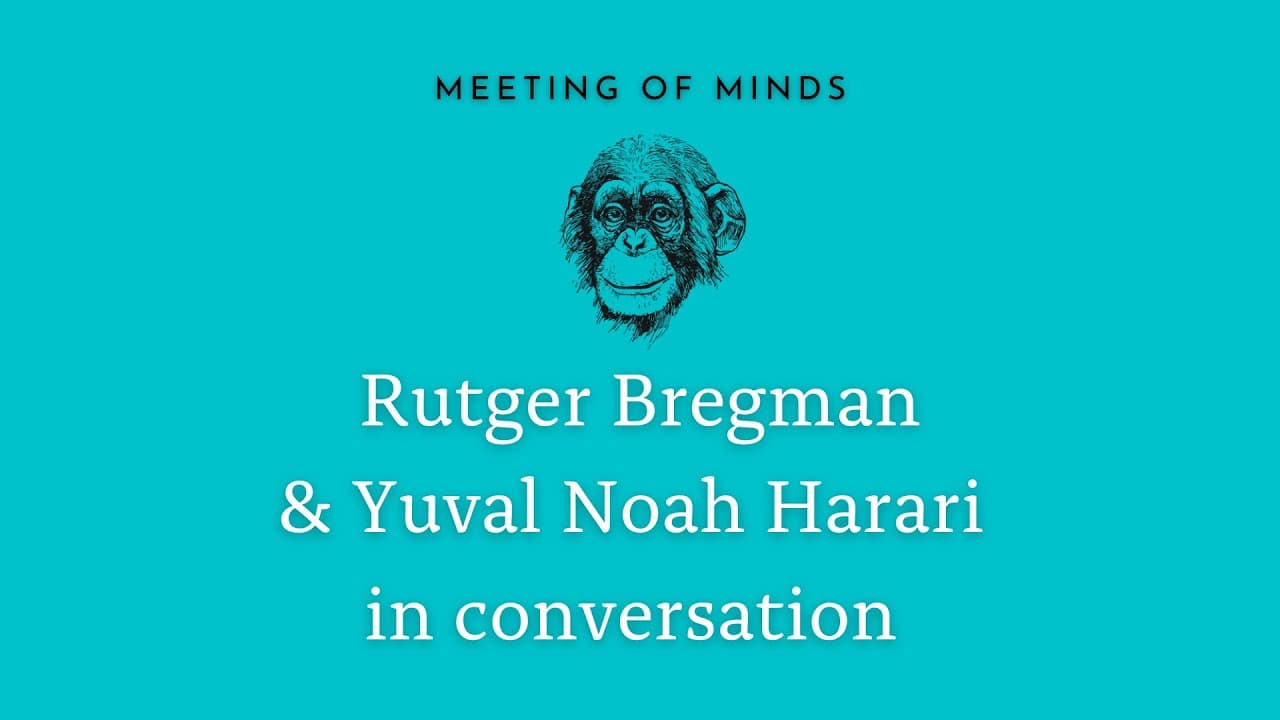
Rutger Bregman & Yuval Noah Harari : What makes humans special?
TL;DR
Humans are special because they can cooperate, with friendliness supporting small-group collaboration and shared stories coordinating millions or even billions of people. Self-domestication theory proposes that, over millennia, friendlier humans had more children and passed on their genes. Yet individual humans can lose intelligence tests to pigs or chimpanzees, shifting the explanation away from intelligence alone. Read on to see how cooperation and storytelling explain humanity’s global power.
Transcript
you know one of the big questions that both historians and philosophers and i think both yuval and me have been interested in for such a long time is what makes human beings special why did we conquer the globe what is our secret superpower for a very long time we like to believe that you know it must have been god's plan that we were chosen by som... Read More
Key Insights
- 😌 The secret superpower of human beings lies in their capacity to work together and cooperate.
- 🥺 The self-domestication theory suggests that humans have evolved to be more friendly and cooperative, leading to their success as a species.
- 🖐️ Friendliness is essential for cooperation in small groups, while storytelling plays a more significant role in mobilizing and coordinating large populations.
Install to Summarize YouTube Videos and Get Transcripts
Explore YouTube Video Summarizer or Get YouTube Transcript Extractor
Questions & Answers
Q: What makes humans special according to Rutger Bregman and Yuval Noah Harari?
Both identify large-scale cooperation as humanity’s secret superpower. Bregman emphasizes friendliness and self-domestication, while Harari argues that storytelling enables millions or even billions of people to coordinate around the same story.
Q: Why is intelligence alone insufficient to explain human success?
Individual humans are not always more impressive than other animals in intelligence tests. The transcript notes that a human toddler competing with a pig or chimpanzee will quite often lose, so humanity’s global success requires another explanation.
Q: What is the self-domestication theory?
Self-domestication theory proposes that humans domesticated themselves over millennia. The friendliest individuals had the most children and therefore the greatest chance of passing their genes to the next generation.
Q: What does “survival of the friendliest” mean?
The phrase describes the idea that friendliness and cooperation, rather than individual superiority, drove human success. This capacity to work together is presented as humanity’s secret superpower.
Q: How does friendliness help humans cooperate?
Friendliness is described as essential for cooperation in small groups. Harari gives examples of groups numbering 10, 50, or 100 people, while questioning whether friendliness can organize much larger populations.
Q: Why is storytelling important for large-scale cooperation?
Storytelling allows millions or sometimes billions of people to believe in the same story and coordinate their actions. Harari argues that this shared belief, even when the story is not true, helps explain why humans control the planet rather than chimpanzees.
Q: How do Bregman and Harari differ on the source of human cooperation?
Bregman presents friendliness and self-domestication as the foundation of humanity’s cooperative power. Harari agrees that cooperation is central but says friendliness works mainly in small groups, whereas storytelling mobilizes populations of a million or even eight billion people.
Q: What social implications does the self-domestication theory have?
It offers a newer and more hopeful view of human nature centered on friendliness and cooperation. Bregman says this perspective has major implications for how people organize democracy and design workplaces and schools.
Summary & Key Takeaways
-
The question of what makes human beings special has long puzzled historians and philosophers, with different explanations arising in different eras, from god's plan to evolutionary superiority.
-
However, individually, humans are not remarkably impressive compared to other animals in terms of intelligence.
-
The self-domestication theory suggests that the real distinguishing factor for humans is their capacity to work together and cooperate, giving rise to the concept of "survival of the friendliest."
Read in Other Languages (beta)
Share This Summary 📚
Summarize YouTube Videos and Get Video Transcripts with 1-Click
Try YouTube Summary with ChatGPT & Claude or YouTube Transcript Generator
Explore More Summaries from Yuval Noah Harari 📚




Summarize YouTube Videos and Get Video Transcripts with 1-Click
Try YouTube Summary with ChatGPT & Claude or YouTube Transcript Generator