What Is the Economic Machine and How Does It Work?
TL;DR
The economic machine functions as a collection of transactions involving the exchange of money and credit for goods and services. It operates primarily through credit, which facilitates spending and drives economic activity. Two main debt cycles, short-term and long-term, dictate fluctuations in the economy, influenced by credit availability and borrower behavior.
Transcript
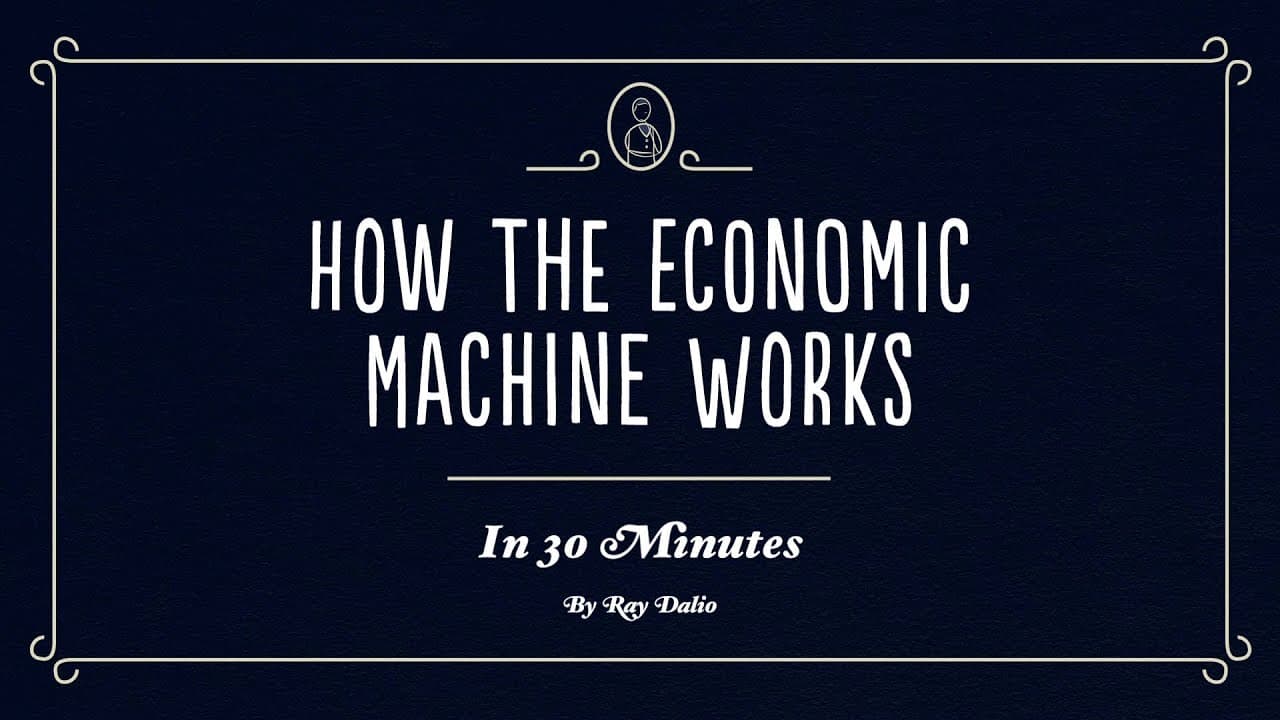
How the economic machine works, in 30 minutes. The economy works like a simple machine. But many people don't understand it — or they don't agree on how it works — and this has led to a lot of needless economic suffering. I feel a deep sense of responsibility to share my simple but practical economic template. Though it's unconventional, it has h... Read More
Key Insights
- 🏍️ The economy is driven by transactions, credit, and debt cycles.
- 👻 Credit is the most important part of the economy and allows borrowers to increase their spending.
- 🍉 There are short-term and long-term debt cycles, with the latter leading to periods of deleveraging.
- 🤑 During a deleveraging, proper balance between cutting spending, reducing debt, wealth redistribution, and printing money is crucial.
- 🥺 The process of deleveraging can lead to a "lost decade" but can also fix the underlying problem and lead to economic stability.
Install to Summarize YouTube Videos and Get Transcripts
Explore YouTube Video Summarizer or Get YouTube Transcript Extractor
Questions & Answers
Q: How does the economy work in a simple, mechanical way?
The economy is driven by transactions, where buyers exchange money or credit with sellers for goods, services, or financial assets. These transactions, repeated over and over again, form the building blocks of the economic machine.
Q: What role does credit play in the economy?
Credit is the most important part of the economy because it allows borrowers to increase their spending. This increased spending leads to more income for others, creating a self-reinforcing pattern of economic growth.
Q: What are the two types of debt cycles?
The short-term debt cycle lasts 5-8 years and is driven by the availability of credit. The long-term debt cycle lasts 75-100 years and is characterized by rising debt levels and eventual deleveraging.
Q: How does the deleveraging process work?
Deleveraging occurs when debt burdens become too high. The four ways to reduce debt burdens are cutting spending, debt restructuring, wealth redistribution, and printing money. If handled well, a deleveraging can result in a "beautiful" process of reducing debt burdens and stabilizing the economy.
Summary & Key Takeaways
-
The economy works like a simple machine, made up of transactions that involve buyers and sellers exchanging money and credit for goods and services.
-
Credit is the most important part of the economy, as it allows borrowers to increase their spending, which drives the economy.
-
There are two debt cycles: a short-term cycle that lasts 5-8 years and a long-term cycle that lasts 75-100 years, and they are primarily driven by credit availability.
Read in Other Languages (beta)
Share This Summary 📚
Summarize YouTube Videos and Get Video Transcripts with 1-Click
Try YouTube Summary with ChatGPT & Claude or YouTube Transcript Generator
Explore More Summaries from Principles by Ray Dalio 📚


Summarize YouTube Videos and Get Video Transcripts with 1-Click
Try YouTube Summary with ChatGPT & Claude or YouTube Transcript Generator