How to think for yourself beyond your default setting
TL;DR
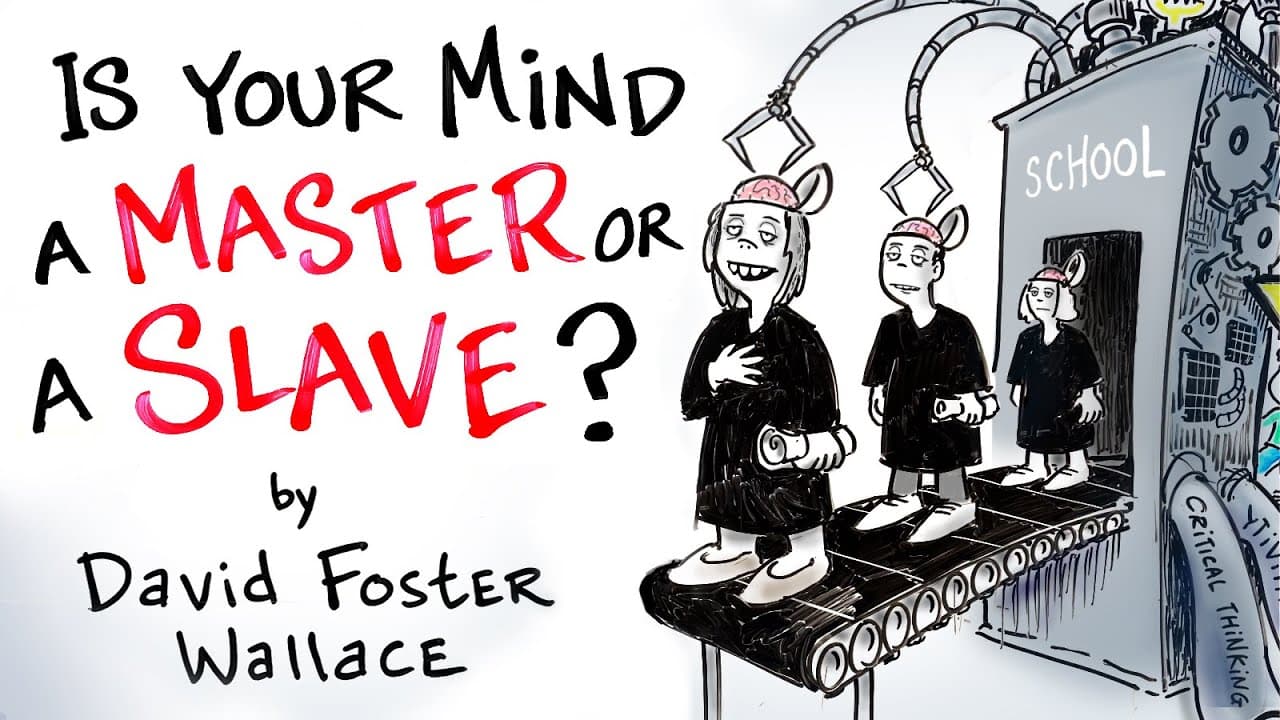
Your liberal arts education teaches you to choose what to think and to notice the water you swim in. It warns against self centered default thinking and shows how boredom and routine shape life; best outcome is learning to control attention and meaning.
Transcript
greetings thanks and congratulations to Kenyon's graduating class of 2005 If anybody feels like perspiring I'd invite you to go ahead because I'm sure going to There are these two young fish swimming along and they happen to meet an older fish swimming the other way who nods at them and says "morning boys how's the water?" and the two young fish sw... Read More
Key Insights
- The water parable demonstrates that obvious realities are hard to see and require mindful attention.
- Liberal arts education is framed as teaching you what to think about, not merely how to think.
- Learning to think means learning to exercise control over your thoughts and attention.
- The default self centered setting is a natural habit that can imprison perception.
- Persistent certainty in beliefs can resemble arrogance and distort interpretation.
- Mindful awareness helps avoid becoming unconscious in daily life.
- Boredom and routine are real parts of adult life that good thinking can help you endure.
- True education aims to prevent a life lived perpetually on automatic pilot and instead fosters deliberate choice.
Install to Summarize YouTube Videos and Get Transcripts
Explore YouTube Video Summarizer or Get YouTube Transcript Extractor
Questions & Answers
Q: How does the water parable relate to thinking clearly?
The water parable is used to illustrate that the most obvious realities are often the hardest to see, suggesting that clear thinking requires recognizing and questioning the default assumptions we swim in every day. It highlights the need to look beyond surface explanations to understand how we interpret experience and choose meaning.
Q: What does the speaker say liberal arts education should teach you to do?
The speaker argues that liberal arts education is less about filling you with facts and more about teaching you how to think, specifically by learning what to think about and how to pay attention. This means cultivating awareness of your internal monologue and the sources of your beliefs and judgments.
Q: Why is attention control emphasized as a core skill?
Attention control is essential because it determines what you notice and how you construct meaning from experience. If you cannot choose what to focus on, you risk being overwhelmed by automatic thoughts and default settings, leading to a life governed by distractions rather than deliberate, conscious choice.
Q: What is meant by the default setting, and why is it problematic?
The default setting refers to the ingrained habit of viewing oneself as the absolute center of the world. This self centered perspective shapes perceptions and can make it difficult to understand others or interpret experiences fairly, contributing to arrogance and a lack of genuine empathy.
Q: How does arrogance relate to interpreting experiences according to the talk?
Arrogance affects interpretation by making a person certain that their own belief template is the correct one, which can distort meaning and hinder openness to alternative perspectives. The speech argues that acknowledging uncertainty and being willing to revise beliefs is part of learning to think.
Q: What common life experiences are used to illustrate the need for mindful thinking?
The speaker describes everyday frustrations like grocery shopping and long supermarket lines to show how routine life can feel soul draining. The point is that mindful thinking helps manage these annoyances without losing perspective or slipping into automatic, unexamined responses, highlighting the value of deliberate choice under pressure.
Q: What is the ultimate value of liberal arts education, according to the speaker?
The ultimate value is not merely knowledge but the ability to keep from living life as a dead unconscious slave to the head. By learning to choose what to think about and how to interpret experiences, graduates can avoid a life of auto pilot and pursue more conscious, meaningful living.
Q: How should one respond to the realization of one’s own default setting?
One should respond with critical self awareness, recognizing that much of what is taken as reality is filtered through a self centered lens. The talk proposes that questioning one’s own certainties and learning to adjust the default setting are essential steps toward more thoughtful, empathetic engagement with the world.
Summary & Key Takeaways
-
The speech argues that obvious realities like water are invisible because our default setting makes us the center of experience, and the education should expose that. It reframes liberal arts as training in what to think about, not just how to think.
-
It emphasizes conscious choice in attention and interpretation, warning that without such control you risk living on autopilot and becoming a slave to your head.
-
Concrete examples describe everyday frustrations and how a trained mind can navigate them without losing humanity or perspective.
Read in Other Languages (beta)
Share This Summary 📚
Summarize YouTube Videos and Get Video Transcripts with 1-Click
Try YouTube Summary with ChatGPT & Claude or YouTube Transcript Generator
Explore More Summaries from After Skool 📚





Summarize YouTube Videos and Get Video Transcripts with 1-Click
Try YouTube Summary with ChatGPT & Claude or YouTube Transcript Generator