What Does Plato's Allegory of the Cave Teach?
TL;DR
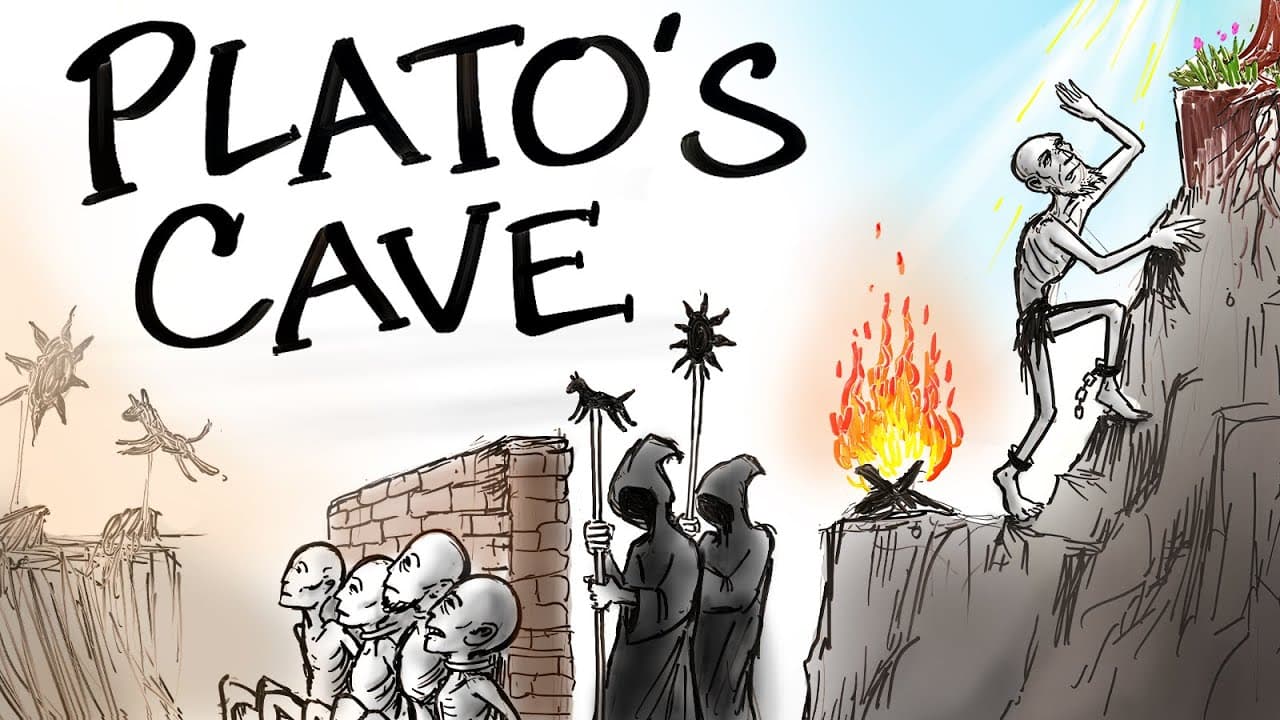
The video explains that Plato uses the cave to show how people mistake shadows for reality, and how the enlightened individual seeks true knowledge by moving from illusion to the world of forms. It links the allegory to the hero’s journey and Prometheus, highlighting resistance to new ideas and the philosopher’s duty to share wisdom.
Transcript
Soren Kierkegaard was right there are two ways to be fooled one is to believe what isn't true the other is to refuse to believe what is true it's a fact that for most of our Lives we humans unconsciously bask in ignorance but sometimes special people come along to wake us from this state that some would call Bliss in fact the myth of the hero w... Read More
Key Insights
- Plato’s allegory uses a subterranean cave to illustrate how senses can deceive and how perception shapes belief.
- The freed prisoner represents the philosopher who discovers the world of forms and the true source of knowledge beyond shadows.
- The escape from the cave mirrors the journey from ignorance to enlightenment and the challenge of adapting to new perspectives.
- The sun in the allegory symbolizes the form of the Good, the source of light and truth in the realm of forms.
- The return to the cave shows the difficulty of teaching others who are still bound to illusion.
- The narrative is tied to Socrates and the Republic, linking epistemology with political and ethical questions.
- The myth of Prometheus echoes the theme of bringing fire or knowledge to humanity, provoking resistance.
- The hero’s journey structure is used to map departure, initiation, and return as universal motifs in myths and philosophy.
Install to Summarize YouTube Videos and Get Transcripts
Explore YouTube Video Summarizer or Get YouTube Transcript Extractor
Questions & Answers
Q: What is the basic message of Plato's Allegory of the Cave?
The basic message is that human perception is often limited to shadows of reality rather than its true form. Through philosophical inquiry, a person can come to understand the world of forms, which is more real than the sensory appearances. This journey from illusion to knowledge defines the philosopher's task and the value of education.
Q: How does the allegory relate to the hero's journey?
The allegory mirrors the hero’s journey by depicting departure from a familiar world, initiation through trials of understanding, and return with new wisdom. The liberated thinker steps into a brighter realm, faces hardships in sharing insights, and must help the group reconcile old beliefs with new truths, completing the transformative arc.
Q: What does the sun symbolize in the cave narrative?
The sun stands for the form of the Good, the ultimate source of truth and knowledge in Plato’s framework. Just as daylight enables sight, the Good illuminates realities beyond appearances, enabling the enlightened to perceive real objects and their relations. This symbol anchors the ascent from illusion to understanding.
Q: Why do the other prisoners resist the freed individual?
They resist because the freed person challenges long held beliefs and threatens the social order based on ignorance. Seeing the world differently destabilizes the prisoners’ identities and sense of safety, provoking hostility and disbelief. This reflects a broader resistance to challenging dominant norms in any society.
Q: How is Prometheus connected to the cave allegory?
Prometheus represents the act of bringing knowledge to people who lack it, similar to the freed prisoner who returns with new understanding. Both narratives emphasize the transformative power of enlightenment and the risk of punishment or rejection when challenging established power structures that profit from ignorance.
Q: What does the allegory suggest about education and enlightenment?
Education is presented as a challenging, sometimes dangerous path that leads away from conventional perceptions toward truth. The process requires patience, courage, and responsibility, as the educated must decide how to use their knowledge and how to influence others who are not yet ready to accept it.
Q: How is the theory of forms connected to the cave?
The cave illustrates the contrast between imperfect sensory experience and the perfect, unchanging forms. The prisoners’ shadows are imperfect copies of real things, while the world outside the cave represents the realm of forms where true knowledge resides, aligning perception with metaphysical reality.
Q: What is the historical context of Plato’s allegory?
The allegory appears in The Republic, within the broader context of ancient Greek philosophy during Athens’ Golden Age. It engages with debates on knowledge, reality, and justice, situating epistemology within political and ethical questions that would influence Western thought for centuries.
Summary & Key Takeaways
-
The video frames the cave as a metaphor for human perception and ignorance, emphasizing the shift from illusion to knowledge as the core message of Plato’s allegory.
-
It connects the cave to myth and the hero’s journey, showing how the liberated thinker faces social resistance when returning to enlighten others.
-
It situates the allegory within Plato’s Republic and its theory of forms, arguing that empirical world is a copy of a higher, unchanging reality.
Read in Other Languages (beta)
Share This Summary 📚
Summarize YouTube Videos and Get Video Transcripts with 1-Click
Try YouTube Summary with ChatGPT & Claude or YouTube Transcript Generator
Explore More Summaries from After Skool 📚






Summarize YouTube Videos and Get Video Transcripts with 1-Click
Try YouTube Summary with ChatGPT & Claude or YouTube Transcript Generator