Tensile curves and their properties
TL;DR
This video explains tensile stress-strain curves and material properties assessment methods.
Transcript
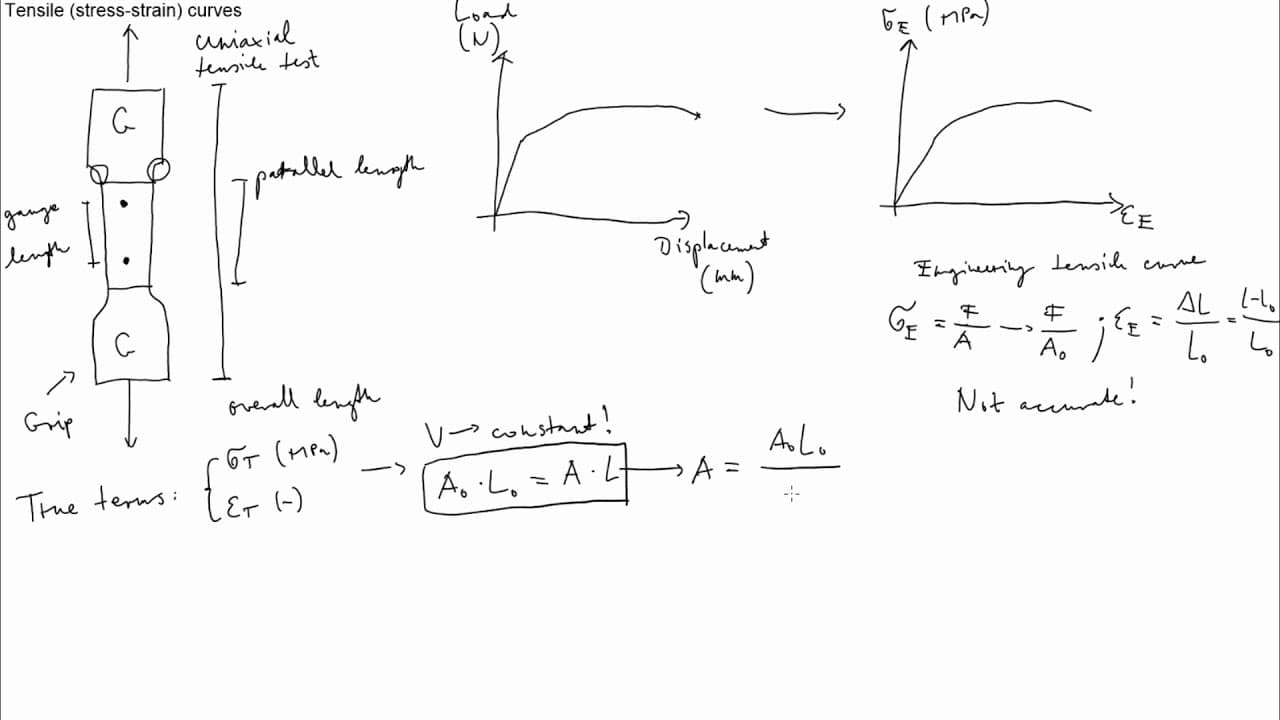
welcome everyone in this video I'm going to talk about the tens a curve or stress-strain curves I will start from the basics so I will show you how a tensile specimen looks like then how the tensile curves looks like how we can interpret the data that we obtain from a measurement and how we can use this data to characterize the properties of the ma... Read More
Key Insights
- ☠️ Tensile specimens are typically dog bone-shaped to ensure accurate testing and measurement.
- ❓ Engineering stress and strain are initial calculations that provide a basic understanding of material performance but can underestimate true material behavior.
- 🖼️ True stress and strain offer a clearer picture of how materials behave under load, reflecting changes in geometry during testing.
- ❓ Young's modulus is a critical parameter derived from the elastic portion of the stress-strain curve, indicative of material stiffness.
- 🤩 Yield strength indicates the transition from elastic to plastic deformation, a key metric for material design.
- 🏆 The process of evaluating tensile test data can be facilitated by software that automates curve fitting and analysis.
- 🦾 Engineering applications depend heavily on understanding the mechanical properties derived from tensile testing, impacting safety and performance.
Install to Summarize YouTube Videos and Get Transcripts
Explore YouTube Video Summarizer or Get YouTube Transcript Extractor
Questions & Answers
Q: What is the significance of the dog bone shape in tensile testing?
The dog bone shape is specifically designed to ensure that the material fails at the narrow central section during tensile testing. This shape guarantees a uniform distribution of stress across this area, allowing for accurate measurement of the mechanical properties of the material while avoiding premature failure at the grips, which would skew results.
Q: What are the differences between engineering stress and true stress?
Engineering stress is calculated using the initial cross-sectional area of the specimen, while true stress accounts for the actual cross-sectional area during deformation. Engineering stress can underestimate the material's strength as it does not consider the reduction in area during strain, while true stress provides a more accurate representation as it incorporates the instantaneous changes in cross-section.
Q: How does one calculate Young's modulus from a stress-strain curve?
Young's modulus, or modulus of elasticity, is calculated from the slope of the initial straight-line portion of the stress-strain curve (the elastic region). By fitting a linear equation to this region, you can determine the ratio of stress (force per unit area) to strain (deformation relative to original length), yielding the material's stiffness.
Q: Why is the yield strength important in material testing?
Yield strength marks the point at which a material begins to deform plastically, indicating the maximum load that can be applied without permanent deformation. Knowing the yield strength helps engineers design structures and components that can withstand specified loads without risking failure.
Q: What methods can be used for curve fitting and analysis in tensile testing?
Various methods such as polynomial fitting, linear regression, and differentiation of curves can be applied to analyze tensile test data. Software tools can simplify this process by automatically calculating parameters like Young's modulus, yield strength, and ultimate tensile strength, making it easier to interpret test results accurately.
Q: How can one use tensile test data to inform real-world applications?
Tensile test data is crucial for engineers and material scientists as it helps determine the material's suitability for specific applications. For example, understanding mechanical properties like tensile strength, ductility, and fracture toughness assists in selecting materials for construction, manufacturing, and safety-critical components in various industries.
Summary & Key Takeaways
-
The video discusses the fundamentals of tensile testing, focusing on the preparation and characteristics of a tensile specimen, such as the dog bone shape, grips, and measurement areas.
-
It provides a detailed explanation of how to calculate engineering stress and strain from experimental data and the limitations of these calculations compared to true stress and strain.
-
The presenter demonstrates practical applications of tensile testing data through software analysis, explaining how to derive important material properties such as Young's modulus and yield strength from the curves generated.
Read in Other Languages (beta)
Share This Summary 📚
Summarize YouTube Videos and Get Video Transcripts with 1-Click
Try YouTube Summary with ChatGPT & Claude or YouTube Transcript Generator
Explore More Summaries from Curious Scientist 📚

![Building a Peltier cooler-based cooling box - First iteration, improvements [Part 2/6] thumbnail](/_next/image?url=https%3A%2F%2Fi.ytimg.com%2Fvi%2F0YlNw0EGnzI%2Fhqdefault.jpg&w=750&q=75)


![Building a coil winder [Part 6] - A few improvements thumbnail](/_next/image?url=https%3A%2F%2Fi.ytimg.com%2Fvi%2F3eyxG_g2iUA%2Fhqdefault.jpg&w=750&q=75)

Summarize YouTube Videos and Get Video Transcripts with 1-Click
Try YouTube Summary with ChatGPT & Claude or YouTube Transcript Generator