How to Set 2026 Business Goals With the Five A's
TL;DR
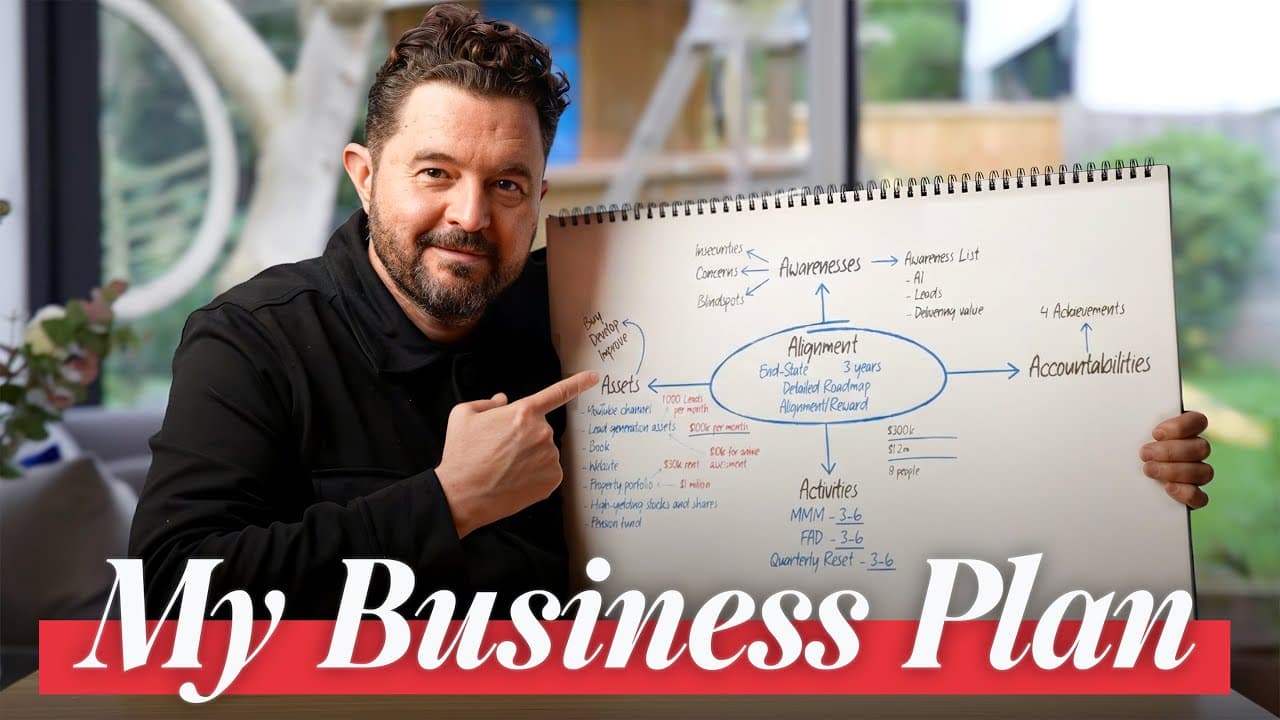
Set effective business goals with the Five A's: alignment, awarenesses, accountability, activities, and assets. Start by choosing an exciting three-year end state, map the path in detail, and align everyone affected by its sacrifices and rewards. Capture concerns and missing capabilities, assign accountability, define weekly non-negotiable activities, and identify needed assets. Revisit the vision every 90 days; read on for practical steps to apply each part of the framework.
Transcript
It's that time of year. You're reflecting on what's just been and you're thinking about the year ahead. I want to give you a goal setting framework that is going to help you to crush your goals in the year ahead. I've been using this framework for the last 20 years and I want to share it with you. I call it the 5 A. I used this in 2025 and had one ... Read More
Key Insights
- Alignment is the starting point of the Five A's framework because a goal should create genuine excitement about the future. The chosen end state must reflect what the entrepreneur truly wants, rather than an outcome selected from obligation, comparison, or external expectations.
- A lifestyle business is designed around fun, freedom, and flexibility, with a smaller operation that might employ 5–10 people. A performance business targets a much larger outcome, potentially including a $100 million sale, but requires more stress, an executive team, and 30–50 employees.
- A detailed three-year roadmap makes an end state concrete by identifying likely headcount, revenue, products, systems, and technologies. Studying or meeting people who already have the desired outcome can reveal the practical details and help determine whether the path itself feels aligned.
- Shared alignment is necessary because spouses, friends, co-founders, and employees can resist a goal when they see only sacrifices and no personal rewards. The roadmap and reward structure should therefore show everyone involved what the destination requires and what achieving it offers them.
- Alignment should be renewed every 90 days because clarity and enthusiasm naturally weaken. Reconnecting a team to the vision, the road ahead, and the rewards helps reenroll every participant and restores a shared understanding of the outcomes everyone is pursuing.
- Awarenesses are the concerns, insecurities, blind spots, and missing capabilities that surface once a goal is defined. Aiming for a $100 million sale, for example, may reveal insufficient revenue, inadequate recurring revenue, missing forecasting tools, or a lack of owned technology.
- An awareness list is a practical system for capturing every issue that could obstruct the goal. Individuals can maintain a rolling list in a notes app, while leadership teams and broader company teams can keep shared lists that turn hidden concerns into discussable work.
- A healthy company culture makes raising an awareness safe at every level. Giving employees simple language such as asking permission to share an awareness helps teams discuss real problems instead of collectively pretending that a plan will work when they privately believe otherwise.
Install to Summarize YouTube Videos and Get Transcripts
Explore YouTube Video Summarizer or Get YouTube Transcript Extractor
Questions & Answers
Q: What are the Five A's for setting business goals?
The Five A's are alignment, awarenesses, accountability, activities, and assets. They connect an exciting end state with known obstacles, responsible people, weekly non-negotiable actions, and the resources the business must buy, develop, or improve.
Q: How do you create an aligned three-year business goal?
Define what your ideal end state would look like three years from now, then study or meet people who have already achieved something comparable. Identify the likely headcount, revenue, products, systems, and technologies, map the pathway, and decide whether both the destination and journey genuinely excite you.
Q: How do you choose between a lifestyle business and a performance business?
Choose the model that matches the future you genuinely want. A lifestyle business prioritizes fun, freedom, and flexibility and may have 5–10 employees, while a performance business could target a $100 million sale but require an executive team, new technologies, greater stress, and 30–50 employees.
Q: Why should family and friends be aligned with a business goal?
A business journey can demand sacrifices from the people closest to the entrepreneur. If a spouse or friend sees no shared benefit, they may resist the goal, so the entrepreneur should explain the destination, sacrifices, and how those people are included in the rewards.
Q: How often should a business team revisit its goals?
The team should reconnect with its goals every 90 days because the framework assumes alignment and enthusiasm last only that long. Each review should revisit the vision, road ahead, and reward structure so everyone from top to bottom becomes reenrolled in the shared outcome.
Q: What is an awareness list in business goal setting?
An awareness list records concerns, insecurities, blind spots, and missing capabilities that could block the goal. Individuals can keep a rolling list in a notes app, while leadership and company teams can maintain shared lists so hidden obstacles become visible and discussable.
Q: What obstacles can a $100 million business-sale goal reveal?
Such a goal may expose insufficient revenue or recurring revenue, missing financial forecasting tools, undeveloped technology, or reliance on technology the company does not own. These awarenesses identify capabilities and problems that must be addressed rather than reasons to conceal the goal.
Q: How can leaders make it safe for employees to raise concerns?
Leaders can teach employees to recognize, record, check, and communicate awarenesses regardless of seniority. They can also normalize simple language such as asking permission to share an awareness, making it easier to discuss problems that team members might otherwise keep hidden.
Summary & Key Takeaways
-
The Five A's framework organizes business goal setting around alignment, awarenesses, accountability, activities, and assets. It begins by defining an exciting end state, understanding the detailed roadmap, and deciding whether the desired destination is a smaller lifestyle business or a larger performance business with greater complexity and management demands.
-
Alignment must extend beyond the founder to spouses, friends, co-founders, and employees because their support affects the journey. Everyone involved should understand the end state, roadmap, sacrifices, and reward structure. Since enthusiasm and clarity are assumed to last only 90 days, teams should be regularly reenrolled in the shared vision.
-
Awarenesses are concerns, insecurities, blind spots, and missing capabilities that surface after a goal becomes clear. They should be captured in a rolling list, raised without risk, discussed openly, and resolved. The broader framework then adds accountability, weekly non-negotiable activities, and assets that must be bought, developed, or improved.
Read in Other Languages (beta)
Share This Summary 📚
Summarize YouTube Videos and Get Video Transcripts with 1-Click
Try YouTube Summary with ChatGPT & Claude or YouTube Transcript Generator
Explore More Summaries from Daniel Priestley 📚



Summarize YouTube Videos and Get Video Transcripts with 1-Click
Try YouTube Summary with ChatGPT & Claude or YouTube Transcript Generator