What Is Asynchronous Advantage Actor Critic (A3C)?
TL;DR
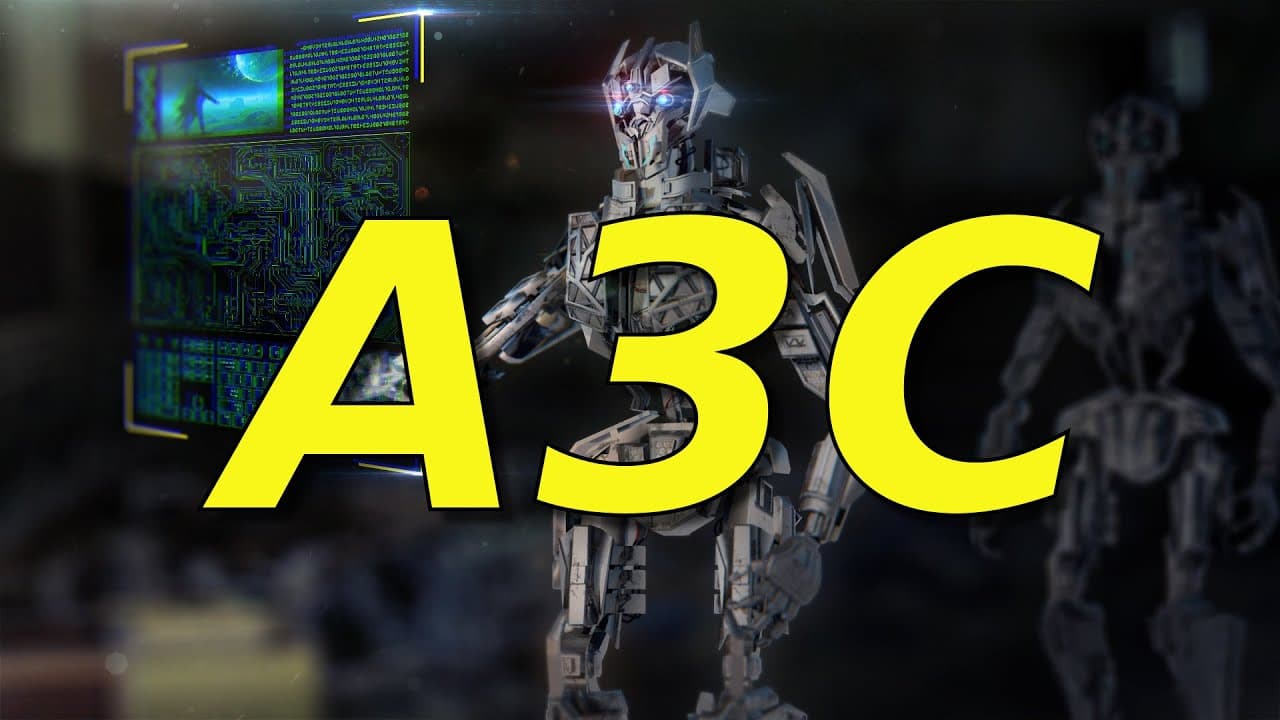
Asynchronous Advantage Actor Critic (A3C) is a deep reinforcement learning algorithm that enables multiple agents to learn independently across separate environments, improving efficiency and reducing memory usage. A3C addresses challenges found in traditional actor-critic methods by allowing actors to utilize uncorrelated experiences, resulting in a more robust and adaptable learning process.
Transcript
if you give me about 45 minutes of your time i will show you how to code a fully functional asynchronous advantage actor critic agent in the pytorch framework starting from scratch we're going to have about 10 to 15 minutes of lecture followed by and about 30 min interactive coding tutorial let's get started really quick if you're the type of perso... Read More
Key Insights
- 😒 Deep reinforcement learning exploded with the development of the deep Q-learning algorithm, which introduced the use of a replay buffer to address the problem of correlated inputs.
- 👻 Asynchronous deep reinforcement learning allows multiple agents to learn in parallel on separate environments, improving learning efficiency and reducing memory requirements.
- 💯 The Asynchronous Advantage Actor Critic (A3C) algorithm combines asynchronous learning with advantage-based actor critic methods to maximize the agent's total score over time.
- 🧑🏭 A3C overcomes the brittleness of traditional actor critic methods and provides a more robust policy and value estimation.
- 😆 A3C can be applied to various algorithms, including deep Q-learning, n-step Q-learning, SARSA, and actor critic methods.
- 🉐 The advantage in A3C refers to the relative advantage of one state over another, allowing the agent to seek out advantageous states.
- 🧑🏭 Actor and critic networks work together in A3C, with the actor determining the agent's actions and the critic evaluating the actions based on their value.
Install to Summarize YouTube Videos and Get Transcripts
Explore YouTube Video Summarizer or Get YouTube Transcript Extractor
Questions & Answers
Q: What is the main problem solved by the use of a replay buffer in deep reinforcement learning?
The replay buffer addresses the issue of correlated inputs in neural networks by allowing the agent to sample uncorrelated experiences, improving its ability to generalize and learn a more robust policy.
Q: How does asynchronous deep reinforcement learning differ from traditional methods?
Asynchronous deep reinforcement learning uses multiple agents playing in parallel on separate environments, allowing for independent and concurrent learning. This reduces the memory footprint required and improves learning efficiency.
Q: What is the advantage of using the Asynchronous Advantage Actor Critic (A3C) algorithm?
The A3C algorithm combines the benefits of asynchronous deep reinforcement learning with advantage-based actor critic methods, allowing the agent to maximize its total score over time by seeking out advantageous states and improving policy and value estimation.
Q: What are the key insights from the content?
- The replay buffer solves the problem of correlated inputs in deep reinforcement learning by allowing the agent to sample uncorrelated experiences.
- Asynchronous deep reinforcement learning enables parallel learning across multiple agents, reducing memory requirements and improving learning efficiency.
- The Asynchronous Advantage Actor Critic (A3C) algorithm combines the benefits of asynchronous learning with advantage-based actor critic methods for improved policy and value estimation.
Summary & Key Takeaways
-
Deep reinforcement learning exploded in 2015 with the development of the deep Q-learning algorithm, which introduced the use of a replay buffer to overcome the problem of correlated inputs.
-
The replay buffer allows the agent to sample uncorrelated experiences, improving its ability to generalize and learn a more robust policy.
-
Asynchronous deep reinforcement learning is a paradigm that uses a large number of agents playing in parallel on separate environments, which reduces the memory footprint required and allows for independent and concurrent learning.
Read in Other Languages (beta)
Share This Summary 📚
Summarize YouTube Videos and Get Video Transcripts with 1-Click
Try YouTube Summary with ChatGPT & Claude or YouTube Transcript Generator
Explore More Summaries from Machine Learning with Phil 📚


Summarize YouTube Videos and Get Video Transcripts with 1-Click
Try YouTube Summary with ChatGPT & Claude or YouTube Transcript Generator