What Is New in Claude Opus 4.6 for AI Agents?
TL;DR
Claude Opus 4.6 improves long-running agentic work, large-codebase reliability, debugging, code review, research, and enterprise document analysis. Its beta one-million-token context window, agent teams, adaptive thinking, compaction, and effort controls expand what Claude can handle, although parallel teams consume significantly more tokens and deeper reasoning can increase cost and latency.
Transcript
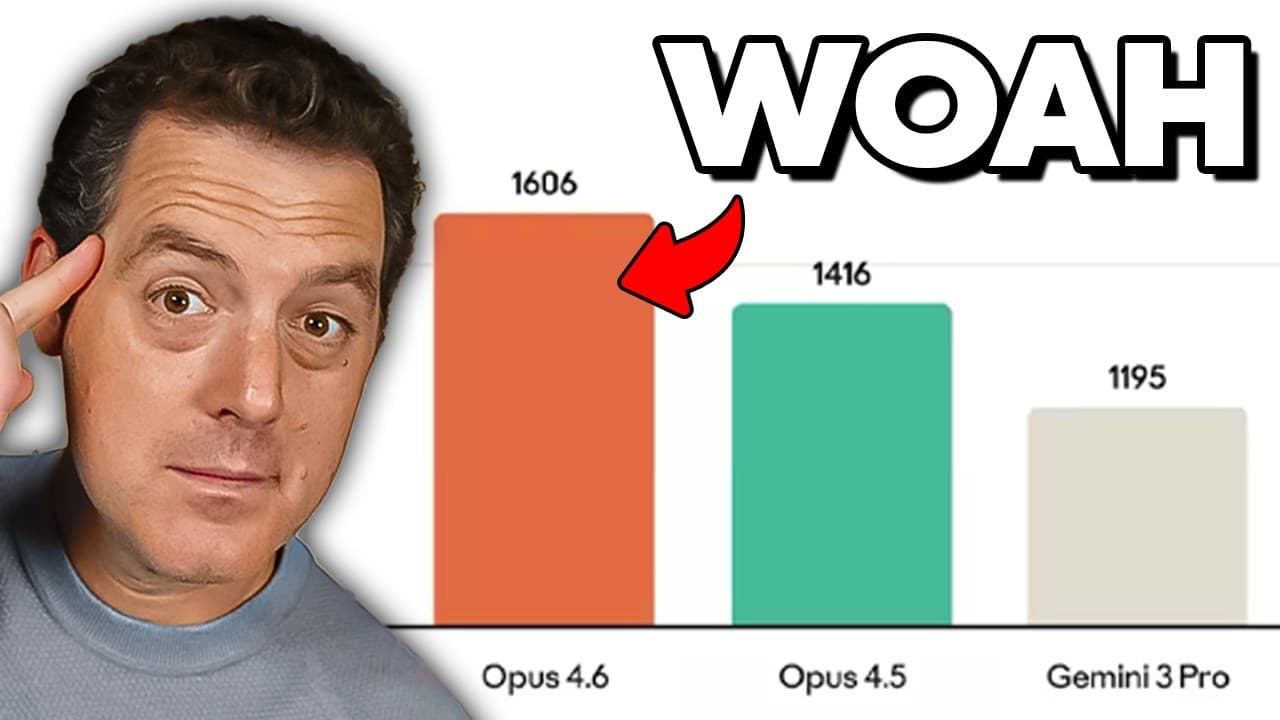
Claude Opus 4.6 is here and it is a big step forward, an improvement over Opus 4.5 and I actually got early access to it. I've been playing around with it and yes, it is that good. Let me tell you everything about it. According to the blog post, it plans more carefully, sustains a gentic task for longer, can operate more reliably in larger code bas... Read More
Key Insights
- Claude Opus 4.6 is designed to plan more carefully, sustain agentic tasks longer, operate more reliably in large codebases, and improve code review and debugging. These capabilities reflect an industry-wide movement toward models that can complete longer autonomous workflows and catch more of their own mistakes.
- The one-million-token context window is currently in beta and represents a major increase from the roughly 200K context windows discussed for Claude and OpenAI model families. Its practical value is strongest when processing large codebases or extensive document collections that cannot fit comfortably into smaller contexts.
- Context rot is the decline in a model's ability to identify and use relevant information as more material enters its context window. Opus 4.6 is reported to retrieve relevant information more effectively from large document sets, making context quality as important as the nominal one-million-token capacity.
- Box's complex-work evaluation reported gains for reasoning over enterprise content, including report drafting, due diligence, and industry-specific tasks. The largest cited industry improvement was life sciences and healthcare, which rose from 39% with Opus 4.5 to 64% with Opus 4.6.
- Agent teams are multiple Claude Code instances coordinated by one lead session. Each teammate operates independently in its own context window, can communicate directly with other teammates, and can be addressed by the user without routing every interaction through the team lead.
- Agent teams are most effective when parallel exploration provides real value, including research and review, development of new modules or features, debugging with competing hypotheses, and cross-layer coordination. Their independence supports comparing multiple approaches, but it also creates coordination overhead and significantly higher token use.
- Adaptive thinking allows Opus 4.6 to adjust its amount of reasoning while executing a task. Additional effort controls provide finer control over intelligence, speed, and cost, while API compaction can compress lengthy context at the risk of losing fidelity or important details.
- Opus 4.6 keeps the same listed pricing as Opus 4.5. Prompts below 200,000 tokens cost $5 per million input tokens and $25 per million output tokens, while prompts above that threshold cost $10 for input and $37.50 for output, with discounts available through prompt caching.
Install to Summarize YouTube Videos and Get Transcripts
Explore YouTube Video Summarizer or Get YouTube Transcript Extractor
Questions & Answers
Q: What are the main improvements in Claude Opus 4.6?
Claude Opus 4.6 is reported to plan more carefully, sustain agentic tasks for longer periods, work more reliably in larger codebases, and perform better at code review and debugging. It also improves financial analysis, research, document creation, spreadsheets, and presentations. The release adds a beta one-million-token context window, agent teams, adaptive thinking, API compaction, and finer effort controls.
Q: How does the one-million-token context window help?
The beta one-million-token context window allows Claude Opus 4.6 to process much larger codebases and document collections within one working context. This can preserve more relevant material before compaction becomes necessary. The benefit depends on retrieval quality because adding more content can cause context rot, where the model struggles to identify useful information. Opus 4.6 is reported to perform better at retrieving relevant details from large document sets.
Q: What is context rot in large language models?
Context rot occurs when a model becomes worse at identifying and using the information it needs as more material is placed in its context window. A large token limit therefore does not automatically guarantee strong performance. The model must retain quality across the full context, retrieve relevant details, and connect information from distant sections. The transcript presents these abilities as an important strength of Opus 4.6.
Q: How do Claude agent teams work?
Claude agent teams coordinate multiple Claude Code instances working together. One session serves as the team lead, assigns tasks, coordinates activity, and synthesizes the results. Teammates work independently in separate context windows, communicate directly with one another, and can be addressed individually by the user. They also use a shared task list, enabling more self-coordination than a structure managed entirely by one main agent.
Q: When should Claude agent teams be used?
Agent teams are most suitable when a task benefits from genuinely parallel exploration. The cited examples include research and review, building new modules or features, debugging through competing hypotheses, and coordinating work across multiple technical layers. Separate teammates can investigate different paths and compare findings. For simpler or tightly sequential tasks, the additional coordination and significantly greater token usage may outweigh the benefits.
Q: What is the difference between agent teams and sub-agents?
Sub-agents have their own context windows, but they report their findings back to the main agent, which manages the overall work. Agent-team members are more independent: teammates can communicate directly with one another, use a shared task list, and interact directly with the user without always going through the lead. This flexibility supports collaborative parallel work, but agent teams carry more coordination overhead and cost significantly more tokens.
Q: How much does Claude Opus 4.6 cost?
Claude Opus 4.6 retains the same listed pricing as Opus 4.5. For prompts below 200,000 tokens, input costs $5 per million tokens and output costs $25 per million tokens. Above 200,000 prompt tokens, input costs $10 per million and output costs $37.50 per million. Prompt caching can provide significant discounts, while agent teams can raise total usage by running multiple Claude Code instances.
Q: What do the reported benchmarks show about Opus 4.6?
The reported benchmarks show improvements over Opus 4.5 across knowledge work, agentic search, terminal tasks, and enterprise document reasoning. Box reported report-drafting performance rising from 36% to 75%, due diligence increasing from 45% to 51%, and life sciences and healthcare improving from 39% to 64%. Terminal Bench reached 65.4%, described as a six-point increase over Opus 4.5.
Summary & Key Takeaways
-
Claude Opus 4.6 is presented as a substantial improvement over Opus 4.5 for sustained agentic tasks, large codebases, debugging, code review, research, financial analysis, and office documents. Its central direction is longer autonomous operation, allowing models to execute increasingly complex software and knowledge-work assignments with less continuous human intervention.
-
The beta one-million-token context window is intended to improve work across large codebases and extensive document collections. Capacity alone is insufficient because context rot can make relevant information harder to locate as inputs grow. The reported advantage of Opus 4.6 is stronger retrieval and reasoning across large sets of enterprise content.
-
Agent teams coordinate multiple Claude Code instances through a lead, independent teammates, direct communication, and a shared task list. They suit parallel research, feature development, competing debugging hypotheses, and cross-layer coordination. However, they introduce coordination overhead and use significantly more tokens than a single session or conventional sub-agent arrangement.
Read in Other Languages (beta)
Share This Summary 📚
Summarize YouTube Videos and Get Video Transcripts with 1-Click
Try YouTube Summary with ChatGPT & Claude or YouTube Transcript Generator
Explore More Summaries from Matthew Berman 📚





Summarize YouTube Videos and Get Video Transcripts with 1-Click
Try YouTube Summary with ChatGPT & Claude or YouTube Transcript Generator