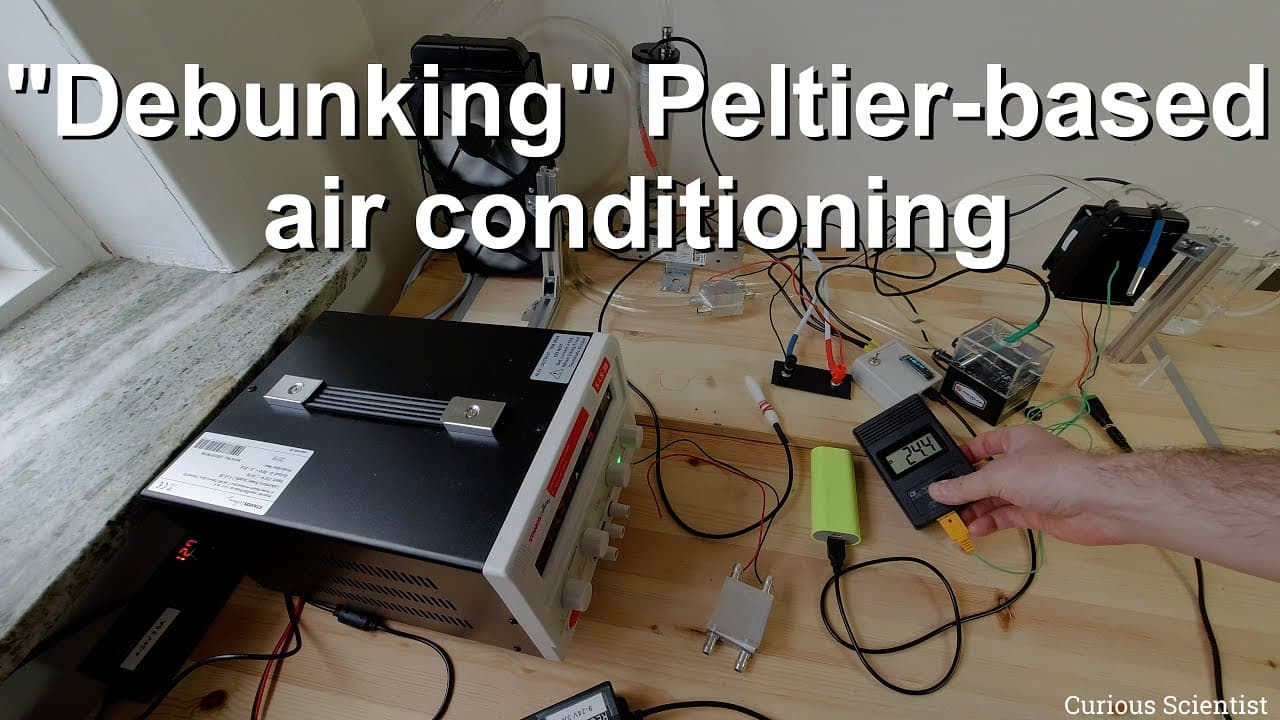
“Debunking” Peltier-based air conditioning
TL;DR
The patio cooler setup demonstrated is inefficient and unsuitable for cooling air significantly.
Transcript
welcome everyone in this video i'm going to show you a patio cooler related experiment this video is dedicated to a question which i receive quite a lot and i want to show you in reality so before telling you the question i want to show you my system because then it becomes more easy to actually tell you what the question was and since this was rea... Read More
Key Insights
- 😘 Peltier coolers are inefficient for large-scale air conditioning applications due to their low cooling efficiency compared to compressor systems.
- 😎 The cooling process in the demonstrated patio cooler is complicated and introduces thermal resistance, decreasing effectiveness.
- 😎 Utilizing Peltier coolers in direct contact applications maximizes efficiency, such as cooling sensitive electronic components.
- 🥺 Overloading the system can lead to inefficiencies or damage, highlighting the importance of gradual power increases during experimentation.
- 🖤 Temperature readings from different sections of the cooler system reveal a lack of significant cooling even at max power settings.
- 🥺 The misconceptions about DIY air conditioning systems using Peltier devices can lead to wasted time and resources.
- 😎 Viewer expectations should be managed when considering the capabilities of inexpensive DIY cooling systems.
Install to Summarize YouTube Videos and Get Transcripts
Explore YouTube Video Summarizer or Get YouTube Transcript Extractor
Questions & Answers
Q: What is a patio cooler, and how is it typically configured?
A patio cooler is a cooling system that often uses Peltier effect devices to create a temperature difference. In this video, the configuration includes a TEC-12 715 Peltier cooler paired with an aluminum cooling block and a radiator to circulate and cool water. However, its design for air cooling is inefficient.
Q: Why is the author skeptical about using this patio cooler setup for air conditioning?
The author expresses skepticism due to the system's inherent inefficiencies and the limitations of the Peltier coolers. They point out that the cooling efficiency of such devices is only about 10-15%, compared to compressor-based systems that achieve 30-40%, making it unfeasible for effective air conditioning.
Q: What factors contribute to the inefficiency of the patio cooler system shown in the video?
Key factors include the poor thermal properties of the setup, such as the complexity of transferring heat through multiple components, the hot side of the cooler generating heat, and the inability to produce significantly colder air compared to room temperature. The system's design inherently introduces thermal resistance.
Q: How did the author measure the effectiveness of the patio cooler system during the experiment?
The author used multiple thermometers to measure the temperatures at various points in the system, including the water tank, the room, and the radiator. By observing temperature changes over time while adjusting the power input of the cooler, they provided a real-time analysis of the system's performance.
Q: What results were observed during the experiment when the cooler was operating at maximum power?
When the cooler was run at increased power levels, the temperatures indicated only minor cooling effects, with the air temperature in front of the radiator remaining close to room temperature. The author concluded that the system could not effectively cool down air despite significant power use.
Q: What alternative uses for Peltier coolers does the author suggest are more appropriate?
The author suggests that Peltier coolers are better suited for direct contact applications, such as cooling specific electronic components like laser diodes or silicon wafers. Placing items directly on the cooler maximizes its effectiveness rather than trying to create an air conditioning system.
Q: What precautions did the author take while running the patio cooler experiment?
The author took several precautions, such as gradually increasing the current supply to avoid overloading the Peltier cooler. They waited while monitoring temperatures regularly to ensure safe operational levels and to prevent freezing the water in the cooling loop.
Q: What does the author advise viewers regarding building their own patio cooler systems?
The author strongly advises against attempting to build a patio cooler system like the one demonstrated, explaining that it is not cost-effective and unlikely to meet cooling expectations. They suggest viewers consider better investments for cooling solutions instead.
Summary & Key Takeaways
-
The video explores a homemade patio cooler system designed to cool air using a liquid cooling loop and a TEC cooler configuration. However, it reveals the installation's overall inefficiency.
-
The discussion highlights the limitations of Peltier coolers for air conditioning purposes, emphasizing the need for more powerful and efficient equipment to achieve effective cooling.
-
The presenter conducts a live experiment measuring temperatures and air flow, ultimately concluding that the system fails to produce significant cold air due to inadequate cooling power and design flaws.
Read in Other Languages (beta)
Share This Summary 📚
Summarize YouTube Videos and Get Video Transcripts with 1-Click
Try YouTube Summary with ChatGPT & Claude or YouTube Transcript Generator
Explore More Summaries from Curious Scientist 📚


![Building a coil winder [Part 6] - A few improvements thumbnail](/_next/image?url=https%3A%2F%2Fi.ytimg.com%2Fvi%2F3eyxG_g2iUA%2Fhqdefault.jpg&w=750&q=75)


Summarize YouTube Videos and Get Video Transcripts with 1-Click
Try YouTube Summary with ChatGPT & Claude or YouTube Transcript Generator