Why Are Database Management Systems Important?
TL;DR
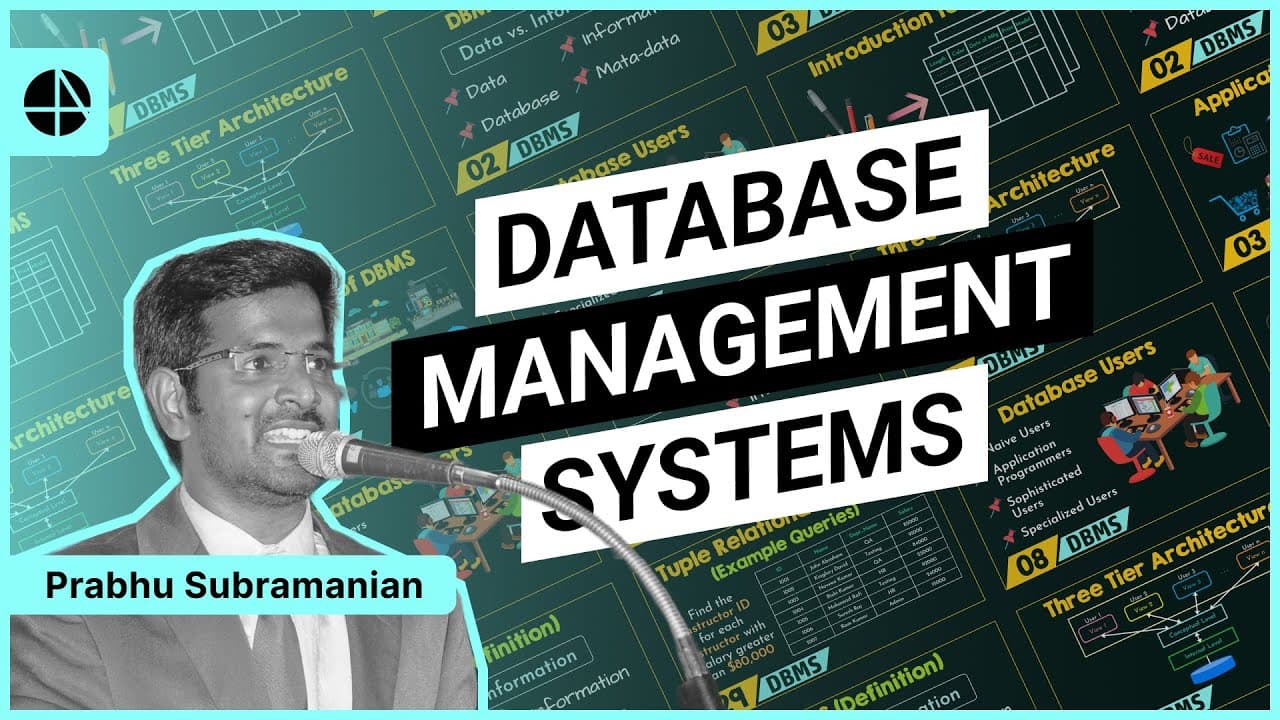
Database management systems permanently store organized data so organizations can investigate problems, document operations, and remain transparent and accountable. Database knowledge also supports work in database administration, data analysis, business analysis, full-stack development, software testing, database testing, and penetration testing, while covering topics from relational databases and SQL to normalization, optimization, transactions, warehousing, mining, XML, and advanced databases.
Transcript
hello everyone i welcome you all to this wonderful course on database management systems before we start the session let's see a quote by alan coven do not wait until conditions are perfect to begin beginning makes the conditions perfect with this wonderful quote let's begin this journey with the introduction before we step into the introduction to... Read More
Key Insights
- A database is a permanent store for operational information that may remain valuable longer than the systems used to create it. Organizations therefore need to document manufactured products and related activities instead of relying only on production or keeping scattered files.
- Product traceability depends on storing identifying and descriptive details such as length, color, manufacturing date, price, model, QR code, barcode, batch, and location. These records connect a faulty pen or pencil to its production history and support a focused investigation.
- A customer complaint can reveal a broader manufacturing problem when the product identifier is linked to batch and manufacturing-date records. The company can examine whether only one item is faulty or whether the same issue affects the entire batch.
- Well-maintained data supports transparency and accountability because an organization can document what it manufactured and how it operated. The transcript also connects permanent records with market sustainability, organizational growth, continuous improvement, regular tax filing, and responsible complaint handling.
- Organizational databases extend beyond product records to employee and human resources details, accounts, finance, research and development, complaints and redressal, logistics, and sales. Keeping these related areas in databases gives the organization a documented foundation for its activities.
- Databases are presented as inevitable across many environments, including manufacturing companies, hospitals, schools, universities, banks, airlines, supermarkets, and insurance organizations. The shared requirement is permanent storage and maintenance of the information needed for daily operations and accountability.
- The DBMS syllabus progresses from relational database foundations and ER design to SQL, relational query languages, normalization, storage, indexing, hashing, query optimization, transactions, concurrency, architectures, data warehousing, data mining, XML, and advanced databases across 14 chapters.
- DBMS knowledge supports several career paths named in the course, including database administrator, data analyst, business analyst, full-stack developer, database tester, software tester, and penetration tester. Back-end database knowledge is especially relevant to developers expected to work beyond front-end interfaces.
Install to Summarize YouTube Videos and Get Transcripts
Explore YouTube Video Summarizer or Get YouTube Transcript Extractor
Questions & Answers
Q: Why do organizations need database management systems?
Organizations need database management systems to store operational data permanently and keep it available for investigation, documentation, transparency, and accountability. A manufacturer, for example, must preserve product details and information from human resources, accounts, finance, research and development, complaints, logistics, and sales. The transcript states that databases are preferable to files for maintaining this broad organizational information.
Q: How does a database help investigate a faulty product?
A database helps investigators connect a faulty product with stored details such as its QR code, barcode, manufacturing date, model, batch, price, color, length, and location. After receiving a complaint, the manufacturer can retrieve the product history and examine what went wrong. Batch and date records also help determine whether the defect is isolated or affects additional products.
Q: What product information should a manufacturer store?
A manufacturer should store the details identified in the production example: the product's length, color, manufacturing date, price, model, QR code, barcode, batch, and location. These fields document the manufactured item and make later tracing possible. The organization should also maintain related operational data involving employees, finance, research, complaints, logistics, and sales.
Q: Why should a manufacturer examine the entire production batch?
A manufacturer should examine the production batch after receiving a complaint to determine whether only one item is faulty or whether the whole batch has the same problem. Stored batch identifiers and manufacturing dates make this analysis possible. The investigation supports complaint handling, continuous improvement, market sustainability, organizational growth, transparency, and accountability, as described in the manufacturing analogy.
Q: What topics are included in the DBMS course syllabus?
The 14-chapter syllabus covers RDBMS, relational databases, database design and ER models, basic SQL, advanced SQL features, formal relational query languages, relational algebra, normalization and dependencies, storage and file structures, indexing and hashing, query processing and optimization, transactions and concurrency control, database architectures, data warehousing, data mining, XML, and advanced databases.
Q: Who is the DBMS course intended for?
The course is intended for undergraduate students, aspirants preparing for competitive examinations such as GATE and ISRO examinations, and people who want to understand database technologies and terminology. It is also relevant to prospective data analysts and business analysts because the transcript identifies database knowledge as essential for those roles in the contemporary employment environment.
Q: What jobs can DBMS knowledge support?
DBMS knowledge supports the roles specifically identified in the transcript: database administrator, data analyst, business analyst, full-stack developer, database tester, software tester, and penetration tester. Database administrators require DBMS knowledge because they hold privileges over databases. Analysts use database foundations, while developers and testers need database understanding for back-end development, verification, and testing activities.
Q: Why is DBMS important for full-stack developers?
DBMS is important for full-stack developers because industries expect them to understand both front-end and back-end activities. Front-end work concerns the user or web interface, while databases form part of the back end. The course therefore presents database management knowledge as mandatory for developers who are expected to work beyond interface development and handle data-related application responsibilities.
Summary & Key Takeaways
-
A manufacturing company must record more than the number of pens and pencils it produces. Details such as length, color, manufacturing date, price, model, QR code, barcode, batch, and location allow the company to trace individual products, investigate complaints, and determine whether a defect affects one item or an entire batch.
-
Permanent databases help organizations preserve information across manufacturing, human resources, accounts, finance, research and development, complaints, redressal, logistics, and sales. Well-maintained records support continuous improvement, tax filing, transparency, and accountability. Databases are described as inevitable across manufacturing, hospitals, schools, universities, banking, airlines, supermarkets, insurance, and other organizational settings.
-
The course contains 14 chapters covering RDBMS, relational databases, ER modeling, basic and advanced SQL, formal query languages, normalization, storage structures, indexing, hashing, query optimization, transactions, concurrency, system architectures, warehousing, mining, XML, and advanced databases. It targets undergraduate students, competitive-exam aspirants, prospective analysts, administrators, developers, and testers.
Read in Other Languages (beta)
Share This Summary 📚
Summarize YouTube Videos and Get Video Transcripts with 1-Click
Try YouTube Summary with ChatGPT & Claude or YouTube Transcript Generator
Explore More Summaries from Neso Academy 📚





Summarize YouTube Videos and Get Video Transcripts with 1-Click
Try YouTube Summary with ChatGPT & Claude or YouTube Transcript Generator