How Does Curiosity Drive Success in the AI Age?
TL;DR
Success in the AI age depends on continuing to learn, asking better questions, seeking truth, and accepting uncomfortable feedback. AI can broaden access to answers and reduce reliance on privileged networks, but its value depends on active curiosity and accurate outputs that provide a trustworthy foundation for further questions, decisions, and knowledge.
Transcript
education is not an event you don't finish in education you can choose to stop it or you can choose to keep learning forever how simple questions and answers tonight we have the honor of inviting and speaking to Arvin Trinas the CEO and co-founder of perplexity AI a major AI instructor in the world of search challenge the likes of Google and open A... Read More
Key Insights
- Education is a continuing process rather than a completed event. People can stop learning after formal study, or they can preserve the questioning mindset developed through education and continue expanding their knowledge throughout their lives.
- Curiosity is the central quality Srinivas associates with perseverance, truth-seeking, and success. His parents spent their limited savings on his education and valued his doctoral research and conference acceptances more than earnings or social status.
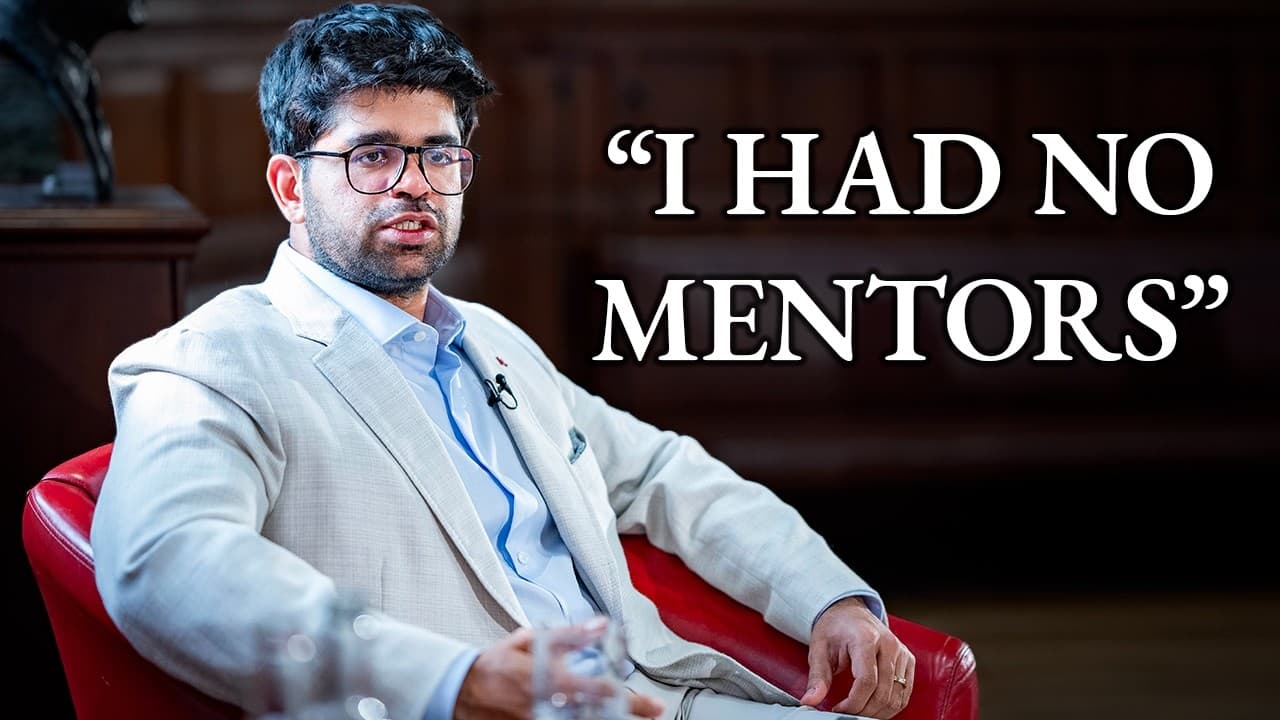
- Perplexity grew from a practical lack of accessible guidance. Srinivas and his co-founders faced questions about matters such as employee health insurance, which their technical education had not covered and their limited professional networks could not answer.
- AI can reduce the advantages provided by elite networks by making answers broadly available. A person without mentors or prestigious connections can use the same tool as a professor from Harvard or Stanford to investigate unfamiliar subjects.
- AI can encourage learning when people treat it as a tool for exploration rather than an excuse for passivity. Instant answers allow users to recover childlike curiosity, ask simple questions, develop hypotheses, and run their own experiments on the world.
- Uncomfortable criticism can redirect a person toward more valuable work. When Ilya Sutskever bluntly challenged Srinivas's doctoral research ideas, Srinivas chose curiosity and introspection rather than dismissal, strengthening his commitment to seeking truth.
- Academic training develops the ability to build knowledge through questions, previous findings, and peer review. Professors do more than transmit existing information, they help students identify new questions that can extend knowledge for future generations.
- Accurate AI outputs are necessary because answers increasingly influence both small and significant decisions. If foundational information is wrong, the questions, conclusions, and decisions built upon it may also become wrong, making accuracy a shared responsibility.
Install to Summarize YouTube Videos and Get Transcripts
Explore YouTube Video Summarizer or Get YouTube Transcript Extractor
Questions & Answers
Q: How does curiosity contribute to success in the AI age?
Curiosity supports success by keeping education active throughout a person's life. Srinivas describes it as a relentless pursuit of knowledge that produces more questions after every answer. When AI can respond instantly, curious users can investigate unfamiliar industries, test hypotheses, seek uncomfortable truths, and continue learning instead of treating available answers as a reason to become passive.
Q: Why does Srinivas say education never truly ends?
Srinivas says education is not a single event that finishes with a degree. Formal study provides a frame of mind for asking questions, checking knowledge, and building on earlier answers. A person can choose to stop learning, but continued curiosity makes it possible to explore new responsibilities, industries, and problems long after completing an important academic qualification.
Q: How can AI reduce the importance of professional networks?
AI can make practical answers available to people who lack mentors, family connections, or helpful alumni. Srinivas experienced this problem when founding a company and confronting questions such as employee health insurance, which were not covered by his electrical engineering or computer science training. A capable question-and-answer tool can provide guidance without requiring access to a privileged network.
Q: Does AI make students and other users less intelligent?
Srinivas argues that the outcome depends on how people choose to use AI. Users can become passive because answers are easy to obtain, or they can treat AI like a calculator or computer that expands what they can investigate. Asking many simple questions, forming hypotheses, and conducting personal experiments can strengthen curiosity rather than replace independent thought.
Q: Why is accuracy especially important for AI answers?
Accuracy matters because each answer can become the foundation for another question, conclusion, or decision. If the original output is wrong, everything built upon it may also become wrong. Srinivas connects this problem to academic peer review and argues that Perplexity cannot solve it alone, so people trained to evaluate knowledge should participate in improving AI accuracy.
Q: What did Srinivas learn from Ilya Sutskever's criticism?
Srinivas learned to accept uncomfortable truths and examine criticism instead of dismissing it. Sutskever told him that his research direction was wrong and proposed using known ideas sequentially, extensive computing resources, and training on the internet. Srinivas chose curiosity and introspection, and the experience helped develop the truth-seeking quality he encourages within Perplexity.
Q: Why does Srinivas warn students about tradition and conventional wisdom?
Srinivas argues that AI will influence decisions ranging from restaurant reservations and flight bookings to career choices and business strategy, and AI will not necessarily respect inherited traditions. He warns that conventional wisdom has often proved wrong and urges students to be careful when people advise resisting the future, especially when emerging evidence challenges established assumptions.
Q: What role should universities and educated people play in AI development?
Universities train people to build knowledge through questioning, previous research, peer review, and attention to accuracy. Srinivas argues that these habits are valuable for evaluating AI outputs and generating better follow-up questions. Educated people should not assume they possess every answer after leaving an institution, but should contribute by checking accuracy and continuing to ask important questions.
Summary & Key Takeaways
-
Aravind Srinivas argues that education should continue throughout life rather than end with a degree. His upbringing taught him to value knowledge above wealth or social status, while his experience founding Perplexity showed how AI could provide practical answers to people who lack mentors, networks, or specialized access.
-
AI may weaken traditional advantages associated with prestigious networks because widely available answers can help people navigate unfamiliar problems. Srinivas encourages students to use AI with childlike curiosity, form hypotheses, conduct experiments, and seek information that previously might have required access to leading experts in a particular field.
-
Accuracy is essential because every answer can become the foundation for another question or decision. Srinivas connects academic peer review with the challenge of making AI trustworthy, arguing that educated people should help improve output accuracy while remaining open to criticism, uncomfortable truths, and ideas that challenge conventional wisdom.
Read in Other Languages (beta)
Share This Summary 📚
Summarize YouTube Videos and Get Video Transcripts with 1-Click
Try YouTube Summary with ChatGPT & Claude or YouTube Transcript Generator
Explore More Summaries from OxfordUnion 📚






Summarize YouTube Videos and Get Video Transcripts with 1-Click
Try YouTube Summary with ChatGPT & Claude or YouTube Transcript Generator