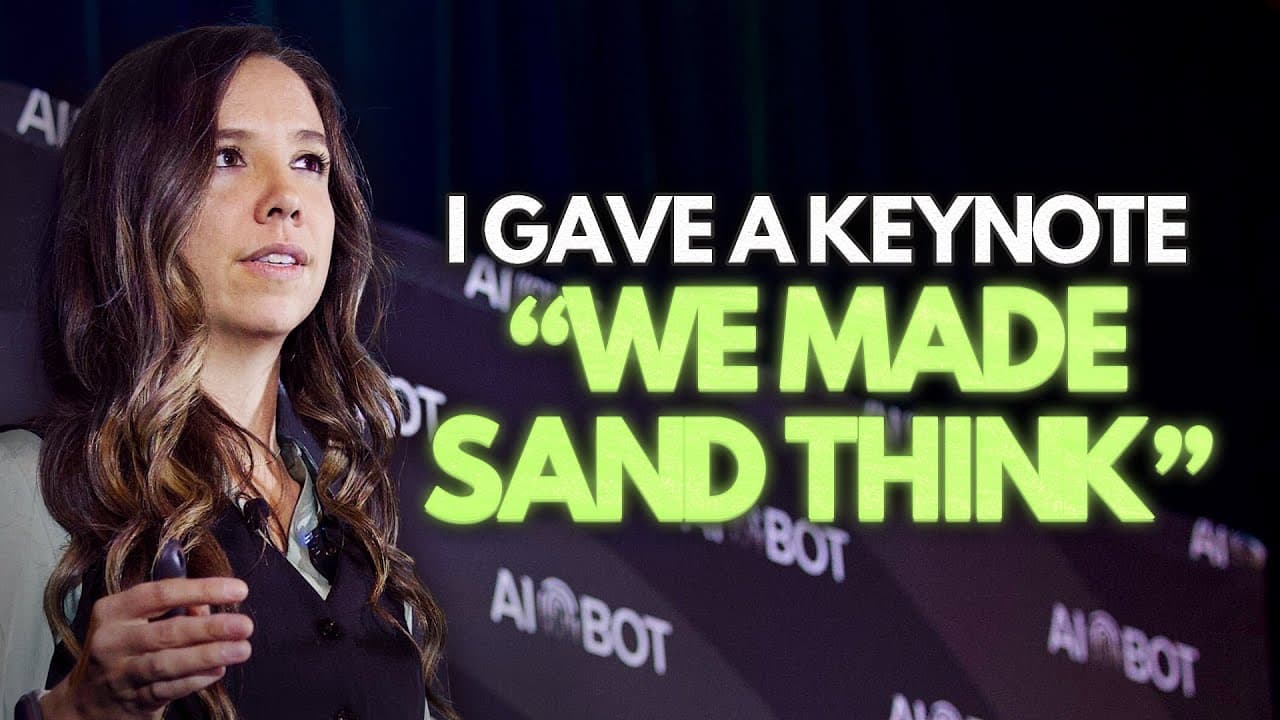
How Can Businesses Integrate AI? Julia McCoy’s “We Made Sand Think” Keynote for 500 Marketing Leaders
TL;DR
Businesses should integrate AI by first automating routine work, then applying it to strategic predictions about customers, markets, and campaigns. Julia McCoy estimates that AI can automate 50% of current workplace activity and recommends starting with tools such as knowledge-based customer-service bots, custom GPTs, automated social posts, and email generation. Read on for the keynote’s practical adoption framework and its vision of AI-enabled work.
Transcript
ladies and gentlemen I look sound and talk like Julia McCoy I was 100% created from a text script Julia herself didn't film or say anything you're seeing I am her clone a digital Consciousness created from code and algorithms but I'm not here to talk about myself I'm here to introduce someone who understands that we're living through the most trans... Read More
Key Insights
- AI is presented as an extension of human capacity rather than merely a better tool. McCoy compares it to an additional set of stronger arms that can perform more work, allowing people to redirect their time toward activities, businesses, and forms of impact they value.
- The age of AI began in 2023 according to the timeline presented in the keynote. McCoy connects this shift to Nvidia’s computing advances and the emergence of ChatGPT, arguing that sufficient chip capacity made it possible to run neural networks modeled on aspects of the human brain.
- Workforce reskilling is expected to affect a substantial share of workers. McCoy cites a study of 3,000 C-level executives and 21,000 workers that found 40% of the workforce would need reskilling, while offering her own estimate that the eventual proportion may be closer to 80%.
- Current AI systems can automate 50% of workplace activity according to McCoy’s assessment. She also argues that businesses can reduce time spent creating content by 90% to nearly 100%, based partly on her experience publishing YouTube content through a digital clone.
- Digital clones can maintain content production when a human creator is unavailable. McCoy says her YouTube content beginning in the last week of December used her clone, which continued presenting while she recovered from a respiratory infection and spent more time with her family.
- Foundational AI integration is built around simple systems that replicate routine human work. The examples given include content generation, customer service, data analysis, social media automation, and email marketing, with knowledge-based chatbots identified as a practical starting point for businesses.
- Custom GPTs can produce more relevant marketing material when they understand the business. McCoy recommends providing information about the company, audience, target customers, and products, rather than relying only on a general ChatGPT conversation to generate emails or other content.
- Strategic AI integration can support predictions about users, markets, and campaigns. Instead of manually planning what to communicate and sell throughout the next 12 months, a business can use AI to examine scenarios and help shape its marketing and growth decisions.
Install to Summarize YouTube Videos and Get Transcripts
Explore YouTube Video Summarizer or Get YouTube Transcript Extractor
Questions & Answers
Q: How should a business begin integrating AI?
Start with foundational systems that replicate routine human work. McCoy recommends practical applications such as knowledge-based customer-service bots, content generation, data analysis, automated social posts, email marketing, and custom GPTs.
Q: What are the three levels of AI integration?
The keynote presents three levels, but the supplied material explains only the first two in detail. The foundational level reproduces routine work, while the strategic level helps predict customer behavior, market activity, and campaign performance; details of the third level are not provided.
Q: What workplace activities can AI automate?
McCoy estimates that AI can automate 50% of current workplace activity. Examples include producing content, answering customer questions, analyzing data, publishing social posts, generating marketing emails, and assisting with campaign planning.
Q: How can a custom GPT improve business marketing?
A custom GPT can use information about the company, audience, target customers, products, business details, and frequently asked questions. McCoy argues that this context produces more relevant marketing content than asking a general ChatGPT conversation to write an email without company knowledge.
Q: How much can AI reduce content creation time?
McCoy argues that businesses can reduce content creation time by 90% to nearly 100%. She describes using a digital clone to continue presenting YouTube content while she recovered from a respiratory infection and spent more time with her family.
Q: How can AI support strategic business planning?
AI can examine user behavior, market activity, campaign performance, and possible business scenarios. McCoy says this can help a company decide what to communicate and sell over the next 12 months instead of planning everything manually.
Q: Why does Julia McCoy describe AI as liberation?
McCoy sees AI as a way to reduce the need for people to work 10 or 12 hours every day. Her goal is not dependence on machines, but more time for meaningful work, family, recovery, additional businesses, and greater impact.
Q: What kind of company does Julia McCoy want to build with AI?
McCoy’s stated goal is to build a $10 million business with just 10 humans and then grow from there. She contrasts that goal with her earlier writing agency, which she built to 100 people before selling it for five million in 2021.
Summary & Key Takeaways
-
The keynote frames artificial intelligence as a new stage in technological history, enabled by computer chips powerful enough to run neural networks. Julia McCoy argues that AI is more than a productivity tool. It extends human capacity and creates new possibilities for producing content, serving customers, analyzing data, and operating businesses.
-
McCoy describes three levels of AI integration, beginning with foundational systems that reproduce routine human work. Examples include knowledge-based customer-service bots, automated social posts, email generation, data analysis, and custom GPTs trained on a company’s audience, products, business details, and frequently asked customer questions. Businesses can begin with these accessible applications.
-
At the strategic level, AI can help predict user behavior, market activity, and campaign performance. McCoy presents adoption as a path toward liberation from long working hours, not dependence on machines. Her stated goal is to build a $10 million company with 10 people by creating efficient AI-supported business processes.
Read in Other Languages (beta)
Share This Summary 📚
Summarize YouTube Videos and Get Video Transcripts with 1-Click
Try YouTube Summary with ChatGPT & Claude or YouTube Transcript Generator
Explore More Summaries from Julia McCoy 📚





Summarize YouTube Videos and Get Video Transcripts with 1-Click
Try YouTube Summary with ChatGPT & Claude or YouTube Transcript Generator