How Does Clinical Hypnosis Change the Brain?
TL;DR
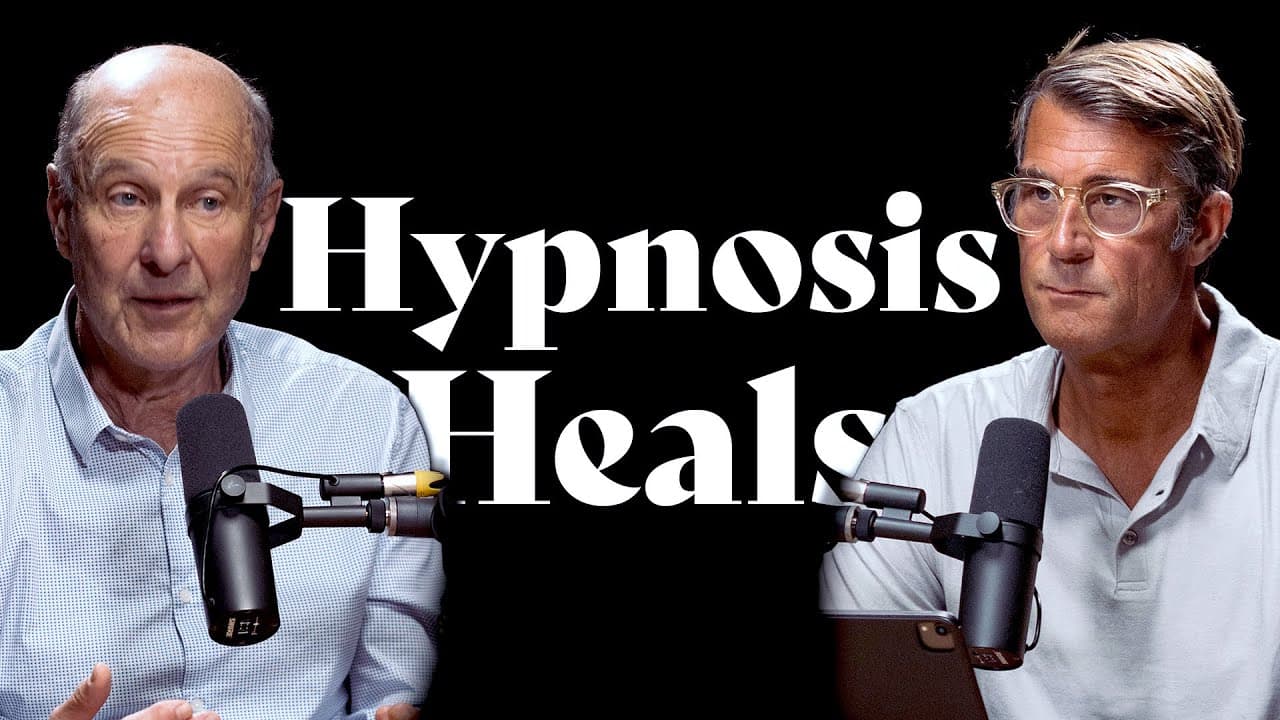
Clinical hypnosis increases control rather than taking it away. It creates a state of highly focused attention, reduced peripheral awareness, cognitive flexibility, and dissociation, allowing people to reconsider problems and influence mind-body experiences. Dr. David Spiegel describes its therapeutic use for trauma, anxiety, chronic pain, sleep, addiction, and performance, while distinguishing it from stage entertainment.
Transcript
the brain can really control what's going on in the body even in rather extreme circumstances what comes to mind when I say the word hypnosis if it's spinning pinwheels or swaying pocket watches then you're not alone but clinical hypnosis what today's guest calls transformation t-r-a-n-c-e is no parlor trick people worry hypnosis means losing contr... Read More
Key Insights
- • Clinical hypnosis is a state of highly focused attention with reduced peripheral awareness. A person narrows attention toward a selected experience and temporarily gives less attention to competing thoughts, physical sensations, or obligations, much like becoming deeply absorbed in a compelling movie.
- • Hypnosis is associated with enhanced control rather than loss of control. The conversation rejects the common fear that hypnosis removes personal agency and instead presents the practice as a way to strengthen control over attention, experience, and some interactions between the brain and body.
- • Hypnotic experience is built around absorption, cognitive flexibility, and dissociation. Absorption concentrates attention, cognitive flexibility supports new interpretations, and dissociation helps a person detach an experience from its usual meaning or from a fixed understanding of personal identity.
- • Cognitive flexibility is a willingness to approach an old situation from a new perspective. Suspending immediate judgment can help a person consider unfamiliar ideas, learn from them, and participate more openly in psychotherapy instead of dismissing a potentially useful interpretation simply because it is different.
- • Dissociation is a normal method of allocating limited attention. People routinely ignore sensations that are not currently important, such as contact with a chair, while focusing on a conversation. Hypnosis intensifies this ability to direct awareness toward selected experiences and away from others.
- • Trauma can produce spontaneous dissociation as a protective response. The transcript describes how a person undergoing an extreme event may experience it as if observing from outside the body, which can reduce immediate engagement with the most distressing aspects of what is happening.
- • PTSD treatment is described as controlled engagement with vulnerability rather than continued avoidance. Dr. Spiegel says traumatic material should be faced in a supportive and thoughtful setting, allowing the person to approach difficult experience without simply running away from it.
- • Hypnotizability varies among individuals and appears in ordinary life. People who readily become absorbed in sunsets, movies, or demanding work may naturally enter hypnotic-like states, demonstrating a strong capacity to allocate attention deeply enough that peripheral concerns temporarily recede.
Install to Summarize YouTube Videos and Get Transcripts
Explore YouTube Video Summarizer or Get YouTube Transcript Extractor
Questions & Answers
Q: What is clinical hypnosis?
Clinical hypnosis is a naturally occurring state of highly focused attention combined with reduced peripheral awareness. It intensifies a person's ability to concentrate on a selected experience while setting aside distractions. The state also involves cognitive flexibility and dissociation, which can support new perspectives, altered responses to problems, and stronger effects across mental and bodily experience.
Q: Does hypnosis make people lose control?
Hypnosis is described as enhancing control, not removing it. The person concentrates attention more deliberately, reduces awareness of peripheral concerns, and becomes more flexible in approaching experience. Although stage portrayals may suggest that a hypnotist takes command, the clinical account emphasizes a person's increased capacity to regulate attention, reconsider problems, and influence subjective mind-body responses.
Q: How does a hypnotic state work?
A hypnotic state works through three connected features: intense absorption, cognitive flexibility, and dissociation. Absorption narrows attention, cognitive flexibility makes new interpretations easier to consider, and dissociation separates an experience from its usual meaning or personal associations. Together, these features allow concentrated thinking and can produce substantial effects on mental and bodily experience.
Q: What does cognitive flexibility mean in hypnosis?
Cognitive flexibility means being willing to view a familiar situation from a different perspective. During hypnosis, a person may suspend immediate judgment and avoid rejecting an idea merely because it is unfamiliar. This openness can support learning and psychotherapy by creating space to explore alternative interpretations, responses, or relationships to an established problem.
Q: What is dissociation in clinical hypnosis?
Dissociation is the capacity to detach from selected sensations, meanings, or aspects of an experience. It occurs normally whenever attention excludes irrelevant information, such as bodily contact with a chair during an engaging conversation. Hypnosis deliberately intensifies this process, helping a person allocate attention toward what matters and temporarily reduce awareness of competing experiences.
Q: How is trauma-related dissociation different from hypnotic dissociation?
Trauma-related dissociation can occur spontaneously during severe stress, serving as a protective way to distance oneself from an overwhelming event. The transcript gives the example of experiencing an assault as though observing the body from above. Hypnotic dissociation, by contrast, is intentionally induced so that detachment can be used in a controlled therapeutic context.
Q: How can hypnosis be used therapeutically?
Clinical hypnosis is presented as a therapeutic protocol with applications involving trauma, anxiety, chronic pain, addiction, sleep, and performance. Its usefulness comes from concentrating attention, increasing flexibility, and changing how a person relates to an experience. The conversation also describes effects on mind-body processes and mentions self-hypnosis tools for applying the approach personally.
Q: Why is facing traumatic experience important in PTSD treatment?
The main approach to PTSD described in the conversation is not continued avoidance but facing traumatic material in a controlled, supportive, and thoughtful way. Avoidance keeps the person running from vulnerability, while guided engagement creates an opportunity to confront what happened under safer conditions. Dr. Spiegel presents this process as necessary for dealing directly with human vulnerability.
Summary & Key Takeaways
-
Clinical hypnosis is presented as a naturally occurring state of concentrated attention rather than a parlor trick. People commonly enter similar states when absorbed in a movie, sunset, or demanding activity. Narrowing attention reduces awareness of distractions and creates conditions in which a person can think clearly and engage deeply with experience.
-
The hypnotic state combines three central features: intense absorption, cognitive flexibility, and dissociation. Cognitive flexibility permits unfamiliar ideas or perspectives to be considered without immediate dismissal. Dissociation allows sensations, meanings, or aspects of identity to be temporarily separated, helping people allocate attention toward useful experiences and away from irrelevant or distressing ones.
-
Dr. David Spiegel describes clinical hypnosis as a therapeutic protocol that can affect both mental and bodily experience. Discussed applications include trauma, anxiety, chronic pain, addiction, sleep, and performance. The conversation also emphasizes controlled confrontation of traumatic memories and introduces self-hypnosis tools, a receptivity test, and the Reveri mobile app.
Read in Other Languages (beta)
Share This Summary 📚
Summarize YouTube Videos and Get Video Transcripts with 1-Click
Try YouTube Summary with ChatGPT & Claude or YouTube Transcript Generator
Explore More Summaries from Rich Roll 📚




Summarize YouTube Videos and Get Video Transcripts with 1-Click
Try YouTube Summary with ChatGPT & Claude or YouTube Transcript Generator