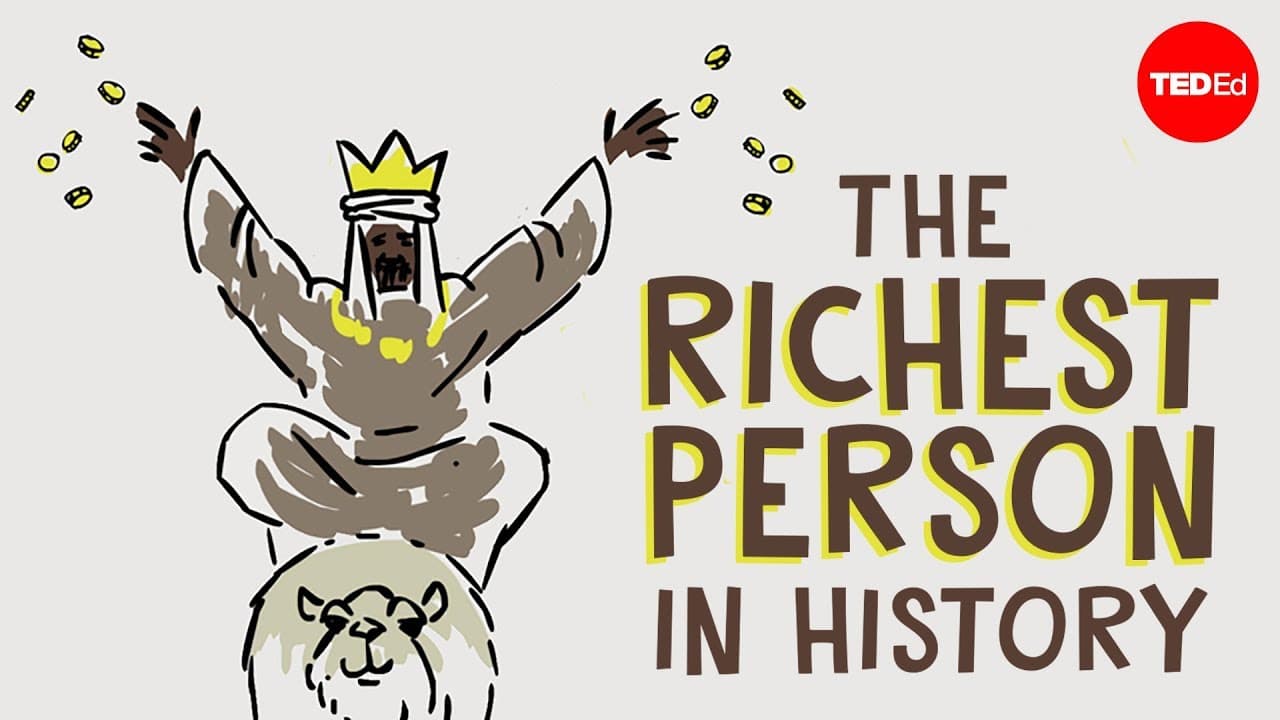
Mansa Musa, one of the wealthiest people who ever lived - Jessica Smith
TL;DR
Mansa Musa, the 14th-century ruler of the Mali Empire, is renowned as one of the wealthiest individuals in history, largely due to his strategic control of trade routes and rich natural resources. His famous pilgrimage to Mecca in 1324 showcased his wealth and led to tales of his grandeur spreading across the Mediterranean, while his legacy also includes significant contributions to education and Islamic culture in Mali.
Transcript
If someone asked you who the richest people in history were, who would you name? Perhaps a billionaire banker or corporate mogul, like Bill Gates or John D. Rockefeller. How about African King Musa Keita I? Ruling the Mali Empire in the 14th century CE, Mansa Musa, or the King of Kings, amassed a fortune that possibly made him one of the wealthies... Read More
Key Insights
- ™️ Mansa Musa was possibly one of the wealthiest individuals in history due to strategic trade practices and exploiting Mali's resources.
- 🥺 His pilgrimage to Mecca showcased Mali's immense wealth, leading to a legendary status in the Mediterranean region.
- 🤕 Mansa Musa's legacy includes urbanization, educational institutions, and cultural advancements that shaped Mali's golden age.
- 🕌 He was not only a wealthy ruler but also a devout Muslim, investing in mosques and universities for the betterment of his empire.
- 🧑🎓 The cultural and educational achievements of Mansa Musa's reign left a lasting impact on Mali, attracting scholars and students from various regions.
Install to Summarize YouTube Videos and Get Transcripts
Explore YouTube Video Summarizer or Get YouTube Transcript Extractor
Questions & Answers
Q: How did Mansa Musa amass his wealth?
Mansa Musa acquired vast wealth through the control of trade routes, annexations of strategic cities like Timbuktu, and exploiting the resources of the Mali Empire, such as gold and salt.
Q: What impact did Mansa Musa's pilgrimage have on Mali's reputation?
Mansa Musa's extravagant pilgrimage to Mecca drew attention to Mali's wealth, elevating the empire to legendary status and causing mass inflation in the regions he passed through.
Q: How did Mansa Musa contribute to the cultural and educational development of Mali?
Mansa Musa built mosques, schools, and universities in Mali, promoting urbanization and attracting scholars and students from across the Islamic world, leaving a rich legacy of education and culture.
Q: What lasting structures and institutions stand as a testament to Mansa Musa's golden age in Mali?
Mausoleums, libraries, and mosques built by Mansa Musa and his successors still stand in Mali, highlighting the prosperous and culturally vibrant era of Mali's history.
Summary
This video explores the life of Mansa Musa, the King of Mali in the 14th century, who is considered one of the wealthiest people in history. It discusses his accumulation of vast wealth, his strategic decisions, his pilgrimage to Mecca, and his contributions to education and religion.
Questions & Answers
Q: How did Mansa Musa amass his wealth?
Mansa Musa amassed his wealth through the annexation of important trade routes between the Mediterranean and the West African Coast. He strategically gained control over cities like Timbuktu and Gao, which were crucial for trade, especially in gold and salt, important resources in the region.
Q: How did Mansa Musa's wealth become known to the world?
Mansa Musa's wealth became known to the world when he embarked on a pilgrimage to Mecca in 1324. He traveled with an extravagant entourage of soldiers, civilians, slaves, and camels carrying abundant gold bars. The scale of his spending and generosity during the journey was remarkable, which led to tales of his amazing wealth spreading throughout the ports of the Mediterranean.
Q: How did Mansa Musa's journey impact the economy?
Mansa Musa's spending during his pilgrimage potentially destabilized the regional economy, causing mass inflation. He spent massive quantities of gold, giving to the poor, buying souvenirs, and even commissioning the construction of mosques. Such a massive influx of gold disrupted the existing economic balance in the areas he visited.
Q: How did Mansa Musa's journey shape Mali's reputation?
Mansa Musa's pilgrimage and his incredible wealth elevated Mali's reputation to near legendary status. The 1375 Catalan Atlas, one of the most important world maps of Medieval Europe, depicted the King holding a scepter and a gleaming gold nugget, symbolizing his position and wealth. This inclusion on the map solidified Mansa Musa's empire and himself as notable figures in history.
Q: What other contributions did Mansa Musa make?
Mansa Musa was not only interested in material wealth but also in education and religion. He took a particular interest in Timbuktu, a center of religion and learning, and upon returning from his pilgrimage, had the Djinguereber Mosque built there. He also established a major university that attracted scholars and students from all over the Islamic world.
Q: How did Mansa Musa influence urbanization in the Empire?
Under Mansa Musa's rule, the Mali Empire became urbanized, with schools and mosques established in hundreds of densely populated towns. His focus on education and religion led to the development of cities and the influx of scholars and students, further cementing the empire's legacy.
Q: How does Mansa Musa's rich legacy persist today?
Mansa Musa's rich legacy can still be seen today through the existence of mausoleums, libraries, and mosques that stand as a testament to the golden age of Mali's history. His contributions to education, religion, and urbanization left a lasting impact on the region.
Takeaways
The story of Mansa Musa challenges the notion that the wealthiest people in history are only found in more recent times. By strategically controlling trade routes and accumulating vast amounts of wealth, Mansa Musa's empire flourished during a time of famine and civil wars in Europe. His extravagant pilgrimage to Mecca, marked by immense spending and generosity, made him a legend in his time and elevated the reputation of Mali. Beyond material riches, his focus on education, religion, and urbanization left a lasting legacy that can still be witnessed today.
Summary & Key Takeaways
-
Mansa Musa, ruler of the Mali Empire in the 14th century CE, became one of the wealthiest individuals in history through strategic annexations and control of trade routes.
-
His pilgrimage to Mecca showcased his extravagant wealth with a caravan of thousands, leading to tales that spread across the Mediterranean.
-
Mansa Musa's legacy includes urbanization, building mosques and universities, and establishing Mali as a legendary empire in history.
Read in Other Languages (beta)
Share This Summary 📚
Summarize YouTube Videos and Get Video Transcripts with 1-Click
Try YouTube Summary with ChatGPT & Claude or YouTube Transcript Generator
Explore More Summaries from TED-Ed 📚





Summarize YouTube Videos and Get Video Transcripts with 1-Click
Try YouTube Summary with ChatGPT & Claude or YouTube Transcript Generator