Who polices AI and how could global governance work?
TL;DR
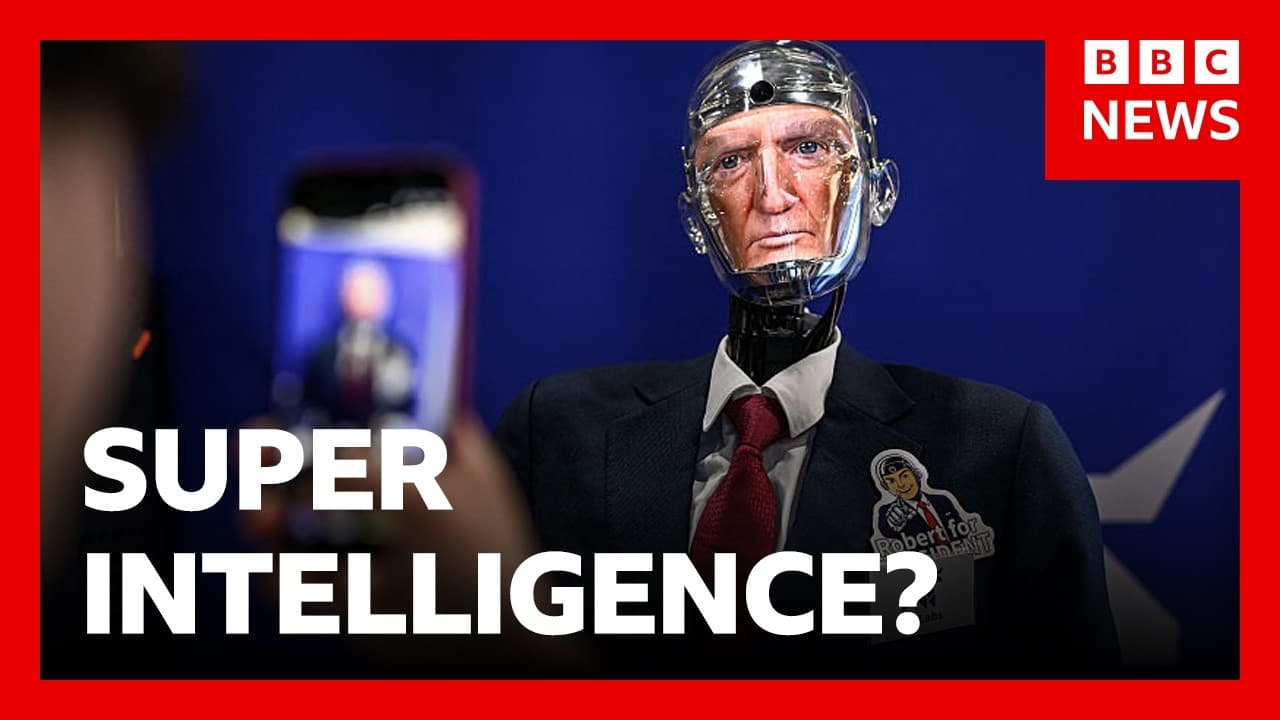
AI governance is uncertain and may rely on third party evaluators and international standards. The discussion covers a proposed watchdog, crisis hotlines, and the need for verification to prevent uncontrolled AI. US and China cooperation is emphasized as essential but difficult to achieve.
Transcript
Donald Trump has just said that we need to rename artificial intelligence super intelligence. Welcome to the new world of super intelligence- SI. Let's see if that goes. It sounds much better. Hello again. Welcome to AI Decoded. In the space of the past few weeks, the battle over AI has changed. It's no longer just about who builds the best technol... Read More
Key Insights
- AI governance is a global concern with different proposed models including inspectors and regulators.
- Third party evaluators are a common theme across proposed governance approaches.
- Verification is the core technical challenge in any AI governance system.
- US and China hold the key to successful governance but have conflicting priorities.
- An international body or agency could coordinate standards and oversight across borders.
- Crisis communication lines are viewed as a potential first step toward coordinated governance.
- There is skepticism about voluntary signatures without credible verification.
- Emerging markets could support governance by adopting cheaper, more transparent models.
- More videos from this channel:
- More from this channel: BBC News
Install to Summarize YouTube Videos and Get Transcripts
Explore YouTube Video Summarizer or Get YouTube Transcript Extractor
Questions & Answers
Q: What is the main question this video asks about AI governance?
The main question is who polices AI under what model and what happens if nobody polices it at all. The panel explores various governance approaches, including third party evaluators, aviation style regulators, and nuclear style watchdogs, while considering how to verify and trust each side’s claims in a global context.
Q: Why is there a push for a global AI watchdog according to the transcript?
The transcript indicates that 22 world leaders backed a Finland declaration calling for a global AI watchdog, signaling a desire for international oversight to prevent unchecked AI development. The idea is to ensure consistent rules, verification, and accountability across countries, reducing the risk of a dangerous or unregulated AI race.
Q: What role do third party evaluators play in AI governance?
Third party evaluators are proposed as independent bodies that would assess AI systems for safety and risk before deployment. They would monitor models for compliance with agreed standards, provide verification, and help build trust across nations and companies, potentially bridging gaps between different regulatory regimes.
Q: How might crisis communication help in AI governance?
Crisis communication lines could enable rapid warnings between the United States and China about looming AI incidents, serving as a practical tool to prevent or mitigate cross border AI risks. However, this is only a preliminary step and requires agreed procedures for what constitutes a reportable incident and what information must be shared.
Q: What is the significance of US and China cooperation in AI governance?
Cooperation is seen as crucial because both countries dominate AI development and infrastructure, and their alignment could set global standards. Without cooperation, competitive dynamics may hinder effective regulation, verification, and risk management, potentially leaving gaps that other nations or actors could exploit.
Q: What are some governance models discussed in the video?
The video discusses various models including a nuclear style watchdog with inspectors, an aviation style regulator that could ground a model, and a standards body similar to financial oversight. Each model emphasizes different mechanisms for verification, enforcement, and international consistency, highlighting the complexity of choosing an optimal approach.
Q: What challenges are highlighted regarding verification in AI governance?
Verification challenges include agreeing on standards that are verifiable across borders, ensuring truthful information sharing, and proving that regulators or evaluators can effectively assess rapidly evolving AI systems. The discussion notes that without credible verification, governance efforts risk being ineffective or untrusted by stakeholders.
Q: Why is there skepticism about voluntary signatures in AI governance?
There is skepticism because a signature alone does not guarantee compliance or real accountability. The transcript suggests that without credible verification of what a country or company builds, a signed agreement may be hollow, and the benefits of governance could be lost in translation between policy and practice.
Summary & Key Takeaways
-
Policy makers are considering multiple governance models including watchdogs, regulators, and standards bodies, with no single global solution yet in place.
-
The episode highlights the role of third party evaluators and the need for verifiable information sharing to manage AI risk.
-
International cooperation and credible verification are presented as critical challenges to achieving effective AI governance.
Read in Other Languages (beta)
Share This Summary 📚
Summarize YouTube Videos and Get Video Transcripts with 1-Click
Try YouTube Summary with ChatGPT & Claude or YouTube Transcript Generator
Explore More Summaries from BBC News 📚



Summarize YouTube Videos and Get Video Transcripts with 1-Click
Try YouTube Summary with ChatGPT & Claude or YouTube Transcript Generator