How to Build a $23K/Month Platform Micro-SaaS
TL;DR
Build a micro-SaaS by finding a recurring problem on a growing platform, adapting a proven add-on from an established platform, and using the platform marketplace for qualified distribution. Data Fetcher followed this model on Airtable, then grew through integration-focused content, customer feedback, and simpler no-code features to reach $23,000 in monthly recurring revenue with an 85% margin.
Transcript
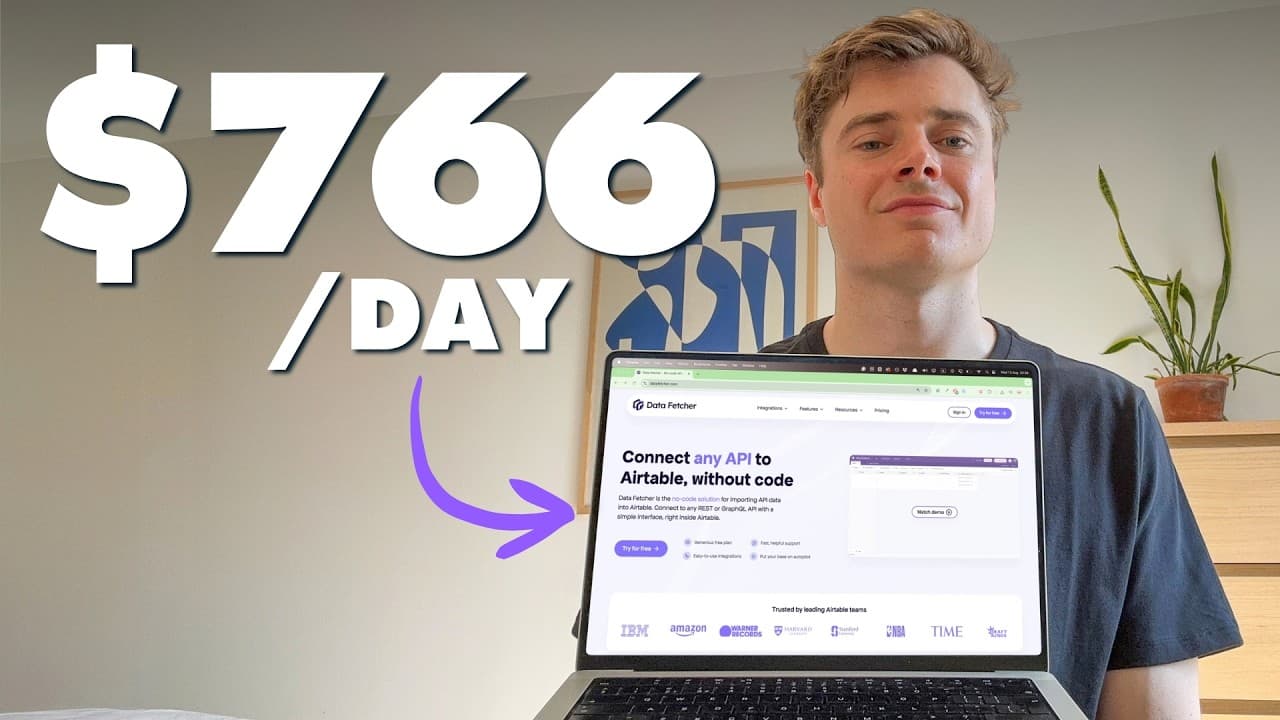
So, I'm Andy Cloak. I'm the founder of Data Fetcher and I make $23,000 a month in recurring revenue. This is Andy. He's a solo founder who lives in London and he built a successful micro SAS with one simple strategy. So, step one is you want to find a I brought him onto the channel to break down exactly how he built this $23,000 per month business.... Read More
Key Insights
- A growing platform can provide built-in distribution through its marketplace. Data Fetcher benefited from a steady stream of qualified Airtable users, and marketplace approval helped establish trust because prospective customers knew the extension had been accepted by the platform.
- A promising platform opportunity can be validated through recurring user complaints. Andy examined Airtable forums for problems people repeatedly encountered and found demand for a flexible way to connect external services and import data into Airtable through APIs.
- A proven add-on on an established platform can reveal an opportunity on a newer platform. Andy saw that a similar Google Sheets product had about 100,000 users, then adapted that established pattern and its user experience to feel native within Airtable.
- Platform compatibility must be checked before committing to an add-on. Andy's framework examines whether the target platform offers a public API, marketplace, or extension SDK, because the proposed product needs sufficient technical access to deliver its intended functionality.
- Opportunity size can be estimated with simple assumptions about platform users, problem frequency, and willingness to pay. Prices charged for comparable products on established platforms can provide a reference point when estimating what customers on a growing platform might pay.
- Platform risk is the main disadvantage of building an add-on business. Founders should review roadmaps and support forums, judge whether the proposed capability feels like a likely native feature, and assess the possibility that the platform could make the add-on redundant.
- Customer behavior can guide both product development and content marketing. Andy identified frequently requested APIs, published blog posts and YouTube videos about those integrations, and later created no-code connections that made Data Fetcher accessible to less technical Airtable users.
- A solo software business can remain highly profitable with a lean cost structure. At $23,000 in monthly recurring revenue, Data Fetcher's stated monthly costs include about $2,500 for hosting, $1,000 for software tools, and $150 for coworking, producing an 85% margin.
Install to Summarize YouTube Videos and Get Transcripts
Explore YouTube Video Summarizer or Get YouTube Transcript Extractor
Questions & Answers
Q: How did Data Fetcher reach $23,000 per month?
Data Fetcher entered Airtable's marketplace early and acquired its first customer within a few days. Andy then identified integrations and use cases that appeared repeatedly, creating blog posts and YouTube videos about them. Revenue reached roughly $1,000 per month after several months and $3,000 after a year. Adding easier no-code integrations helped push revenue to $10,000, while continued customer conversations, product improvements, and content eventually raised it to $23,000.
Q: What does Data Fetcher do for Airtable users?
Data Fetcher is an Airtable extension that connects Airtable with other platforms through APIs. Instead of manually transferring information into an Airtable database, users can configure connections and schedule data imports to run automatically. Customers use it for marketing data, including Facebook ads and Google Analytics, as well as operational workflows. Its flexibility allows users to create a wide variety of connections and processes.
Q: How can founders find micro-SaaS ideas on growing platforms?
The six-step framework begins with finding a growing platform, then locating a recurring pain point through forums, Reddit, or Twitter. Next, borrow a proven add-on pattern from an established platform and adapt it to feel native. Confirm that APIs, a marketplace, or an extension SDK make integration possible. Estimate demand and pricing, then assess whether the platform is likely to build the feature itself.
Q: How did Andy validate the idea for Data Fetcher?
Andy combined personal experience with evidence from existing markets. He had encountered the problem while pulling financial information into Airtable for an IPO newsletter. He also found a similar Google Sheets add-on called API Connector that had about 100,000 users. Finally, he examined Airtable's forums and saw demand for a flexible connection tool, giving him evidence that Airtable users faced the same problem.
Q: What are the benefits of building a SaaS on a platform marketplace?
A platform marketplace can supply a steady stream of users who are already looking for tools that extend the platform. These visitors are highly qualified because they already use the underlying product, and marketplace approval can increase their trust in an add-on. Entering early also helped Data Fetcher gain visibility. Andy viewed the opportunity as large enough to matter financially without necessarily attracting competitors seeking a $100 million business.
Q: What are the risks of building a business on another platform?
The primary risk is that the underlying platform could introduce a native feature that makes the add-on redundant. Andy recommends examining the platform's roadmap, support forums, and public discussion for signals about planned capabilities. Founders should also judge whether their product naturally belongs in the platform's core feature set. Data Fetcher currently sits between Airtable's scripting tools and no-code imports, which Andy believes reduces that risk for now.
Q: What technology and services power Data Fetcher?
The Airtable extension uses TypeScript, React, and Airtable's extension SDK. Its backend also uses TypeScript, along with PostgreSQL, GraphQL, and Node. The web application and marketing site use Next.js, Tailwind, and shadcn. Heroku hosts the API and database, while scheduled workers run on Hetzner. Other services include Help Scout, Fastmail, Plausible, MailerLite, ChartMogul, and Airtable itself.
Q: What are Data Fetcher's costs and profit margin?
Data Fetcher produces $23,000 in monthly recurring revenue and operates with a reported margin of 85%. Hosting is its largest expense at about $2,500 per month. The collection of software services used for support, email, analytics, newsletters, and other operations costs approximately $1,000 monthly. Andy also pays $150 for a coworking office, keeping the overall operation lean as a solo software founder.
Summary & Key Takeaways
-
Andy Cloak created Data Fetcher after encountering the difficulty of bringing financial data into Airtable for an IPO newsletter. He validated the concept through Airtable forums and a successful Google Sheets add-on, then built an Airtable extension that connects external platforms through APIs and automatically schedules data imports for varied workflows.
-
Data Fetcher gained its first customer within days of entering Airtable's marketplace. Repeated customer use cases guided blog posts and YouTube videos about popular integrations. Revenue reached roughly $1,000 per month after several months, $3,000 after a year, and then $10,000 after Andy introduced easier no-code integrations for less technical customers.
-
The business eventually reached 600 paying customers and $23,000 in monthly recurring revenue with Andy operating as a solo founder. Monthly hosting costs are about $2,500, other software tools cost approximately $1,000, and coworking costs $150. These expenses leave the software business with a reported margin of 85%.
Read in Other Languages (beta)
Share This Summary 📚
Summarize YouTube Videos and Get Video Transcripts with 1-Click
Try YouTube Summary with ChatGPT & Claude or YouTube Transcript Generator
Explore More Summaries from Starter Story 📚






Summarize YouTube Videos and Get Video Transcripts with 1-Click
Try YouTube Summary with ChatGPT & Claude or YouTube Transcript Generator