Refrigeration with 4x TEC12706 Peltier Block
TL;DR
This video explores advanced methods and experiments for cooling using TEC elements in patio applications.
Transcript
welcome everyone in this video I'm going to talk about the patio cooling again I have a few videos about this topic but I would like to provide more information because you can do many more experiments with this that I showed and I received some questions so I would like to try to answer those questions by this video or in this video so what you ca... Read More
Key Insights
- 😎 A TEC 12 76 cooler effectively cools small volumes but struggles with large quantities due to efficiency limitations.
- 😎 Cooling performance is highly dependent on environmental factors like the insulation of the surrounding structure.
- 😅 A combination of water cooling on the TEC's hot side significantly enhances overall efficiency and performance.
- 👱 The video highlights that while TEC coolers perform well, they are not ideal for room-sized air conditioning due to inefficiencies.
- 👻 Proper thermocouple setups allow real-time monitoring of both the water and air temperature for accurate analysis.
- 😎 Time taken to reach specific temperatures can vary significantly based on the initial temperature of the object being cooled.
- 😎 It is essential to manage the current and voltage applied to prevent overheating, which negatively affects cooling efficiency.
Install to Summarize YouTube Videos and Get Transcripts
Explore YouTube Video Summarizer or Get YouTube Transcript Extractor
Questions & Answers
Q: What is a TEC 12 76, and how does it work?
The TEC 12 76 is a thermoelectric cooler that operates by transferring heat from one side to the other when electrical current is applied. It utilizes Peltier effect principles where the cold side absorbs heat, cooling the surrounding area, while the other side releases it, requiring adequate heat dissipation to function optimally.
Q: How effective is the patio cooler in cooling larger volumes of liquid?
The patio cooler's effectiveness diminishes with larger volumes due to thermal inertia. For instance, cooling a cup of water takes significant time and may not achieve desired temperatures as rapidly as smaller applications, indicating that these devices excel more in compact setups than in cooling extensive fluids efficiently.
Q: What experiments were conducted to measure cooling performance in the video?
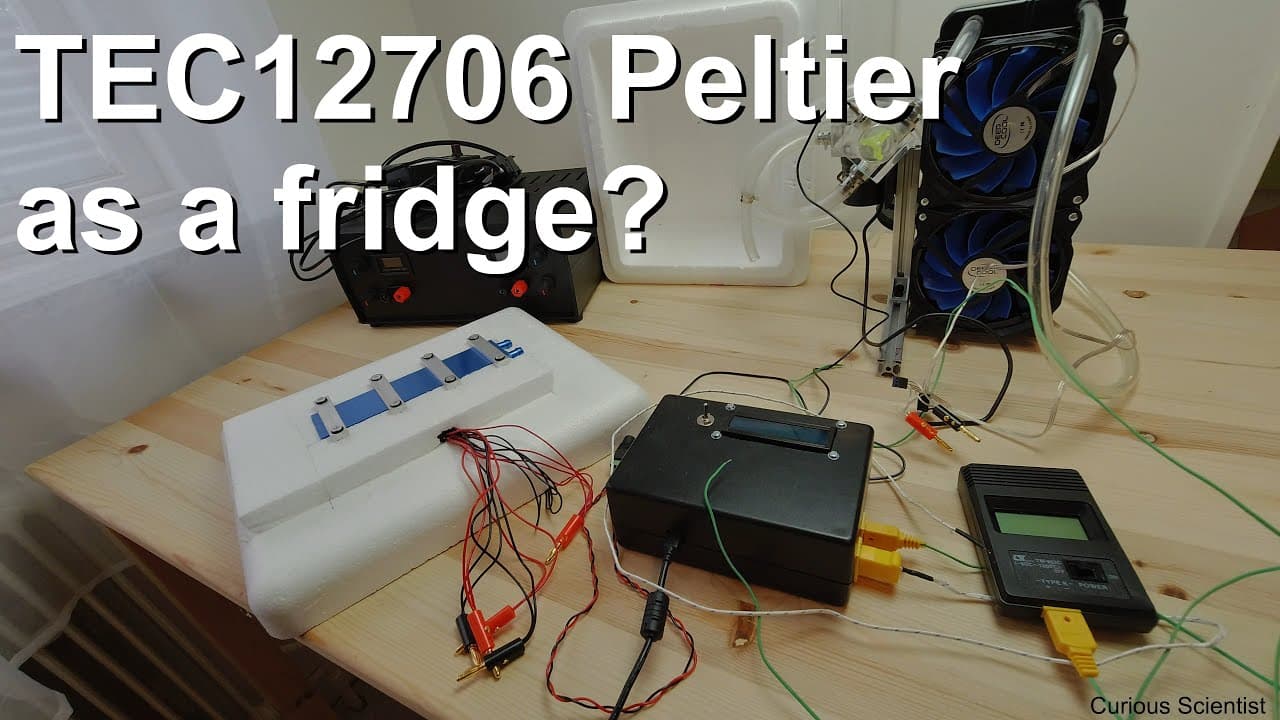
The creator conducted experiments by placing a cup of water inside a polystyrene box equipped with a TEC cooler. They monitored temperature changes over time using thermocouples. Results showed initial successful cooling, with subsequent assessments highlighting the challenges of cooling warm objects in poorly conductive environments.
Q: What challenges does the TEC cooler face when cooling water?
The main challenge is the inefficient heat transfer to the air within the cooling box. Despite maintaining low temperatures on the TEC's cold side, the water's cooling process is slow. This is due to poor convection and extended time needed to transfer heat from the water to the cooler effectively.
Summary & Key Takeaways
-
The video presents detailed information about using the TEС 12 76 patio cooler, including specifications, setup, and operation.
-
The creator demonstrates how to measure performance, including cooling times for air and water using thermocouples and a well-insulated box.
-
Insights are offered on the inefficiency of TEC coolers for large volumes while being effective in smaller applications like microchips or cooling boxes.
Read in Other Languages (beta)
Share This Summary 📚
Summarize YouTube Videos and Get Video Transcripts with 1-Click
Try YouTube Summary with ChatGPT & Claude or YouTube Transcript Generator
Explore More Summaries from Curious Scientist 📚


![Building a coil winder [Part 6] - A few improvements thumbnail](/_next/image?url=https%3A%2F%2Fi.ytimg.com%2Fvi%2F3eyxG_g2iUA%2Fhqdefault.jpg&w=750&q=75)
Summarize YouTube Videos and Get Video Transcripts with 1-Click
Try YouTube Summary with ChatGPT & Claude or YouTube Transcript Generator